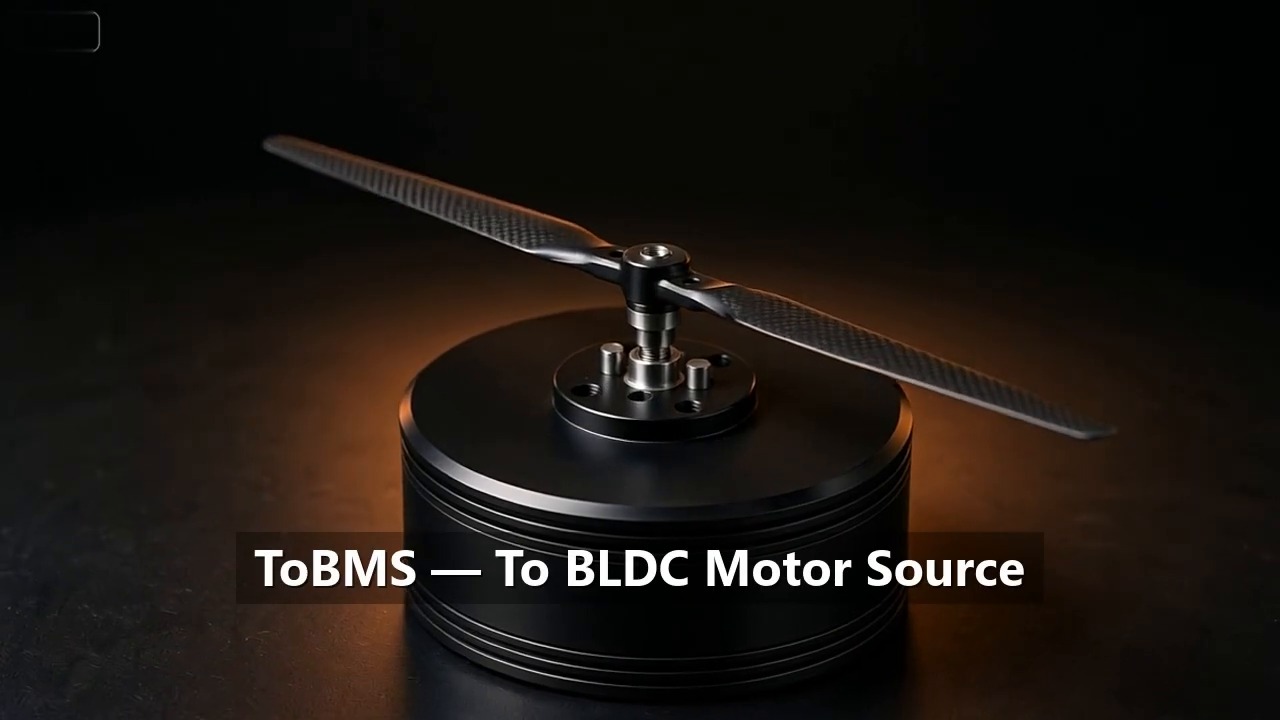
ToBMS — To BLDC Motor Source — is a global product discovery and technical information platform for the BLDC motor and related motion products. The hard part of motor selection is rarely finding a candidate; it is putting two candidates from different manufacturers on the same axes and reading them honestly. The 38-second walkthrough below shows the whole path: narrow the field, compare BLDC motors on shared axes, open the documentation, and reach the manufacturer.
The rest of this article walks through what the clip shows and why each step matters when engineers compare BLDC motors across brands instead of inside a single range.
What the Video Shows
The clip moves through the platform in four beats. It opens on the entry point for BLDC motors and motion products, then narrows results by brand, weight and diameter with the table updating as each filter is applied. From there, selected products are added to a comparison tray so that their specifications can be read on the same axes. The last part opens a product page, where technical detail, frequently asked questions and manufacturer documentation sit in one place, and closes on the route to the manufacturer behind the product.
Original Video
Source: ToBMS Official YouTube Channel
Video: Compare BLDC Motors by Specification — Filter, Compare, Connect on ToBMS
Why the Axes Come Before the Numbers
Two motors that publish the same rated torque figure are not automatically comparable. Torque is published at a stated voltage, against a stated current limit, under a thermal condition the manufacturer defines. KV describes unloaded rpm per volt, so the same KV produces a different speed on a different bus voltage. Peak figures are generally tied to a duration or duty that the manufacturer sets. The number and the condition behind it travel together.
Heat is part of the same story. A BLDC motor bolted to a large aluminium housing and the same model suspended in free air do not hold the same continuous output, because the published condition covers how the motor is cooled and for how long. BLDC motor specifications are therefore read as a set rather than as a ranking: bus voltage, current limit, rated and peak torque, and the condition each figure was measured under. Sorting a shortlist by one headline number is what makes it possible to compare BLDC motors on equal terms afterwards.
That is why the first job is to fix the axes, not to collect figures. Once voltage, mechanical envelope and the rated-or-peak question are settled, engineers can compare BLDC motors without re-reading the conditions on every line. Reading a figure without its condition is the most common way a shortlist goes wrong, and it is also the easiest mistake to avoid. Motor selection works better as a sequence of eliminations than as a search for one winning number: fix the axes, drop what cannot meet them, and compare what is left.
Step 1 — Narrow by Brand, Weight and Diameter in Select
Mechanical constraints behave differently from electrical ones. A diameter that does not fit the bore or frame ends the conversation; a mass that exceeds a payload or joint budget ends it just as quickly. Both are pass-or-fail, and both can be checked before any electrical rating is read. Electrical performance is an optimization problem, and it makes sense inside an envelope that already fits rather than as a reason to revisit the mechanics later.
On ToBMS, the Select page applies brand, weight and diameter filters and refreshes the table as the filters are applied. Starting there turns an open search into a bounded one: filter down to the diameters and masses the design can accept, then compare BLDC motors that remain, rather than working through candidates the design could not accept in the first place.
Step 2 — Read the Ratings on the Same Axes in Compare Products
With the field narrowed, the candidates go into the comparison tray on Compare Products, where the specifications are placed on shared axes. Reading in a fixed order keeps the comparison honest:
| Axis | What it answers | Why it comes first |
|---|---|---|
| Rated voltage | Which bus the figures were measured on | Every rating below it depends on this value |
| KV | Unloaded rpm per volt | Ties speed to the bus voltage in use |
| Rated torque (Nm) | Continuous output under the published condition | Sets the steady working point |
| Peak torque (Nm) | Short-term output under the published condition | Covers acceleration and transient loads |
| Rated and peak current | What the drive and wiring must supply | Decides the ESC or driver class |
| Weight and diameter | Whether the design can carry and house it | The pass-or-fail envelope from Step 1 |
Table note: rated torque, peak torque, KV, current, weight and diameter as published by the manufacturer on each product page; the published condition belongs to the figure.
Rated torque and peak torque answer different questions, and mixing them is the second most common source of a bad shortlist. Rated torque describes continuous output under the condition the manufacturer publishes. Peak torque describes a short-term output, also under a published condition, and it is the figure that covers acceleration, a hard start, or a transient load. Where a candidate runs on a different bus voltage from the rest of the shortlist, the voltage belongs next to the figure rather than in a footnote nobody reads.
KV variants of one frame are worth a note, because they are the case where a comparison is easiest and most often skipped. The same mechanical envelope is offered with several windings: the low-KV variant turns more slowly per volt and delivers more torque per amp, while the high-KV variant turns faster on the same bus. Reading them together shows what the winding buys and what it costs, and it is the clearest example of why engineers compare BLDC motors at one stated voltage rather than across two.
Step 3 — Confirm Every Figure Against the Manufacturer Documentation
Each product page on ToBMS keeps the technical detail, the frequently asked questions and the manufacturer documentation in one place, which is what makes a comparison checkable rather than remembered. Specifications shown on the platform are drawn from official manufacturer documentation, and where a value is not published, the manufacturer remains the source to confirm with.
Datasheets are revised. Winding options are added, connectors change, and test conditions are restated. A shortlist built this month reads the documentation that is current this month, and any figure that decides a design gets confirmed with the manufacturer before it decides an order.
Where a Comparison Tray Stops
Shared axes settle the engineering question; they do not settle the commercial one. Pricing, availability, lead time, minimum order quantity, warranty terms and custom winding options are set by the manufacturer and move independently of the datasheet, so they sit outside a specification comparison. What the tray does is narrow the field to the models worth asking about, which makes the question that goes to the manufacturer specific: this model, at this voltage, under this condition.
Reading BLDC motor specifications on shared axes also exposes the cases where no comparison is possible yet: a candidate whose documentation publishes no figure for the axis in question. The honest move there is to ask rather than to interpolate from a similar model. That discipline is what lets engineers compare BLDC motors without carrying assumptions from one candidate to the next.
Step 4 — Reach the Manufacturer
By the time the comparison tray holds two or three candidates, the remaining questions are the ones no datasheet answers: the mounting interface on a specific frame, cable length options, a custom winding, a lead time, or a test report for the exact operating condition. Those go to the manufacturer, and the product page is where that conversation starts. The Manufacturers section collects the profiles behind the products for anyone who wants the wider range before asking.
This is the step that closes the loop. Filtering narrows the field, shared axes rank it, documentation confirms it, and a direct question settles what is left — the sequence the clip runs through in 38 seconds.
Frequently Asked Questions
How do engineers compare BLDC motors from different manufacturers?
Fix the axes first: the bus voltage, the mechanical envelope, and whether a rating is continuous or short-term. Then compare BLDC motors on those axes, treating the published condition as part of every figure. Ranking candidates without the conditions in view is what turns two similar-looking numbers into the wrong choice.
Why filter by weight and diameter before comparing electrical ratings?
Diameter and mass are pass-or-fail: a motor that does not fit the bore or exceeds the payload budget is out regardless of its torque. Electrical ratings rank the candidates that survive that test. Filtering first keeps the comparison inside the designs that can actually be built.
What separates rated torque from peak torque?
Rated torque is the continuous output under the condition the manufacturer publishes. Peak torque is a short-term output, also under a published condition, and it covers transients such as acceleration or a hard start. Both are quoted in Nm, and neither means much without the condition attached to it.
Where do the specifications on ToBMS come from?
From official manufacturer documentation. Each product page keeps the technical detail, the FAQ and that documentation together so a figure can be traced back to its source. Values a manufacturer has not published stay unpublished, and the manufacturer is the source to confirm with.
Conclusion
A 38-second clip can show the sequence; the discipline behind it is what makes the result trustworthy. Narrow by the constraints the design cannot negotiate, then compare BLDC motors on axes that are stated the same way, confirm every deciding figure against the documentation, and ask the manufacturer what the datasheet leaves open. Filter, compare, connect — in that order. Treated as a sequence, motor selection stops being a search through figures and becomes what the clip shows: a short, checkable path from an open field to a question worth asking the manufacturer.