T-MOTOR builds its VL series VTOL motor range around one job: lifting VTOL airframes that have to transition from vertical hover to wing-borne cruise. This 65-second clip from the manufacturer’s own channel shows the range fitted to working aircraft rather than sitting on a bench, and two models appear on screen by name — the T-Motor VL1155 KV65 VTOL Drone Motor during a salt-spray test, and the T-Motor VL7015 KV190 VTOL Drone Motor as part of a complete propulsion set with its ESC and propeller. Between them they bracket the family: 57 kg of thrust per arm at one end, 15.9 kg at the other.
The rest of this article walks through what the clip shows, where the two featured models sit inside the range, and how the published numbers map onto airframe take-off weight.
What the Video Shows
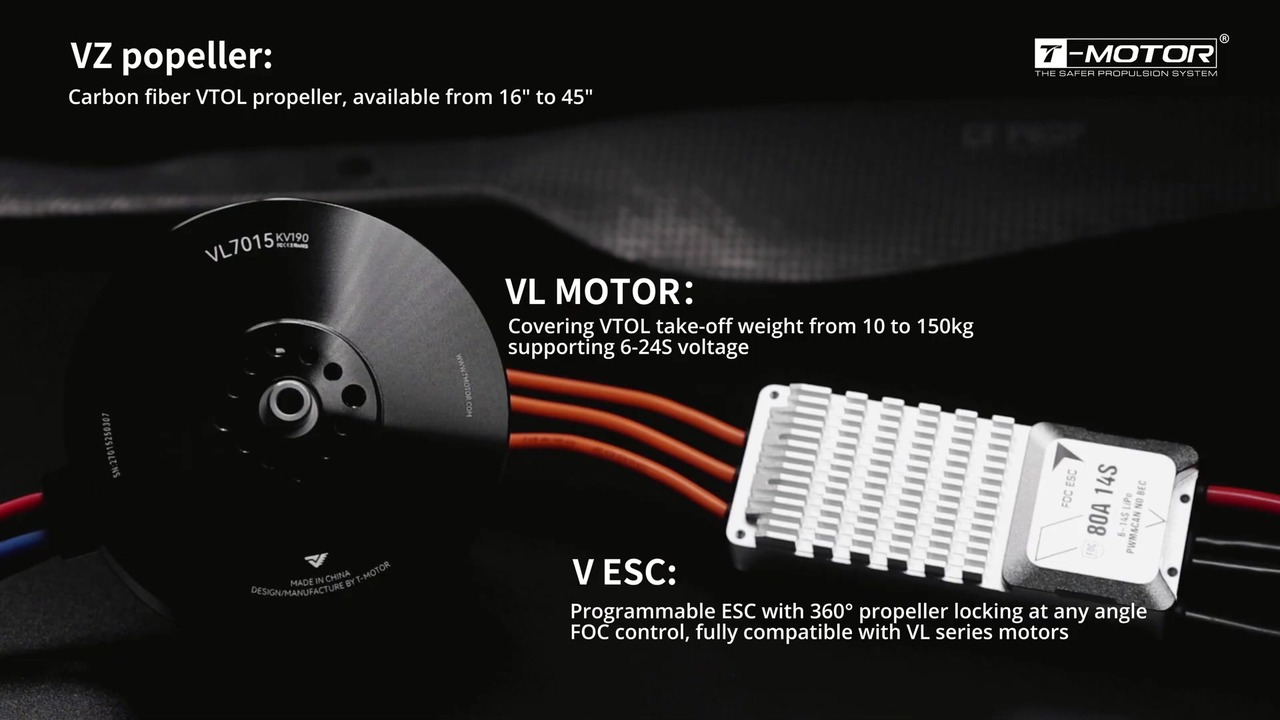
The clip opens on a VL7015 KV190 mounted with a V series ESC and a VZ carbon-fibre propeller, then cuts to a compound-wing aircraft lifting off from a shoreline and settling into cruise. A mid-clip caption marks the transition: once the airframe is flying on its wing, the lift rotors stop and lock, and thrust moves to the tail-mounted pusher. A later caption identifies the aircraft as a working customer platform, and the closing section moves indoors to a salt-spray chamber where a VL1155 KV65 runs under a fine mist as part of factory validation.
There is no narration. The information is carried by the captions and by what the aircraft actually do, which is why the clip reads as a demonstration rather than a pitch — and why the two models named on screen are worth taking as the anchors for the whole range.
Original Video
Source: T-MOTOR FOR UAV DRONE YouTube Channel
Video: Built into Real VTOL Platforms: T-MOTOR Propulsion Delivers
What the VL Series Covers
The VL series VTOL motor family from T-MOTOR spans 8.6 kg to 88.1 kg of maximum thrust per arm across sixteen models. The manufacturer describes the range as covering VTOL platforms from roughly 12 kg up to the 140–150 kg class in a quad configuration, with FOC control, quick-lock propellers and CAN 2.0 integration on the ESC side. Two voltage levels dominate the range: 12S across the compact half, and 24S from the VL1035 upwards.
Every model is published as part of a matched VTOL propulsion system — a VL series VTOL motor, a V series ESC and a VZ or P-series propeller sized for it. That pairing matters more for a VTOL propulsion system than for a plain multirotor, because the same power train has to be efficient in hover and then stop cleanly for cruise. A VL series VTOL motor that produces excellent hover thrust but will not lock its propeller is only half a solution.
VL1155 KV65: the Heavy-Lift End of the VL Series
The VL1155 KV65 is the model shown under salt spray. Its published figures are 65 KV, 24S LiPo, 161 A peak current and 3300 W of continuous power over 180 s, producing 57 kg of maximum thrust per arm from a 1420 g motor measuring Ø120.5 × 60.9 mm. T-MOTOR pairs it with the VL200A 24S ESC and a VZ40 × 16.1 propeller, and recommends the set for airframes in the 90–105 kg class.
Two details from the manufacturer’s page for this VL series VTOL motor deserve separation from the headline thrust number. The motor carries an IP45 dust-protection rating with a mesh over the windings, which is exactly the kind of property that matters for aircraft working from unprepared surfaces — and it is the claim the salt-spray sequence in the clip is illustrating. The motor also reports winding temperature back to the flight controller, so a sustained high-load climb does not run unmonitored.
VL7015 KV190: the Compact End of the VL Series
The VL7015 KV190 sits near the other end of the VL series VTOL motor range. It is a 12S motor at 190 KV, rated 85 A peak and 1600 W continuous over 180 s, and it produces 15.9 kg of maximum thrust per arm from 540 g including cable. The body measures Ø79.2 × 44.4 mm, and T-MOTOR matches it with the V80A ESC and a P24 × 7.2 propeller for quad platforms of 22–24 kg.
The size gap against the VL1155 is the point of having a family rather than a single model: 880 g and roughly 41 kg of thrust separate the two, and that span is what lets one VL series VTOL motor design cover everything from a 22 kg survey quad to a 90 kg compound-wing aircraft.
VL Series Motors Compared
| Model | KV | LiPo | Max thrust per arm | Recommended MTOW, quad | Motor weight | Motor size | Peak current |
|---|---|---|---|---|---|---|---|
| VL5009 KV275 | 275 | 12S | 8.6 kg | 12–15 kg | 280 g | Ø55.6 × 38.9 mm | 52 A |
| VL6011 KV180 | 180 | 12S | 10.5 kg | 15–18 kg | 300 g | Ø67.2 × 38.4 mm | 55 A |
| VL6013 KV210 | 210 | 12S | 12.9 kg | 20–22 kg | 388 g | Ø68.8 × 39.4 mm | 70 A |
| VL8015 KV170 | 170 | 12S | 14.8 kg | 25 kg | 610 g | Ø88.8 × 42 mm | 74 A |
| VL7015 KV190 | 190 | 12S | 15.9 kg | 22–24 kg | 540 g | Ø79.2 × 44.4 mm | 85 A |
| VL8018 KV180 | 180 | 12S | 17.1 kg | 30–32 kg | 655 g | Ø88.8 × 43.5 mm | 100 A |
| VL8020 KV170 | 170 | 12S | 19.7 kg | 35 kg | 735 g | Ø88.8 × 45.5 mm | 116 A |
| VL8022 KV170 | 170 | 12S | 22.3 kg | 40 kg | 785 g | Ø88.8 × 47.5 mm | 135 A |
| VL1028 KV190 | 190 | 12S | 26.3 kg | 45–50 kg | 940 g | Ø109.6 × 52.5 mm | 180 A |
| VL1032 KV180 | 180 | 12S | 31.8 kg | 50–55 kg | 1090 g | Ø109.6 × 56 mm | 200 A |
| VL1035 KV150 | 150 | 14S | 36.2 kg | 55–60 kg | 1205 g | Ø109.6 × 61 mm | 182 A |
| VL1040 KV150 | 150 | 14S | 45.8 kg | 65–70 kg | 1100 g | Ø107.2 × 64.8 mm | 245 A |
| VL1155 KV65 | 65 | 24S | 57 kg | 90–105 kg | 1420 g | Ø120.5 × 60.9 mm | 161 A |
| VL1165 KV60 | 60 | 24S | 66 kg | 115–125 kg | 1710 g | Ø120.5 × 67.9 mm | 180 A |
| VL1380 KV60 | 60 | 24S | 83 kg | 140–150 kg | 2400 g | Ø149.6 × 63.8 mm | 230 A |
| VL1180 KV60 | 60 | 24S | 88.1 kg | 140–150 kg | 2680 g | Ø120.5 × 96 mm | 254 A |
Thrust and current figures as published by T-MOTOR on its own product pages; take-off weight figures from the manufacturer’s VL series propulsion kit page. Weight includes cable. Rows are ordered by maximum thrust per arm.
Propeller Locking and the V Series ESC
The transition sequence in the clip is the clearest statement of what a VTOL propulsion system built around a VL series VTOL motor has to do beyond producing thrust. While the aircraft is on the wing, the lift rotors are dead weight and a source of drag; a free-spinning propeller in the slipstream adds turbulence right where the wing needs clean airflow. The manufacturer’s answer is electronic propeller locking: the ESC holds the rotor at a set angle instead of letting it windmill, and it adjusts holding current to match the external load rather than holding at a fixed value. Published standby consumption for the locked state is about 10 W.
The locking function is also described as fast — the manufacturer quotes a lock in seconds with a 360° settable angle — which matters because the aircraft has to be able to restart lift rotors quickly if the transition has to be aborted.
Factory Testing in the Clip
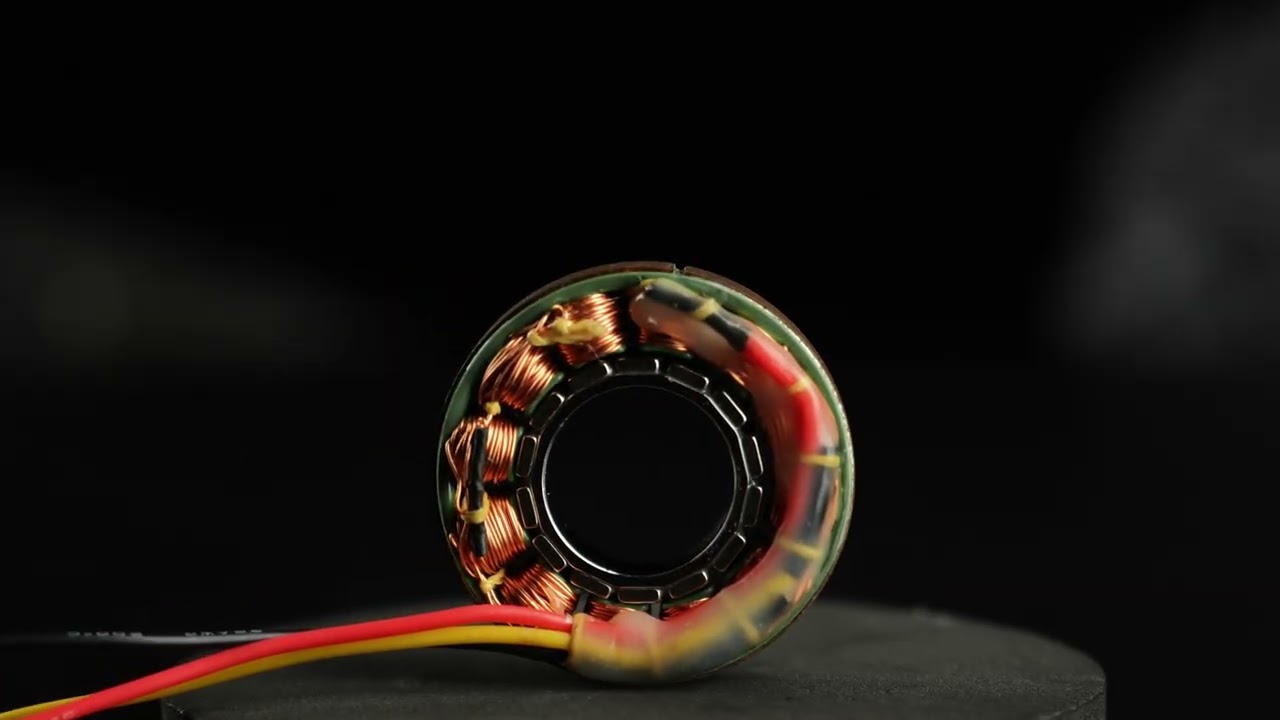
The closing salt-spray sequence is short but specific: a VL1155 KV65 running while a fine mist fills the chamber. Salt spray is a corrosion-acceleration test, and it is the natural companion to the IP45 dust rating and the sealed winding construction the manufacturer publishes for the larger VL models. For aircraft that work over water or from coastal strips, this is the test that decides service life, not peak thrust.
The clip also shows water spray over the ESC and motor together, which is consistent with the way the range is sold — as a matched power train rather than as separate components.
Matching a VL Series Motor to Take-off Weight
The selection order that the published data supports is straightforward. Start from all-up weight, divide by the number of lift arms, and leave a margin — a heavy-lift VTOL motor sized exactly at hover thrust has nothing left for a gust, an aborted transition or one failed arm. The manufacturer’s recommended take-off weights already build in that margin, which is why the VL1155 KV65 at 57 kg per arm is recommended for a 90–105 kg airframe rather than a 228 kg one.
Voltage comes next, and it splits the range cleanly: 12S up to the VL1040, then 14S and 24S above it. Weight and envelope follow, and they are where the two featured models diverge most — 540 g and Ø79.2 mm against 1420 g and Ø120.5 mm. Finally, the propeller and ESC have to be taken as part of the same decision, since the published thrust figures are measured with the matched set and not with arbitrary hardware.
Frequently Asked Questions
What take-off weight does the VL1155 KV65 suit?
T-MOTOR recommends the VL1155 KV65 set for airframes in the 90–105 kg class. It produces 57 kg of maximum thrust per arm at 24S, which leaves the hover margin a quad needs for wind and for a failed-arm case.
Which VL series motor fits a 22–24 kg quad?
The VL7015 KV190 is the model the manufacturer recommends for that class. It produces 15.9 kg of maximum thrust per arm on 12S, weighs 540 g including cable, and ships as a set with the V80A ESC and a P24 × 7.2 propeller.
What separates a VL series VTOL motor from a conventional multirotor motor?
Propeller locking. A conventional multirotor motor is optimized only for producing thrust; a VL series VTOL motor has to produce thrust in hover and then hold its propeller still during cruise, which is why the range is published together with V series ESCs and matched propellers.
Does a VL series VTOL propulsion system include the propeller?
The motor and ESC are sold as a matched set. The propeller is sized and tested with that set — VZ40 × 16.1 for the VL1155, P24 × 7.2 for the VL7015 — and is ordered separately.
About T-Motor
T-Motor develops brushless motors, ESCs and propellers for unmanned aircraft, with ranges covering multirotor, fixed-wing and VTOL platforms. The VL series VTOL motor line is its VTOL range, and the manufacturer publishes matched motor, ESC and propeller sets rather than standalone motors.
The whole range sits in the Drone Motors category and is filed under VTOL Drone. Models can be filtered by thrust, voltage and envelope in Select, or placed head to head in Compare Products.
Conclusion
The clip is only 65 seconds long, but it makes the case for the VL series VTOL motor range better than a specification sheet can: two named models, one at each end of the range, one flying and one being tested to destruction-adjacent standards. The VL1155 KV65 and the VL7015 KV190 are 880 g and 41 kg of thrust apart, and the sixteen models between and around them cover a VTOL propulsion system from a 12 kg quad up to the 140–150 kg class. For anyone sizing a VTOL power train, the published take-off weight figures are the fastest way into the range, and the matched ESC and propeller sets are not optional extras — they are how the published thrust is measured.