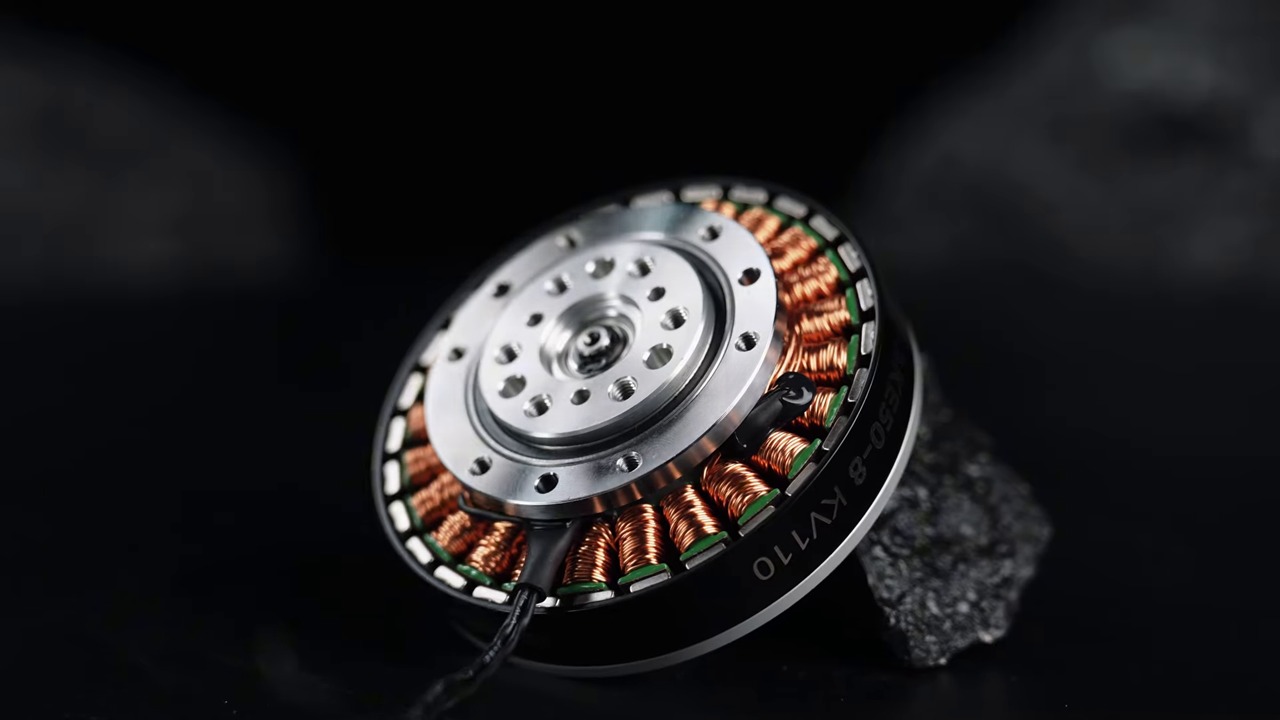
CubeMars added a fourth member to its AKE quasi direct drive family in mid-October 2026, and the launch clip runs sixteen seconds: one module on a black set, four caption blocks, no narration. The AKE50-8 KV110 is the subject — a 190 g actuator measuring Ø61.2 × 22.5 mm, rated 2.5 Nm and 7.5 Nm peak, with an 8:1 planetary stage folded into a housing barely deeper than the stator stack it contains.
Sixteen seconds is a thin brief for a technical write-up, so this article works from a second source alongside the film: the specification table CubeMars publishes for the model. Where the clip and the published table diverge, the table is treated as correct — and where the clip is silent, which covers most of the interesting numbers, only the published values appear here.
What the Video Shows
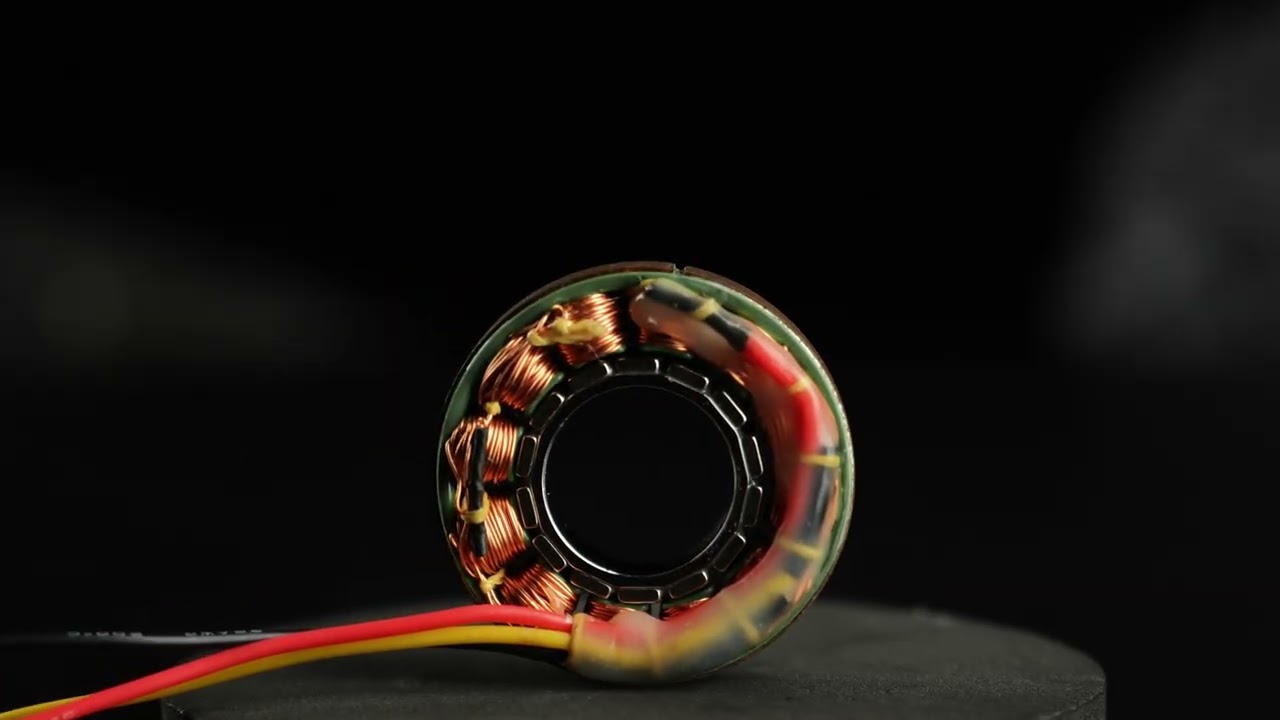
The set is black, the light is single-source and hard, and the module turns through four positions. Face-on, a caption block reads 8:1 reduction ratio, 7.5 Nm peak torque, 2.5 Nm rated torque and 320 rpm no-load speed — all four matching the published table exactly. The side view swaps in the dimensional claims: 61.2 mm across the housing, 22.5 mm face to face, 190 g on the scale. A macro pass around the seven-second mark holds on the copper winding and the lamination stack, and the closing frames pull back with the marking AKE50-8 KV110 legible on the housing wall.
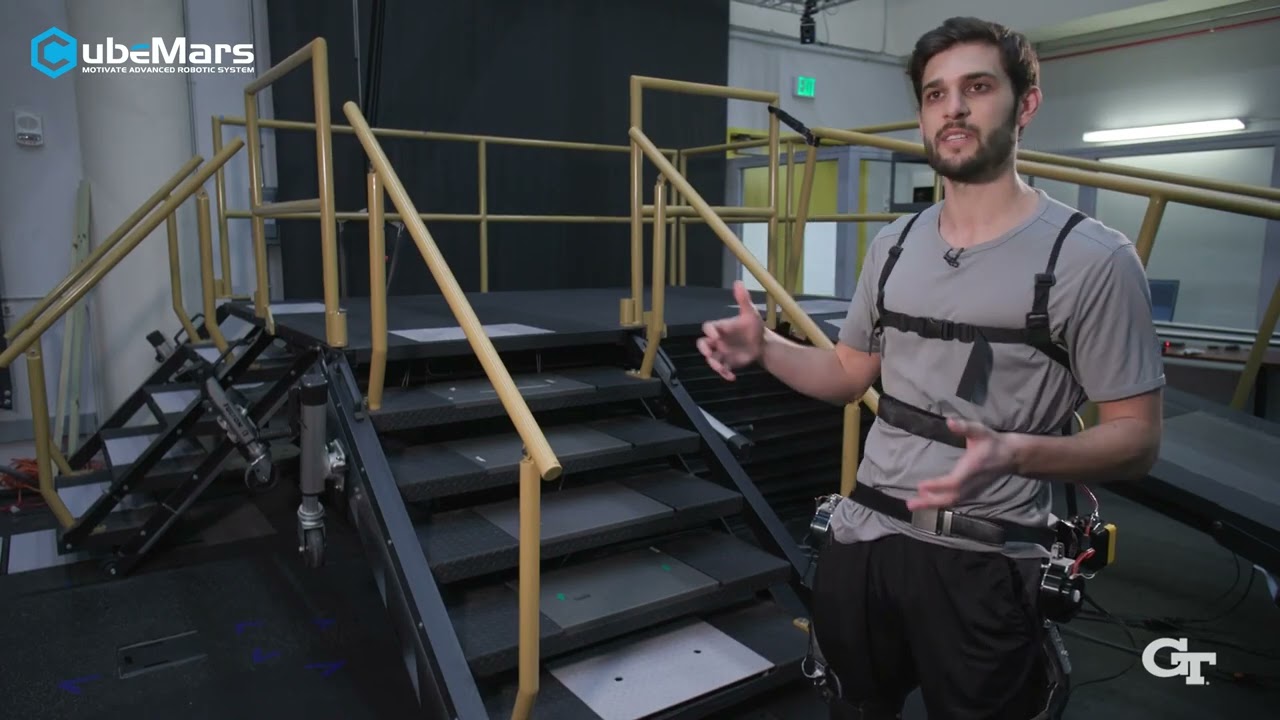
What the clip does not contain is application footage. There is no exoskeleton leg, no arm, no load cell and no thermal run. Every application claim attached to this model therefore comes from the manufacturer product page rather than from the film, and the two should not be read as the same kind of evidence: the video is a shape-and-marking shot, the product page is the data.
Original Video
Source: CubeMars Official YouTube Channel
Video: Meet the New CubeMars AKE50-8 KV110 | Compact QDD Actuator for Robotics
AKE50-8 KV110 at a Glance
Three numbers carry most of the decision on a joint actuator: how deep it is, how much torque it holds continuously, and how much torque comes back through the output when something outside pushes on it. On the AKE50-8 KV110 they read 22.5 mm, 2.5 Nm and 0.09 Nm.
Frame and envelope
190 g in Ø61.2 × 22.5 mm, built on 24 slots and 14 pole pairs. Operating ambient is -20 to 50 ℃, insulation class F, dielectric strength 500 V, and published noise is 65 dB at 65 cm. The axial figure is the one that decides whether a module can sit inside a limb instead of bolted to the outside of one. Basic dynamic load rating is published at 1100 N and static at 840 N — the pair a designer checks against the cantilever load the output flange has to carry, since bearing capacity, not motor torque, usually caps a compact joint.
Drivetrain and backlash
An 8:1 planetary stage sits inside the rotor, with backlash held to 9 arcmin and rotor inertia published at 153.81 g·cm². A low ratio is what keeps the gearbox small enough to fit a 22.5 mm envelope, and it is also what keeps the output tied closely to the motor — the mechanical precondition for the backdrive figure below.
Electrical envelope
24 V nominal, 65 W maximum continuous power, 3 A rated current and 9 A peak. Rated speed is 240 rpm at 2.5 Nm and no-load speed 320 rpm; torque constant 0.104 Nm/A, speed constant 110 RPM/V, motor constant 0.097 Nm/√W, phase resistance 792 mΩ, phase inductance 560 µH.
Three points in the published chart sit above rated torque rather than below it: 2 Nm at 248 rpm and 2.97 A, 2.5 Nm at 233 rpm and 3.49 A, 3 Nm at 220 rpm and 4.08 A. Those are chart readings, not continuous figures. The 2.5 Nm rating holds within the thermal limits, and nothing in the launch clip tests that limit.
What the Numbers Mean in a Joint
39.5 Nm/kg is a peak figure
Peak torque divided by module mass gives 39.5 Nm/kg, the number CubeMars puts in its own highlight block. It is measured against the bare module: no brackets, no cable management, no external structure. Used that way it is a fair comparison between modules of the same class; used as a rated figure it overstates by a factor of three, because rated torque on the AKE50-8 KV110 is 2.5 Nm.
0.09 Nm of backdrive, and what it buys
Backdrive torque is the resistance felt when something else moves the output. At 0.09 Nm the AKE50-8 KV110 is close to transparent: an external load can push the output and the motor feels it. That is the property an exoskeleton actuator needs, because the control loop has to sense and yield to the wearer motion rather than fight it. A high-ratio servo joint is built the other way round — the gear stage holds position against external motion by design, an advantage in a positioning axis and a liability in a joint that has to stay compliant. The 8:1 ratio, the 9 arcmin backlash and the 0.09 Nm figure are three statements about one trade.
Where a Compact QDD Actuator Fits
Exoskeleton and wearable joints
A knee or ankle assist joint has a packaging problem before it has a torque problem: the module sits against a limb, under a brace or under clothing, and every millimetre of axial depth pushes the mechanism away from the body. 22.5 mm and 190 g are the numbers that make that packaging possible, and 0.09 Nm of backdrive is what keeps the device from feeling like a brake when the wearer moves under their own power. The 7.5 Nm peak and 1100 N dynamic load rating place this module in the assist and guidance class; the larger AKE90-8, at 170 Nm peak and 1400 g in the same family, is the model for joints that have to carry a body.
Lightweight robotic arms and humanoid joints
On a small collaborative arm, 9 arcmin of backlash and a 240 rpm rated speed suit wrist and elbow axes where payload is measured in single-digit kilograms and the axis has to be backdrivable for hand-guiding. The same reasoning carries to humanoid upper-body joints, where the packaging budget is set by the shell rather than by the motor. For a shoulder or hip axis the torque budget is a different order of magnitude, and the AKE50-8 KV110 sits at the wrong end of the family for that work.
Product Details
| Specification | Details |
|---|---|
| Manufacturer | CubeMars |
| Type | Quasi direct drive actuator, 8:1 planetary |
| Rated voltage | 24 V |
| Max continuous power | 65 W |
| Rated torque | 2.5 Nm |
| Peak torque | 7.5 Nm |
| Rated current | 3 A |
| Peak current | 9 A |
| Rated speed | 240 rpm |
| No-load speed | 320 rpm |
| Reduction ratio | 8:1 |
| Backlash | 9 arcmin |
| Backdrive torque | 0.09 Nm |
| Max torque density | 39.5 Nm/kg |
| Torque constant | 0.104 Nm/A |
| Speed constant | 110 RPM/V |
| Motor constant | 0.097 Nm/√W |
| Phase resistance | 792 mΩ |
| Phase inductance | 560 µH |
| Back-EMF constant | 7 V/kRPM |
| Rotor inertia | 153.81 g·cm² |
| Pole pairs | 14 |
| Slots | 24 |
| Weight | 190 g |
| Dimensions | Ø61.2 × 22.5 mm |
| Dynamic load rating | 1100 N |
| Static load rating | 840 N |
| Noise | 65 dB at 65 cm |
| Operating ambient | -20 to 50 ℃ |
| Insulation class | F |
All figures as published on the CubeMars product page for the AKE50-8 KV110. Torque density is peak torque divided by module mass. Rated torque holds within the thermal limits; peak torque is a short-duration value, not a mechanical limit.
Inside the AKE Series
Three AKE models are documented on ToBMS, all on 24 V and all built on the same low-ratio planetary layout. The difference between them is where the torque budget stops.
| Model | Supply | Rated torque | Peak torque | Ratio | Mass | Envelope |
|---|---|---|---|---|---|---|
| CubeMars AKE40-6 KV90 Quasi Direct Drive Actuator | 24 V | 1.8 Nm | 5.5 Nm | 6:1 | 140 g | Ø51 × 24.5 mm |
| CubeMars AKE50-8 KV110 Quasi Direct Drive Actuator | 24 V | 2.5 Nm | 7.5 Nm | 8:1 | 190 g | Ø61.2 × 22.5 mm |
| CubeMars AKE60-8 KV80 Quasi Direct Drive Actuator | 24 V | 5 Nm | 12.5 Nm | 8:1 | 260 g | Ø69 × 25 mm |
Specifications as published by CubeMars for each model. AKE40-6 and AKE50-8 were released together and share a 24 V supply and a low-profile layout; the AKE50-8 KV110 is the only one of the three with a 22.5 mm axial depth.
The AKE40-6 is 50 g lighter and 2 mm shallower than the AKE50-8 KV110, and gives up 2 Nm of peak torque for that. The AKE60-8 doubles peak torque to 12.5 Nm and adds 70 g, but grows to 25 mm deep. The 50-8 therefore sits where it does in the family: same depth class as the 40-6, two thirds of the payload of the 60-8.
Explore on ToBMS
The AKE50-8 KV110 is filed under Quasi Direct Drive Actuators alongside the rest of the CubeMars range. For the reasoning behind the low ratio, Quasi Direct Drive Actuators: What an 8:1 Ratio Buys You sets out what backdrivability costs in torque; for the same family seen from the heavier end, Exoskeleton Actuators: Three CubeMars QDD Actuators from 260 g to 1.4 kg covers the range across mass. The earlier launch film is covered in CubeMars AKE Series Quasi Direct Drive Motors for Compact Robot Joints. Models can be filtered in Select or placed head to head in Compare Products.
About CubeMars
CubeMars designs and manufactures brushless motors and robotic power modules, with lines covering frameless torque motors, integrated robotic actuators, gimbal motors and underwater thrusters. The AKE quasi direct drive range is its low-profile line for exoskeleton and lightweight joint work, and the AKE50-8 KV110 is its newest member at the compact end.
Frequently Asked Questions
What is the peak torque of the AKE50-8 KV110?
7.5 Nm peak against 2.5 Nm rated, on a 24 V supply drawing 9 A peak and 3 A rated. The peak figure is a short-duration value for acceleration and disturbance rejection, not a continuous rating.
Why does the AKE50-8 KV110 use only an 8:1 reduction?
Because the ratio sets how much of the outside world the motor can feel. An 8:1 planetary stage holds backlash to 9 arcmin and backdrive torque to 0.09 Nm, so an external load can move the output and be measured at the motor — the mechanical basis for compliant control. A higher ratio would buy torque and lose that transparency.
What supply and thermal envelope does the AKE50-8 KV110 need?
24 V nominal with 65 W of maximum continuous power. Rated ambient is -20 to 50 ℃, insulation is class F, and noise is published at 65 dB measured 65 cm from the housing. Rated torque holds only inside those thermal limits.
Is the AKE50-8 KV110 a complete joint with driver and encoder?
In the manufacturer comparison table the AKE models are listed without an integrated driver board, so the module is a motor-and-reducer unit that expects external drive electronics. That is part of how the 22.5 mm depth is achieved: the controller sits outside the joint envelope.
Conclusion
A sixteen-second launch film cannot prove a joint design, and this one does not try to: it shows a 190 g module turning under studio light with four numbers on screen, and every number on screen matches the published table. What the table adds is the part that decides whether the AKE50-8 KV110 is usable in a given joint — 2.5 Nm rated and 7.5 Nm peak inside a 22.5 mm envelope, 9 arcmin of backlash, and 0.09 Nm of backdrive that keeps the output readable from outside. For a knee or ankle assist joint, a wrist axis on a small collaborative arm, or a humanoid upper-body joint where the shell sets the packaging budget, those are the four figures worth checking first.