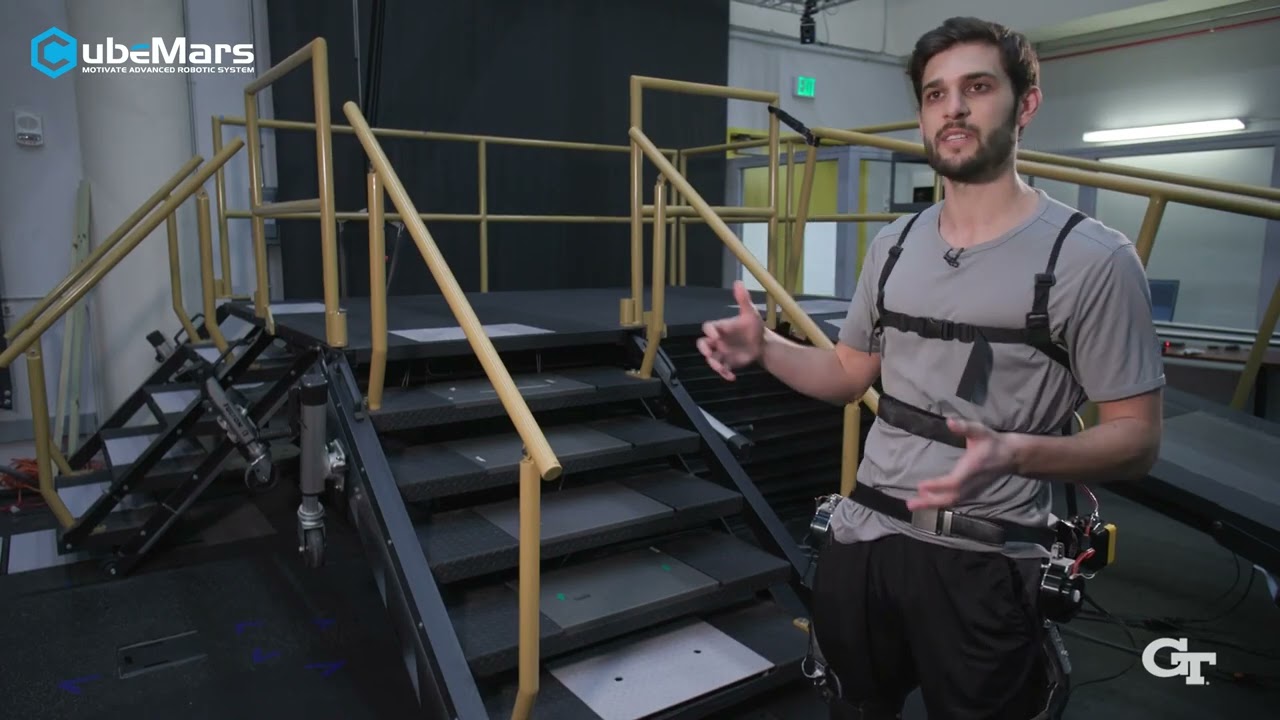
CubeMars has published a short demonstration video showing its AK80-6 KV100 robotic actuator driving a bilateral lower-limb exoskeleton developed at the Georgia Institute of Technology (Georgia Tech). The two-minute clip is a compact, real-world reference for engineers evaluating integrated actuators for wearable robotics: it shows the actuator working inside an actual research platform rather than on a test bench.
In this article we break down what the video demonstrates, the verified specifications of the AK80-6 KV100, and why this actuator class matters for exoskeleton and human-mobility applications.
What the Video Shows
The video, published on the official CubeMars YouTube channel on February 24, 2026, shows a bilateral (two-leg) wearable exoskeleton built by the Georgia Tech research team, with AK80-6 actuators providing powered joint assistance. According to the video description, the lightweight wearable system combines high torque density with smooth, precise motion, and is aimed at rehabilitation and human mobility research.
For engineers, the key value of the footage is integration context: connector placement, mounting, cabling and how a 98 mm-class integrated actuator fits into a wearable joint assembly - details that are hard to judge from a datasheet alone.
Original Video
Source: CubeMars Official YouTube Channel
Video: CubeMars AK80-6 Powers Georgia Tech’s Advanced Robotic Exoskeleton
Product Featured: CubeMars AK80-6 KV100
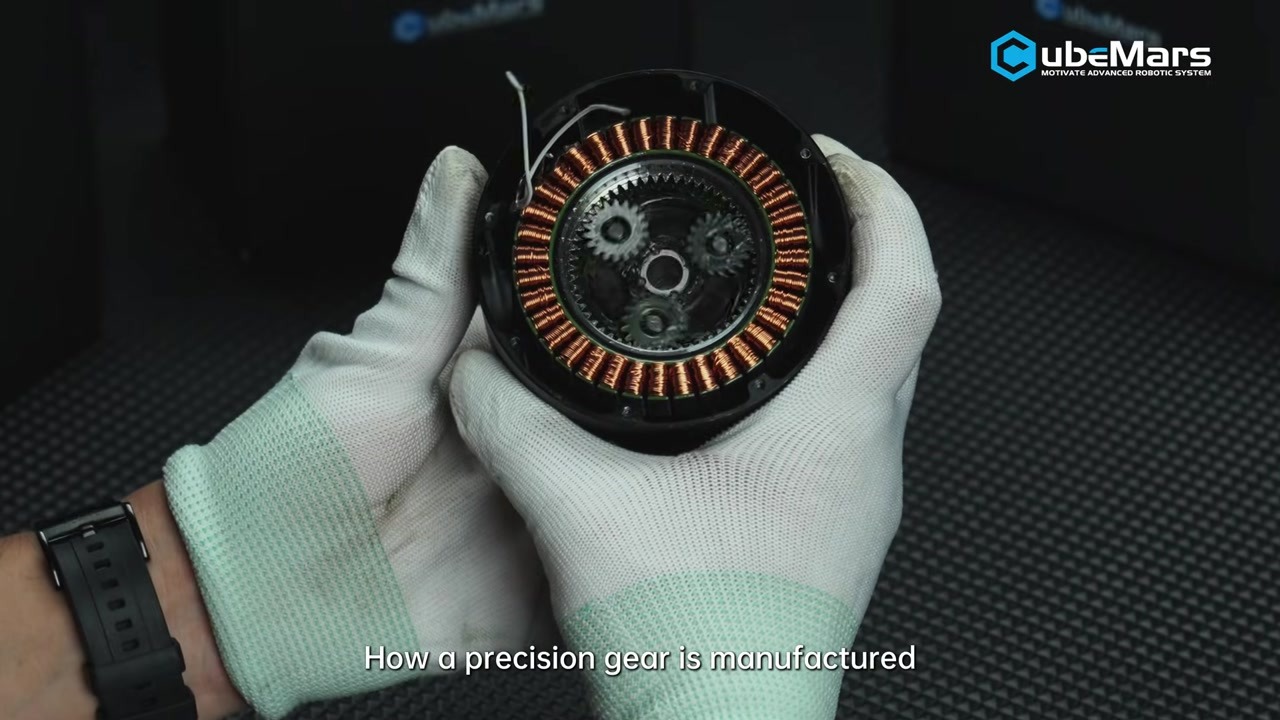
The AK80-6 KV100 is a classic high-integration robotic actuator from CubeMars’ AK series. It integrates a high-performance BLDC motor, a 6:1 planetary gearbox, a 14-bit magnetic encoder and an FOC driver board in a single Ø98 × 38.5 mm, 485 g housing. According to CubeMars’ official product page, the actuator is designed for exoskeletons, quadruped robots and similar medium-load legged applications, and supports multi-loop control (position, speed, torque and MIT hybrid mode) over CAN and UART.
Note on the torque figures in the video description: CubeMars states that the Georgia Tech exoskeleton delivers up to 15 Nm of continuous torque and 38 Nm of peak torque at the joint. The AK80-6 KV100 actuator itself is rated at 6 Nm (rated) / 12 Nm (peak) on the official product page, which suggests the exoskeleton’s drivetrain includes additional transmission between the actuators and the joints. The video description does not specify the drivetrain details, so this remains an interpretation rather than a verified fact.
Key Features Highlighted
- High torque density: 6 Nm rated and 12 Nm peak torque from a 485 g actuator (official product page).
- Fast, balanced dynamics: 6:1 gear reduction with a no-load speed of up to 800 rpm, supporting responsive joint control.
- Precise feedback: built-in 14-bit magnetic encoder for high-resolution positioning.
- Flexible control: multi-loop control modes including MIT hybrid mode, over CAN and UART interfaces.
- Integrated protection: overcurrent, overvoltage/undervoltage and overtemperature protection for demanding wearable and mobile applications.
Exoskeleton Application Context
Exoskeleton joints are one of the most demanding actuator targets in robotics: they need high torque at low speed, low reflected inertia for comfortable human interaction, backdrivability, and a compact envelope that fits close to the human body. The video description also emphasizes rehabilitation and human mobility as the target domains, which aligns with how research exoskeletons at universities like Georgia Tech are typically used: gait assistance, rehabilitation training and human augmentation studies.
For teams selecting actuators for this class of device, the demonstrated configuration - an integrated 48 V actuator with encoder and driver on board - reduces wiring complexity and controller count compared with assembling a motor, gearbox, encoder and servo drive separately.
Product Details
| Specification | Details |
|---|---|
| Manufacturer | CubeMars |
| Product | AK80-6 KV100 Robotic Actuator |
| Category | Integrated robotic actuator (AK series) |
| Rated Voltage | 48 V |
| Rated Torque | 6 Nm |
| Peak Torque | 12 Nm |
| Rated Speed | 603 rpm (no-load up to 800 rpm) |
| Reduction Ratio | 6:1 planetary |
| Weight | 485 g |
| Dimensions | Ø98 × 38.5 mm |
| Encoder | 14-bit magnetic encoder |
| Communication | CAN / UART |
| Applications | Exoskeletons, legged robots, AGV |
All specifications sourced from CubeMars’ official product page; joint-level torque figures quoted in the video description are attributed to the video, not the actuator datasheet.
Explore the Product on ToBMS
- Explore CubeMars AK80-6 KV100 Robotic Actuator →
- View the CubeMars manufacturer profile on ToBMS →
- Explore BLDC motors for exoskeletons →
About CubeMars
CubeMars is a robotics power brand specializing in high-integration actuator modules, frameless torque motors and gimbal motors. The company contributed to the MIT Mini Cheetah project and has since built a broad AK-series actuator portfolio used in humanoid, quadruped, exoskeleton and robotic-arm research worldwide.
Conclusion
The Georgia Tech exoskeleton video is a useful data point for actuator selection: it shows a widely available, catalog-grade integrated actuator - the AK80-6 KV100 - doing real work in a research-grade wearable system. Where actuators are specified for exoskeleton joints, rehabilitation robots or quadrupeds, the video plus the official datasheet give a realistic picture of what this torque class delivers in practice.