CubeMars builds its frameless torque motor range around two rotor architectures: the RI series, an inner-rotor (inrunner) design, and the RO series, an outer-rotor (outrunner) design. Both are supplied as stator-and-rotor kits without housing, bearings or shaft, which leaves the mechanical envelope to the machine designer. This article puts the manufacturer’s published data for both series side by side and explains where each architecture fits in a robotic joint.
What the Video Shows
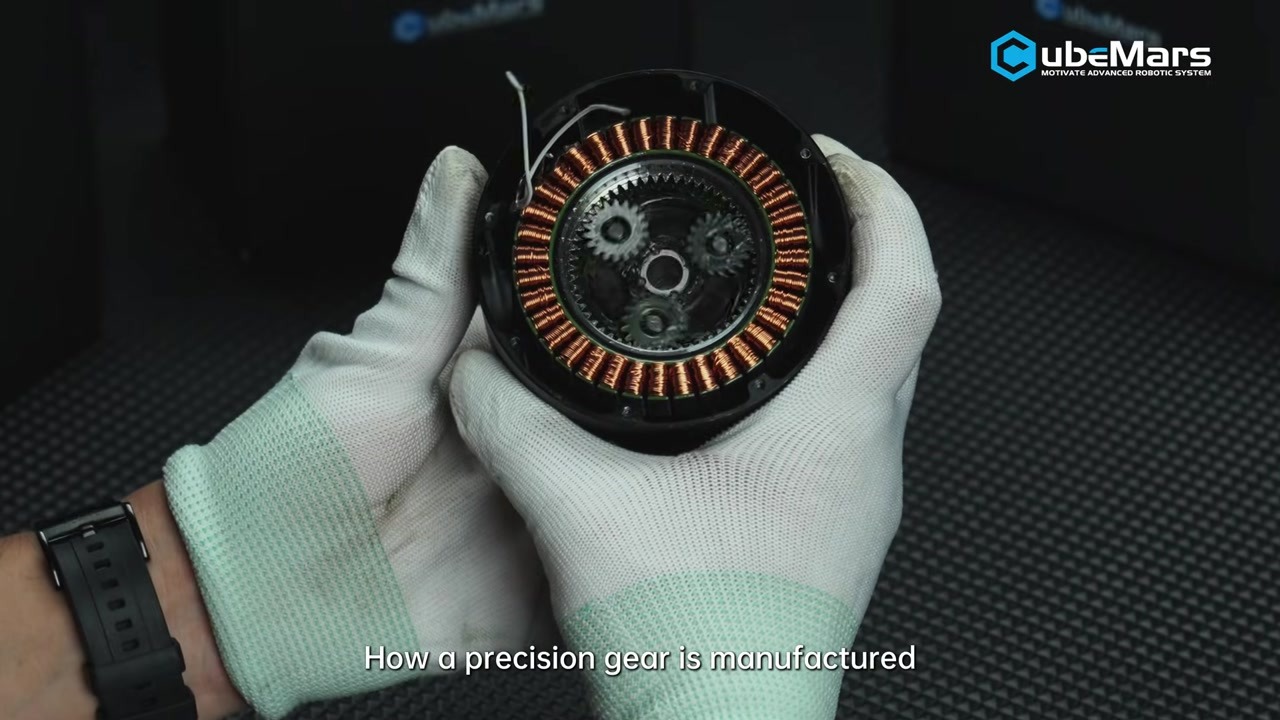
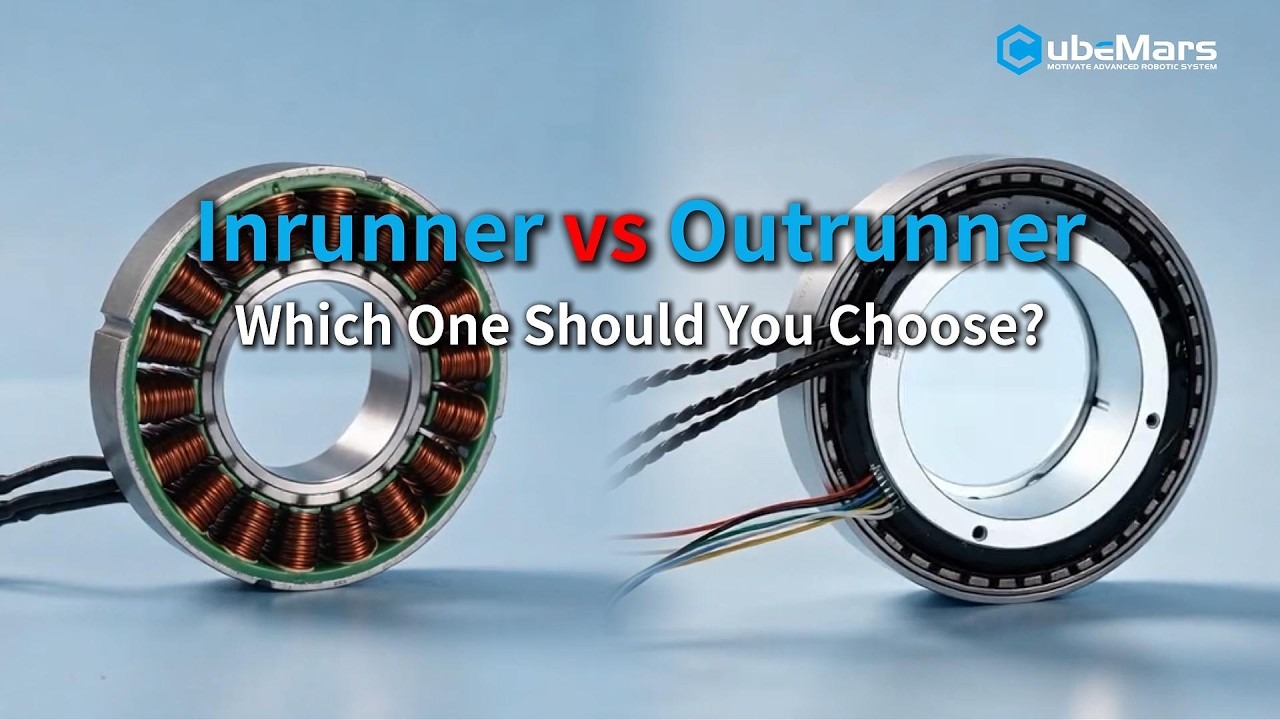
CubeMars frames the decision as a question of rotor layout in 46 seconds. The inrunner keeps the stator on the outside with the rotor spinning at the centre, which gives lower rotational inertia and a faster response; the manufacturer points it at precision joints that start and stop frequently. The outrunner puts the stator at the centre with the rotor turning around the outside, and its longer lever arm produces more torque within the same envelope. The clip closes on the selection criteria: torque, speed, available space, hollow-shaft needs and mechanical integration.
Original Video
Source: CubeMars Official YouTube Channel
Video: CubeMars RI and RO Series Frameless Torque Motors
What “Frameless” Means in Practice
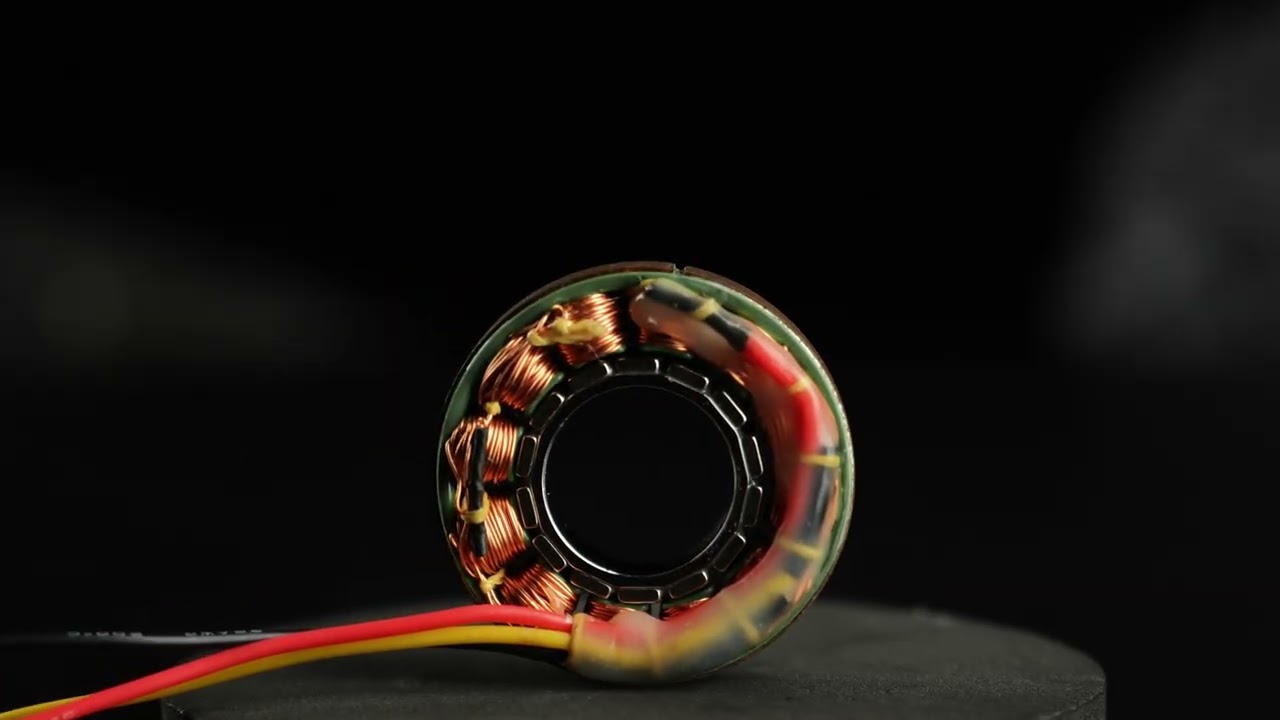
A frameless torque motor ships as two parts — a wound stator and a rotor ring — with no housing, output shaft or bearings. The assembly is bonded or clamped directly into the joint structure, so the motor’s outer diameter becomes the joint’s outer diameter, and the hollow bore along the rotation axis stays free for cabling, slip rings or a reducer input shaft.
The practical consequences are compactness and mechanical transparency: there is no gearbox housing to design around, and joint stiffness is set by the host structure rather than by a motor casing. The trade-off is that bearing support, alignment and heat dissipation all move to the integrator. A frameless design rewards teams that already own the structural and thermal design of the joint, and penalises those looking for a drop-in unit.
The RI Series: Frameless Inrunner Torque Motors
The RI series is the inner-rotor side of the range. According to the manufacturer, these motors are developed for high-precision robotics and industrial automation — exoskeletons, quadruped robots and collaborative arms — and are characterised by high torque density, low cogging torque and control resolution down to 0.01°. Width and thickness are engineered for tight installation envelopes, and the series supports customisation to fit specific joints.
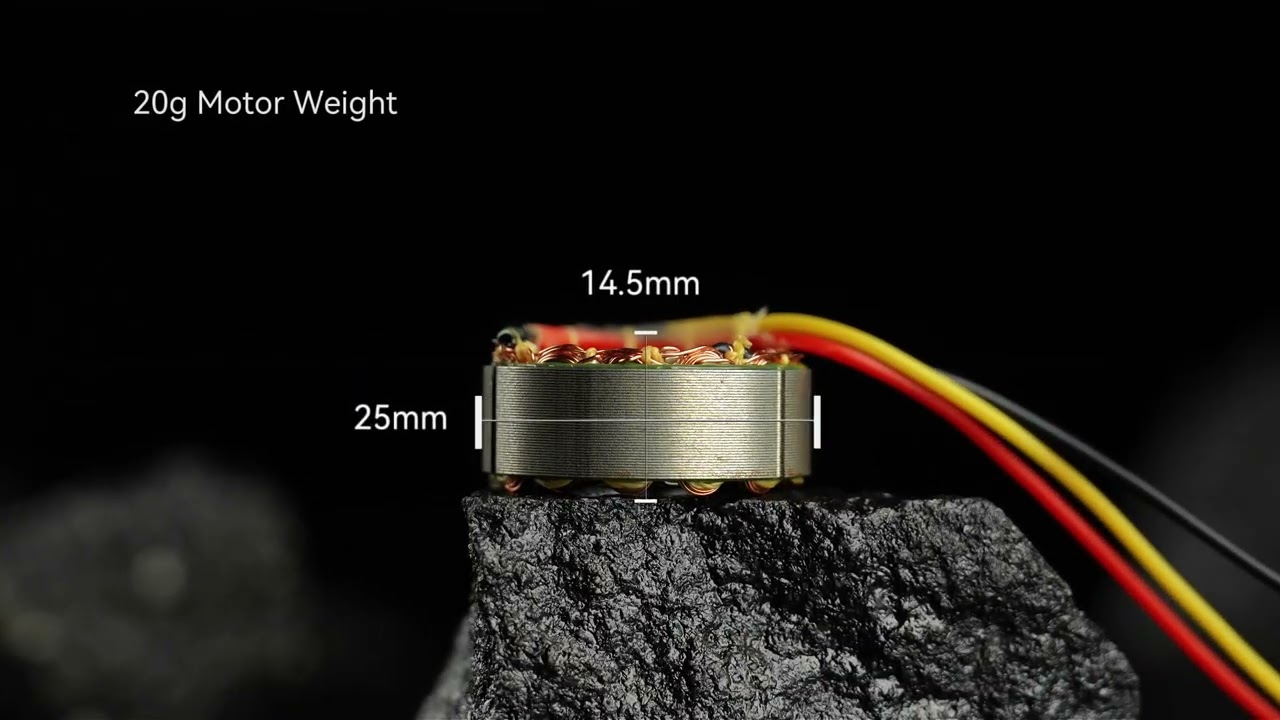
Seven RI models are covered in the comparison below, spanning 20 g to 500 g and peak torque from 72 mN·m to 4.95 N·m. The bore grows steadily with frame size, from 11.6 mm on the RI20 to 45 mm on the RI100, which is the parameter that usually decides whether a given joint can route its harness through the motor.
| Model | Dimensions | Bore / hollow shaft | Weight | Peak torque |
|---|---|---|---|---|
| RI20 KV600 | Ø25 × 14.5 mm | 11.6 mm | 20 g | 72 mN·m |
| RI30 KV260 | Ø38 × 14 mm | 17 mm | 40 g | 230 mN·m |
| RI50 KV100 | Ø54 × 27 mm | 22 mm | 180.8 g | 1.67 N·m |
| RI60 KV120 | Ø60 × 23 mm | 30 mm | 155.9 g | 1.63 N·m |
| RI70 KV95 | Ø76 × 24 mm | 38 mm | 270.4 g | 2.68 N·m |
| RI80 V2.0 KV75 | Ø85 × 27 mm | 40.5 mm | 411 g | 4.1 N·m |
| RI100 KV105 | Ø104 × 26 mm | 45 mm | 500 g | 4.95 N·m |
Specifications as published by the manufacturer on its own product pages. Bore is given as through-bore diameter or hollow shaft diameter depending on the model.
The RO Series: Frameless Outrunner Torque Motors
The RO series takes the opposite approach: the rotor runs outside the stator. CubeMars positions the range for robotics with an emphasis on a large hollow bore, and it splits each size into two builds — a Standard variant supplied with Hall sensors and a Lite variant supplied without them. The split matters at integration time, because a joint that needs commutation feedback at start-up needs the Hall-equipped build.
Five RO models are covered below, from the 60 g RO40 Lite to the 710 g RO100. Peak torque spans 0.6 N·m to 12 N·m, and the published no-load speed falls as frame size rises, from 5520 rpm on the RO60 down to 2550 rpm on the RO100 — the expected consequence of a lower KV on the larger, higher-torque models.
| Model | Dimensions | Weight | Peak torque | No-load speed | Build |
|---|---|---|---|---|---|
| RO40 KV140 Lite | Ø46.3 × 13 mm | 60 g | 0.6 N·m | 3400 rpm | Lite (without Hall) |
| RO50 KV108 Lite | Ø61.7 × 14.5 mm | 105 g | 0.9 N·m | 2600 rpm | Lite (without Hall) |
| RO60 KV115 Standard | Ø73.8 × 23 mm | 248 g | 2.4 N·m | 5520 rpm | Standard (with Hall) |
| RO80 KV105 Standard | Ø92.6 × 26.4 mm | 352 g | 4 N·m | 5040 rpm | Standard (with Hall) |
| RO100 KV55 Standard | Ø113.5 × 36.2 mm | 710 g | 12 N·m | 2550 rpm | Standard (with Hall) |
Specifications as published by the manufacturer on its own product pages. “Standard” and “Lite” denote the Hall-equipped and Hall-free builds respectively.
Inrunner or Outrunner: How the Architectures Differ
The choice between the two series is mostly a question of which physical envelope the joint can absorb. An inrunner concentrates its rotating mass near the axis, which keeps the rotor inertia low and suits joints that must accelerate quickly; the published RI figures reflect this, with the largest RI model reaching 4.95 N·m at 500 g. An outrunner places the rotor at a larger radius, which favours torque production at lower speed — the RO100 delivers 12 N·m, roughly two and a half times the RI100 peak, at 710 g.
| Attribute | RI100 KV105 | RO100 KV55 |
|---|---|---|
| Rotor layout | Inner rotor | Outer rotor |
| Outer diameter | 104 mm | 113.5 mm |
| Axial length | 26 mm | 36.2 mm |
| Weight | 500 g | 710 g |
| Peak torque | 4.95 N·m | 12 N·m |
| Bore | 45 mm | Large hollow bore |
| Commutation feedback | Depends on model | Hall on Standard builds |
Figures as published by the manufacturer. The two models are the largest in their respective series and are not direct drop-in substitutes.
Axial length is the second decisive number. The RI series stays thin — 13 mm to 27 mm across the whole range — which suits joints where the motor has to disappear into a limb segment. The RO range is taller, and the RO100 at 36.2 mm asks for more axial room than a compact wrist or ankle usually has.
Where Each Series Fits
Both series are aimed at the same broad set of machines, but the published dimensions push them toward different joints. The RI range, with its thin section and small bores at the bottom end, suits lightweight and space-critical joints: the RI20 and RI30, at 20 g and 40 g, sit naturally in exoskeleton hips and small quadruped legs where every gram is carried by the wearer or the payload budget. The larger RI models move into collaborative arm axes, where a 45 mm bore on the RI100 leaves room for the harness that has to pass through a rotating joint.
The RO range concentrates on joints that trade axial space for torque and a large through-bore. A collaborative robot arm base axis, a heavy quadruped robot hip, or an exoskeleton joint that needs both torque and wiring clearance are typical fits for the Standard builds. The Lite builds, at 60 g and 105 g, are the weight-critical option where the joint can commutate without Hall feedback.
Integration Notes
Three details decide most frameless installations. The first is commutation feedback: the RO Standard builds ship with Hall sensors and the Lite builds do not, so a controller that needs rotor position at start-up has to be matched to the right build. The second is the bore — it has to clear the harness, slip ring or reducer shaft the joint actually uses, and the published bore figures range from 11.6 mm to 45 mm across the RI series. The third is thermal path. With no housing, the stator’s heat has to leave through the structure it is bonded to, so the mounting surface becomes part of the thermal design.
Explore on ToBMS
The models below are covered in this article and can be compared side by side:
- CubeMars RI50 KV100 Frameless Inrunner Torque Motor
- CubeMars RI80 V2.0 KV75 Frameless Inrunner Torque Motor
- CubeMars RI100 KV105 Frameless Inrunner Torque Motor
- CubeMars RO50 KV108 Lite Frameless Torque Motor
- CubeMars RO100 KV55 Standard Frameless Torque Motor
Twelve of the models currently listed in the Frameless Torque Motors category belong to the RI and RO series, and the full range is published by CubeMars.
Conclusion
The RI and RO series cover the two standard frameless architectures from a single manufacturer, which makes the comparison unusually clean: the same brand, the same published data format, and a clear split between inner-rotor designs that stay thin and light, and outer-rotor designs that trade axial length for torque and bore size. For a joint with a hard axial budget, the RI series is the natural starting point. For a joint that needs torque and wiring clearance more than thinness, the RO series — and specifically the Hall-equipped Standard builds — is the better place to start.