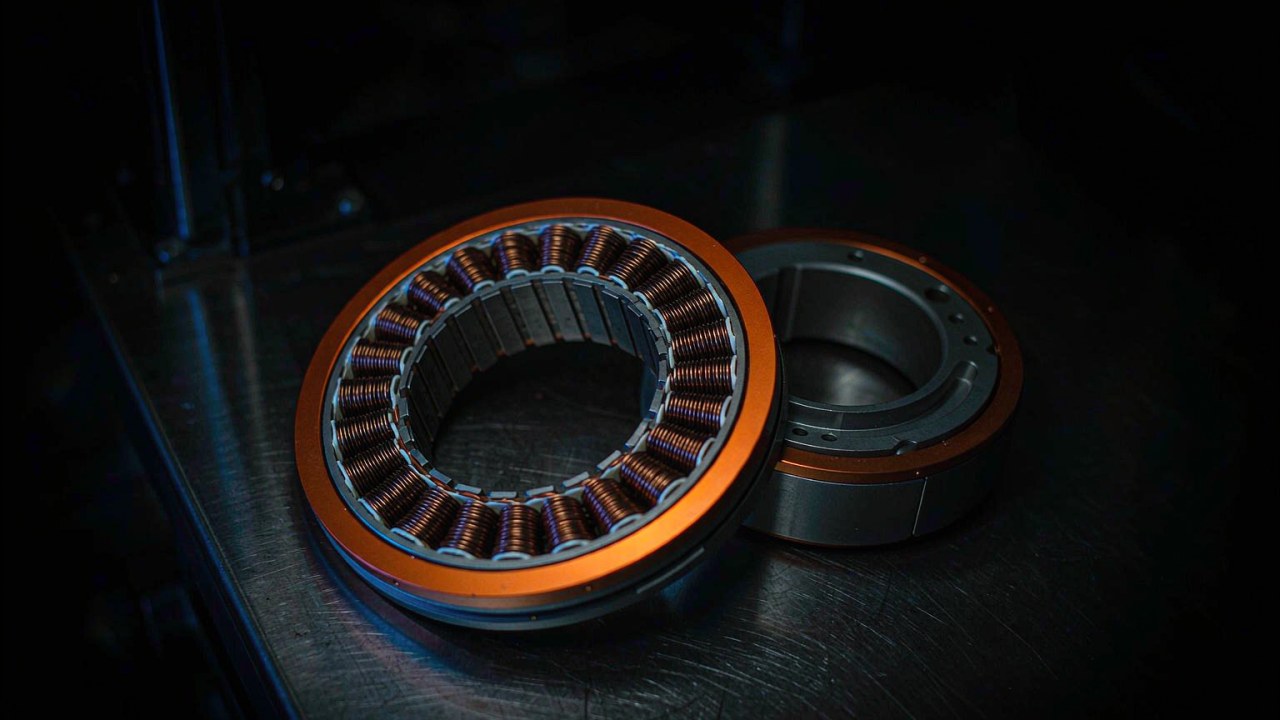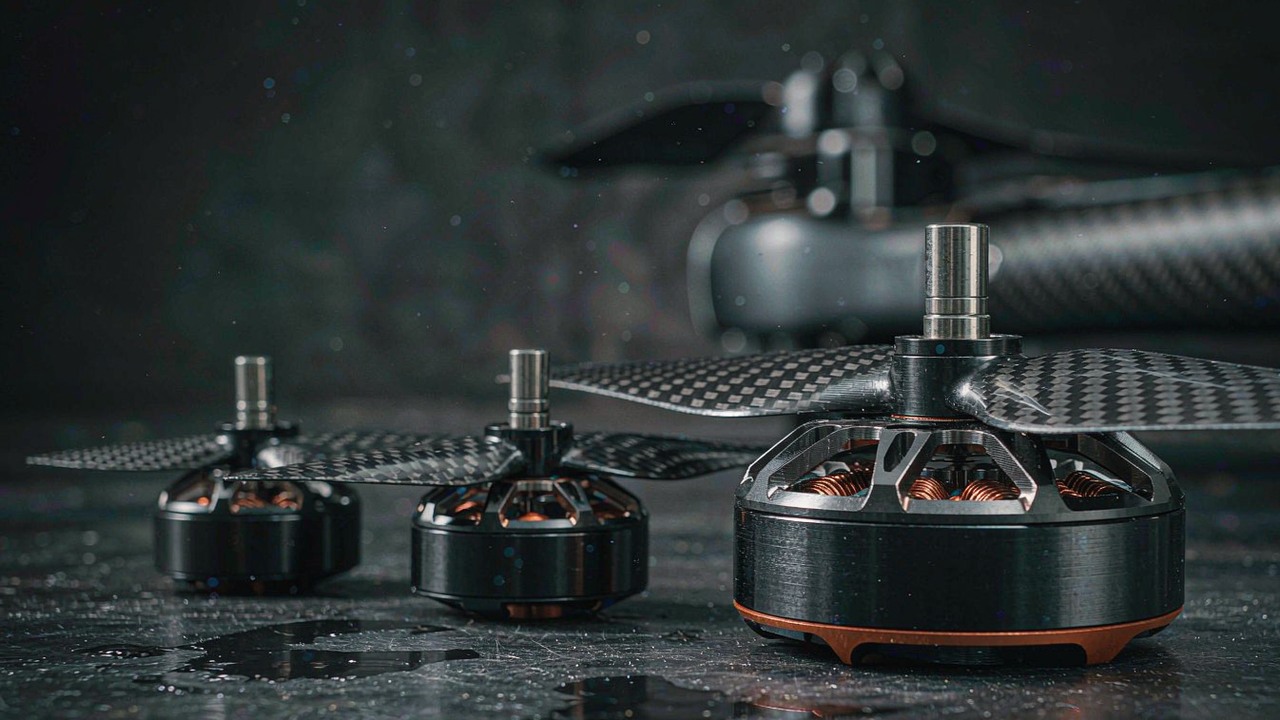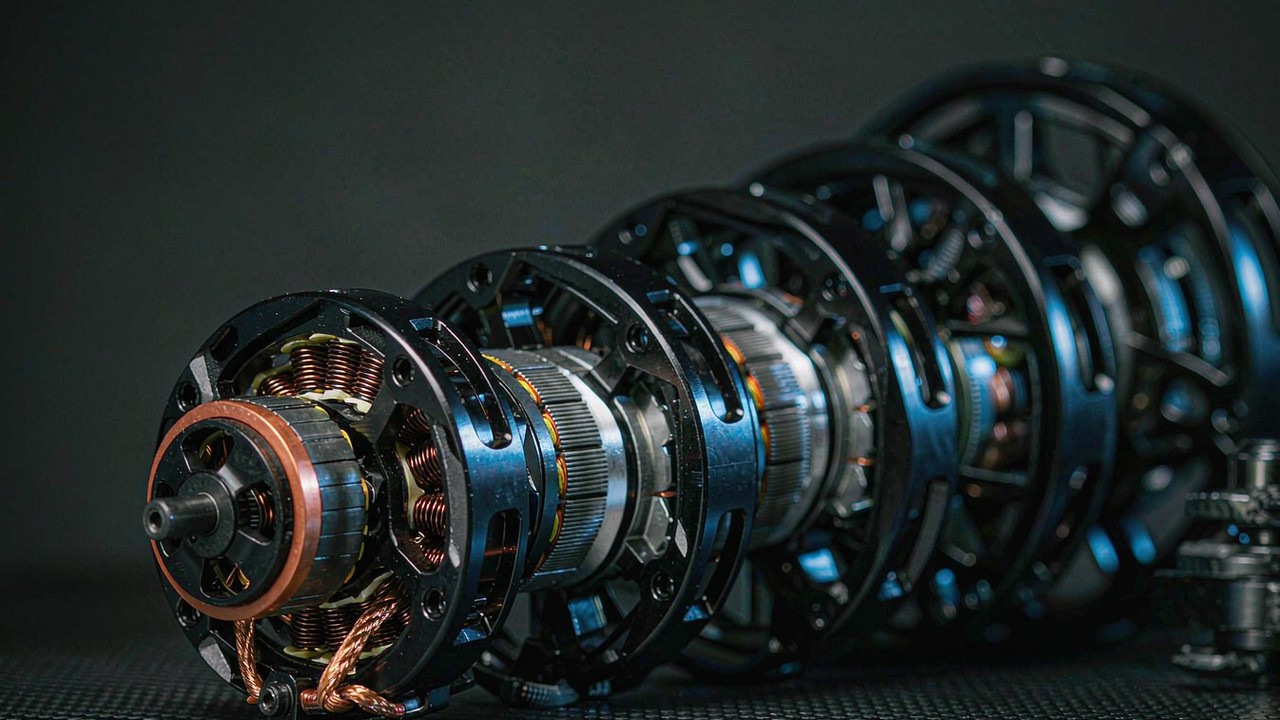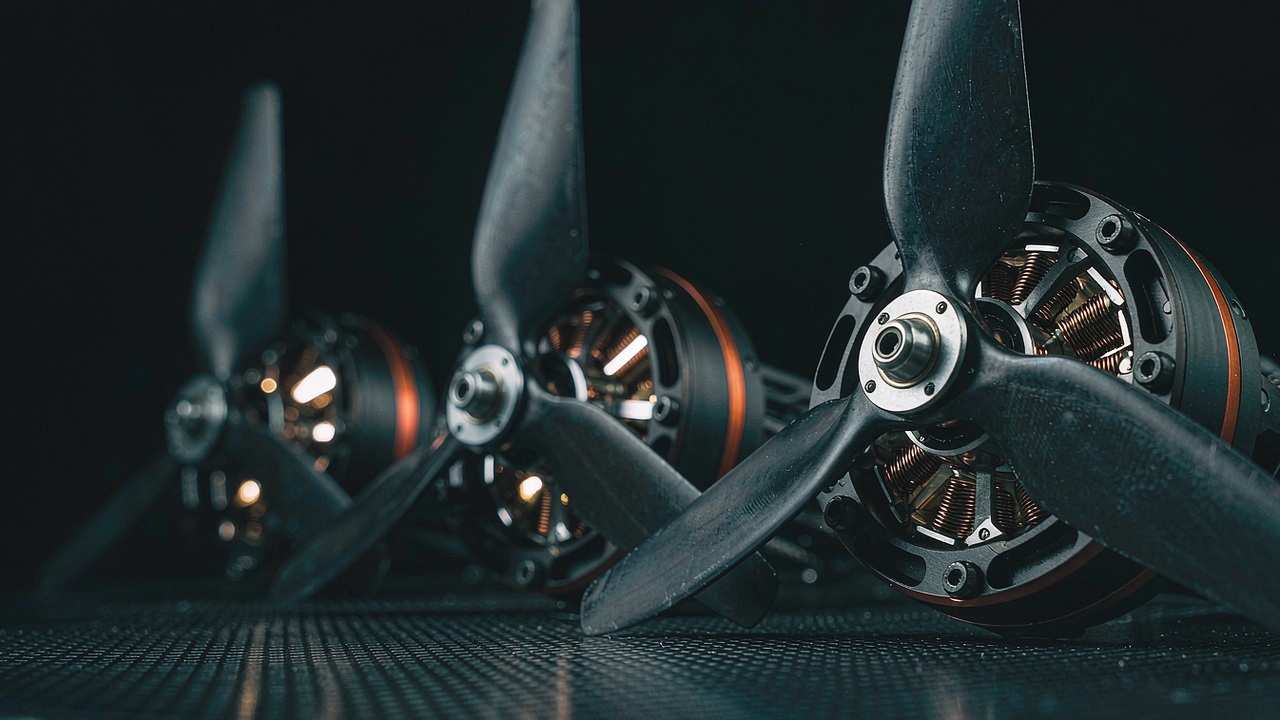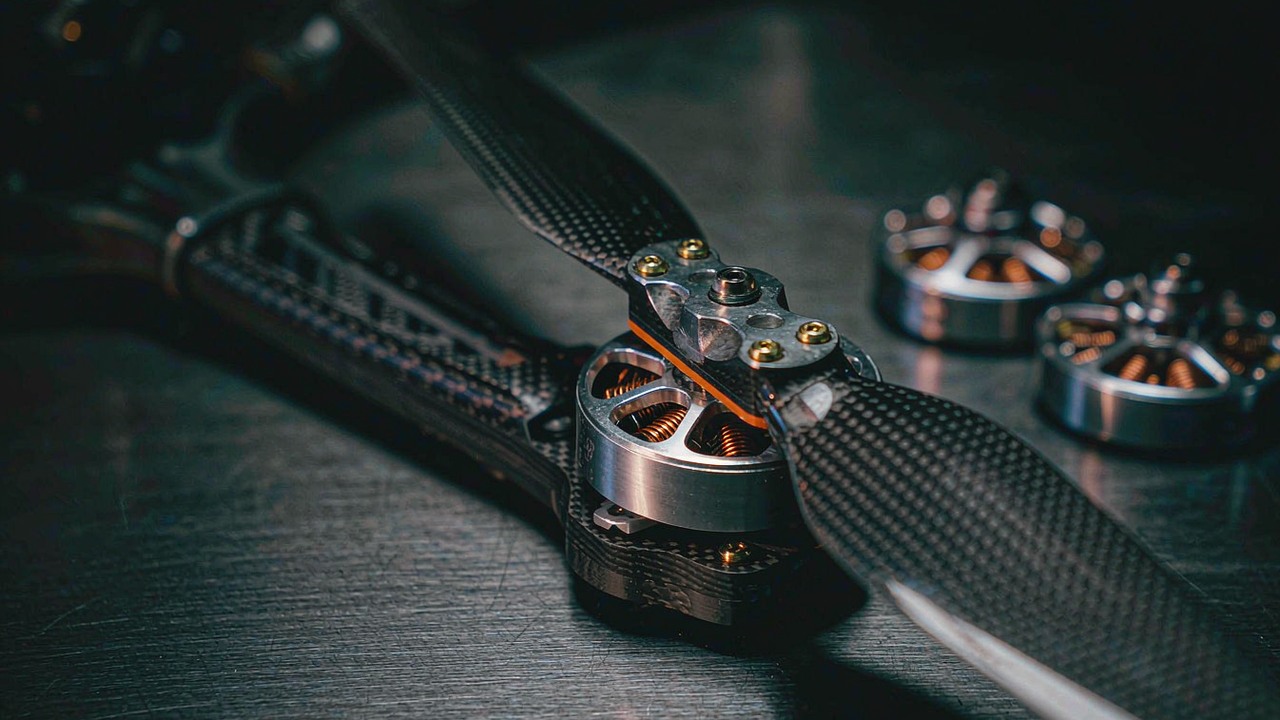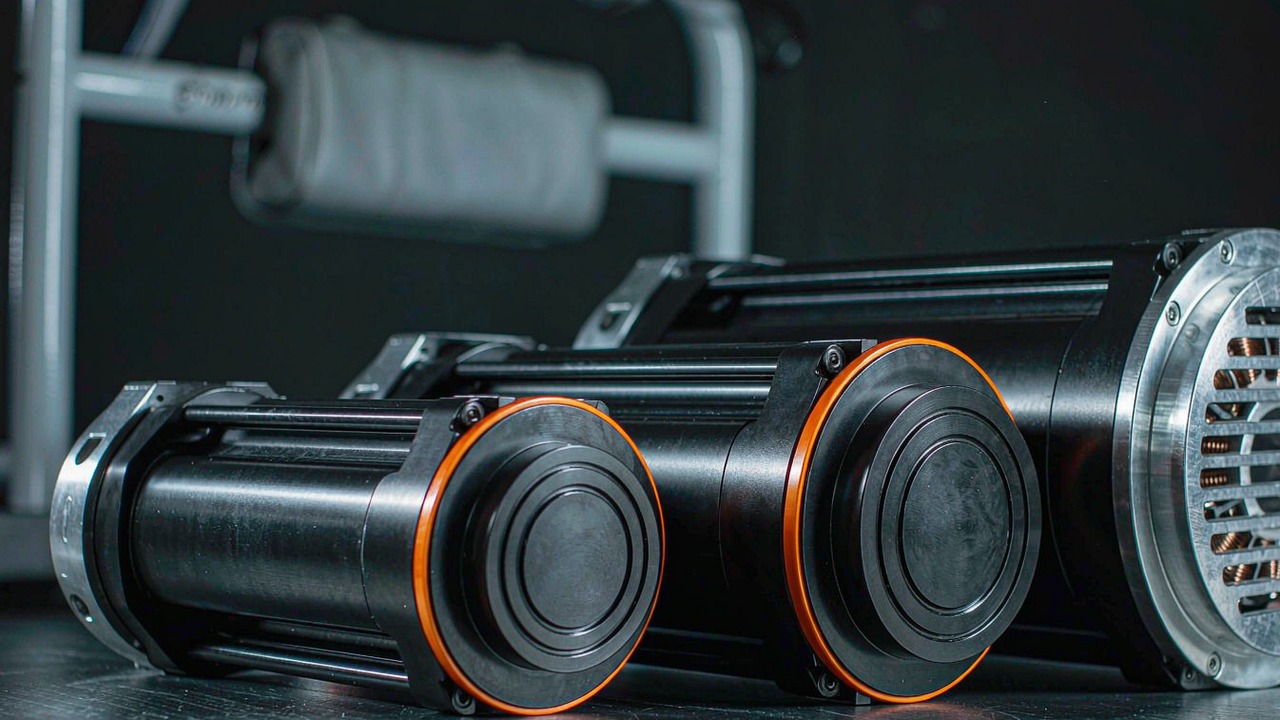
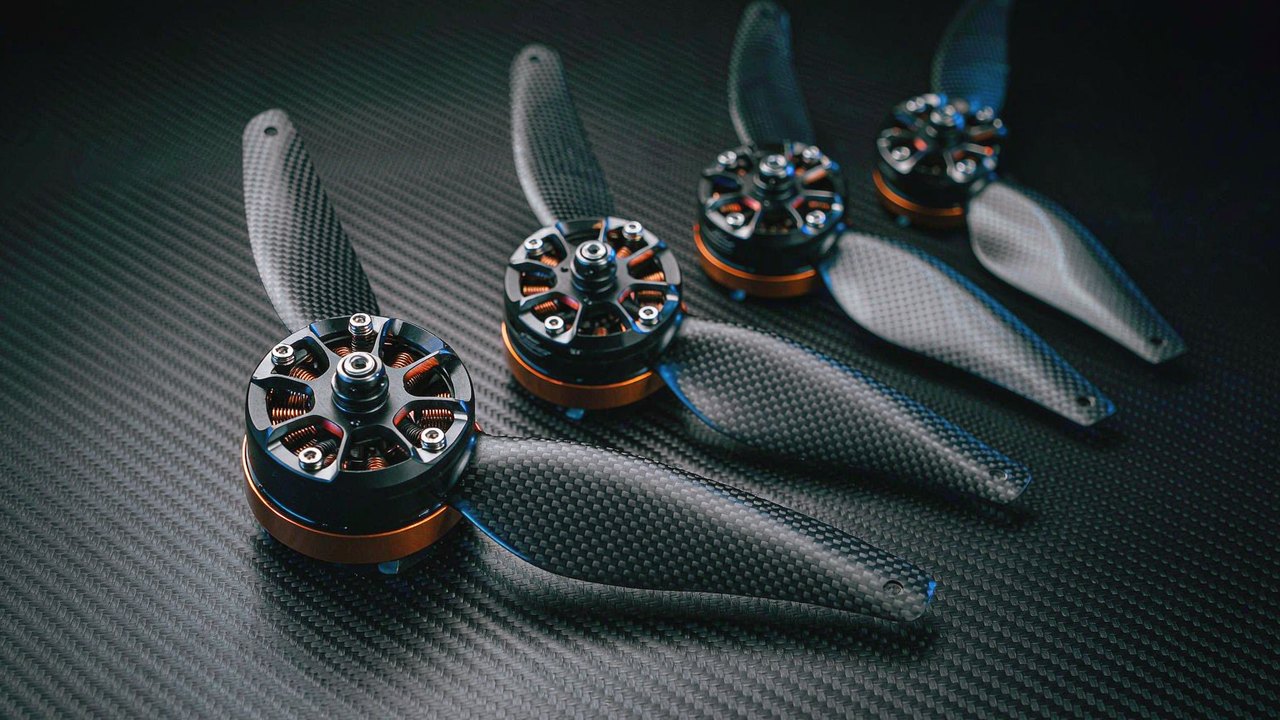
An Inspection UAV works while it hovers. It holds a fixed point a few metres from a bridge pier, a tower leg or a roof edge, and the images are taken from that hold rather than from a pass at speed. An inspection UAV motor is therefore chosen on the thrust it can sustain at part throttle and on the steadiness of the control loop it feeds, not on the peak number it reaches once. All-up weight still sets the budget, but the payload on this class of airframe is a camera and a gimbal rather than a tank or a cargo box, which is why the four records gathered here span 135 g to 282 g rather than several kilograms.
The four inspection UAV motor records in this comparison share one architecture: a brushless outrunner with an external electronic speed controller, mounted at the end of a thin arm and turning a propeller large enough to hover at a modest fraction of full throttle. What separates them is where each one lands on thrust, mass and bus voltage, and those three values are what decide which airframe each record suits. Two of the four are 24N28P machines, one is a 12N14P machine and one is a 36N42P machine, and that spread turns out to matter more at low throttle than the raw thrust figures suggest.
Quick answer
The shortlist follows the size and the steady-state demand of the aircraft rather than a ranking. On a small inspection UAV motor asked to carry a single camera on four arms, the T-Motor MN5008 KV340 UAV Motor records 4215 g of maximum thrust from 135 g on a 6S pack, and the T-Motor U5 KV400 UAV Motor covers a wider 3-8S window with 2850 g from 195 g.
Where the airframe grows into a six-arm or eight-arm platform carrying a gimbal and a longer sortie, the T-Motor MN501-S KV240 UAV Motor sits one step up at 4660 g from 170 g across a 6-12S window, and it is the record in this group that publishes the widest cell range.
The upper end of an inspection drone motor comparison is the T-Motor U8 Lite L KV110 UAV Motor. It records 11200 g of thrust and 2140 W for a 180 s window from 282 g on a fixed 12S bus, which is enough for an airframe that also carries a heavier sensor package or a second battery without changing the motor.
One caution applies to all four. None of the records carries a hover-rated thrust figure, so the published maxima are test-stand values at a stated propeller and voltage, and on an airframe each inspection UAV motor will spend its working life well below that point. Reading a recorded maximum as a usable hover number is the single most common way a propulsion budget is set too tight.
What an inspection UAV motor has to do
The duty on a BLDC motor for inspection UAV work is unusual among multirotor applications because the aircraft does its work while stationary. A cargo multirotor accelerates, climbs and translates, and its motors are judged on how much thrust they can deliver in bursts. An inspection airframe lifts to a working altitude, arrives on station and then stays there, and everything that happens afterwards is a small correction against a fixed point. The recorded maximum thrust still gates the take-off, but it is not the number the winding spends its thermal budget on.
Hover is the whole mission
A multirotor that cruises spends most of its energy pushing air backwards; a multirotor that inspects spends most of its energy standing still in moving air. That single difference is the argument for treating an inspection UAV motor as a hover device first. The motor holds a thrust value close to the share of the airframe mass resting on it, continuously, at a throttle setting that never approaches the published maximum. It is the opposite of the duty that suits a racing motor, where the winding is asked for everything it has for a few seconds and then unloaded.
The practical consequence is that the operating point sits low on the throttle curve, and the low end of that curve is where a winding behaves least efficiently and where cogging is most visible as a control disturbance. An inspection UAV motor that is oversized for the airframe makes this worse rather than better: a large motor held at a small fraction of its rating runs at a poor point on the curve, and the extra mass has to be carried on every sortie. The right size is the smallest record whose published thrust covers the hover requirement with the margin the mission needs.
Position hold is a control problem before it is a power problem
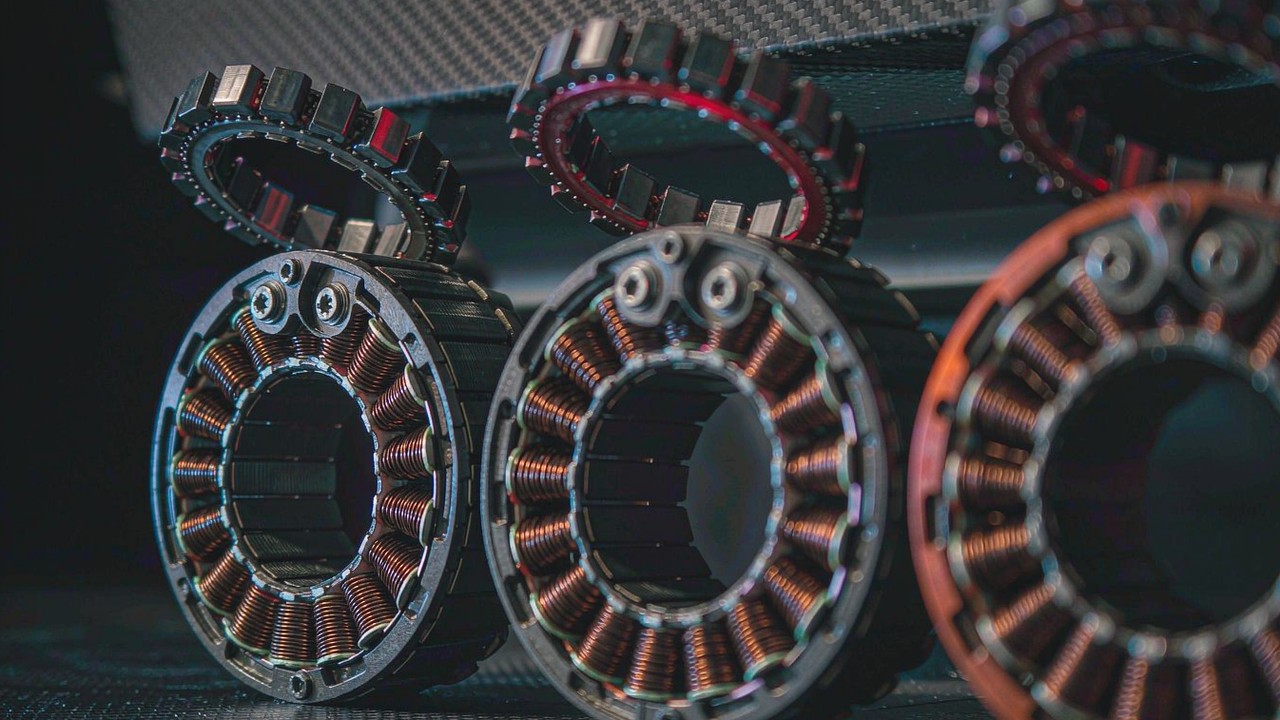
Holding a position in turbulent air is not solved by thrust alone. The flight controller issues small, frequent corrections, and the motor has to translate those corrections into changes in thrust without lag and without a step in the response. That is why stator configuration matters as much as thrust on an inspection UAV motor. The slot and pole count sets how smoothly torque is produced as the rotor moves through a revolution, and a higher count spreads the torque production across more positions, which lowers the cogging contribution and gives the control loop a quieter signal to work against.
The group reflects that reasoning. The T-Motor MN5008 KV340 UAV Motor and the T-Motor MN501-S KV240 UAV Motor both use a 24N28P stator, the T-Motor U8 Lite L KV110 UAV Motor uses a 36N42P stator, and only the T-Motor U5 KV400 UAV Motor runs a 12N14P stator. The 12N14P record is also the lightest-thrust unit in the group, which is consistent: a smaller, faster-turning motor is the usual answer on a very light airframe, and the slot count follows the size rather than the mission.
Wind rejection sets the thrust margin
An inspection flight often happens beside a structure, and structures make their own wind. A bridge deck, a cooling tower or the corner of a building turns a steady breeze into a gust field with a short period, and the airframe has to absorb that without being pushed out of the camera frame. The thrust margin an inspection UAV motor carries is therefore a wind margin rather than a payload margin, and it is the reason a propulsion budget for this class of work is usually set with more headroom than a pure endurance calculation would suggest.
Margin on an inspection UAV motor held at hover is not free. Every increment of held thrust costs current, and current costs heat in the winding and capacity in the pack. Because the figure that would settle the question is a hover-rated thrust value at a realistic propeller and voltage, and because none of the four records publishes one, the margin has to be estimated from the recorded maximum and then confirmed against the manufacturer’s own thrust table. Treating the recorded maximum as the margin gives a number that looks comfortable and is not.
The sensor is light, so the airframe is light
The payload that defines an inspection mission is a camera, a gimbal and possibly a lidar or a thermal unit, and the combined mass of that package is a small fraction of the airframe. That is what keeps the inspection UAV motor class light. Where an agricultural airframe is sized around a tank that changes mass through the flight, and a heavy lift airframe is sized around freight measured in tens of kilograms, an inspection airframe is sized around a sensor that weighs a few hundred grams and does not change.
A constant, modest payload simplifies the specification of an inspection UAV motor in one useful way: the hover point does not move through the mission. The motor sees the same thrust requirement at the start and at the end, so the thermal duty is a steady state rather than a sequence of peaks, and the winding can be sized against a single operating point. It also means the mass of an inspection UAV motor is a larger share of the total than the payload is, which is why the four records here sit between 135 g and 282 g and why a step up in mass has to be justified by something other than payload.
Sortie length and how often a motor is swapped
Inspection work is repetitive. The same asset is photographed from the same angles at intervals, and the airframe accumulates hours rather than flights. That pattern shifts part of the decision away from a single mission. The U8 Lite L KV110 publishes a mean time between failures of about 1000 hours, and the U5 record carries the same class of figure, so the question an inspection operator faces is not only which inspection UAV motor holds the airframe best today but how the service interval lines up with the airframe it is bolted to.
Long service intervals on an inspection UAV motor also make the mounting decision more permanent. The shaft diameter, the bolt pattern and the lead length chosen at the start of a program tend to survive several airframes, so a record that is marginally better on thrust but awkward on mounting can be the more expensive choice over a season of flying. The envelope figures in the table below are worth reading against the arm the motor will actually sit on, not only against the airframe mass.
The five figures behind an inspection drone motor
Five recorded values carry most of the decision on an inspection drone motor, and only some of them are published in full across the group. The gaps matter as much as the values, because a propulsion budget that quietly assumes a number the manufacturer never published is a budget that has to be reopened later. The same five values decide a BLDC motor for inspection UAV work at any size in this group.
Thrust at the hover point, not at the stand
The recorded maximum thrust for an inspection UAV motor in this group runs from 2850 g to 11200 g, and none of those figures is a hover number. They are measured on a test stand at a stated propeller, voltage and throttle. What makes them comparable across airframes is the number of arms sharing the load: 2850 g on a four-arm airframe at 4 kg all-up weight is a very different proposition from 2850 g on an eight-arm airframe of the same mass, even though the motor is identical.
The useful reading for an inspection UAV motor is therefore thrust per arm against the mass that arm has to support, with the control margin added on top. A 4 kg airframe on four arms asks each inspection UAV motor for about 1000 g simply to hover, which any record in the group covers; the same airframe on four arms with a wind margin and a reserve for a failing motor asks for considerably more, and that is where the choice between 2850 g and 4660 g of recorded thrust starts to matter.
Mass, paid out of pack capacity
The mass of an inspection UAV motor is a fixed deduction from a budget that is otherwise spent on battery. Each record here between 135 g and 282 g is the mass including the cable as published, and the difference across the group is 147 g per motor. On a four-arm airframe that spread becomes 588 g across the aircraft, which is roughly the mass of a small additional pack and therefore roughly a few minutes of hover time.
Mass also compounds in a way that is easy to underrate on a hover-duty aircraft. A heavier inspection UAV motor needs more thrust to hold the airframe up, which draws more current, which needs a larger pack, which adds further mass. The loop is mild at this scale, but it runs in one direction only, and a motor chosen for a thrust figure the mission does not need is paid for twice: once in the mass of the motor and once in the capacity it displaces.
KV against the propeller and the bus
KV on an inspection drone motor is a match statement, not a quality statement. It describes how fast the shaft turns per volt with no load, and it only becomes meaningful alongside the propeller the motor has to turn and the cell count it is fed from. A low KV record turning a large propeller on a high-voltage bus reaches hover at a moderate fraction of full throttle; a high KV record on the same bus would need a small propeller to stay inside its current limit.
Across the four records, an inspection UAV motor spans 110 to 400 KV, and the spread tracks the bus rather than a preference. The U5 KV400 covers 3-8S, the MN5008 KV340 runs a fixed 6S, the MN501-S KV240 covers 6-12S and the U8 Lite L KV110 is fixed at 12S. Read as pairs, the low KV records are the ones paired with the higher bus, which is the expected arrangement: a 12S bus and a 110 KV winding put the shaft speed in the range a large inspection propeller wants, while a 6S bus and a 340 KV winding do the same job at a smaller diameter.
Resistance and the part-throttle window
Internal resistance is the column that decides how much of the pack energy reaches the propeller on an inspection UAV motor, because the motor works at part throttle for the whole sortie rather than at a burst. Copper loss rises with the square of the current, and at a hover setting the current is modest but continuous, so resistance is a loss that runs for the entire flight rather than for a few seconds of climb.
The four records differ by more than a factor of two here: the MN5008 KV340 publishes 55 mΩ, the MN501-S KV240 publishes 85 mΩ, the U8 Lite L KV110 publishes 105 mΩ and the U5 KV400 publishes 116 mΩ. The ordering follows the size of the winding rather than the thrust, which is the point worth taking from the column. Resistance also has a second use on an inspection drone motor: multiplied by the square of the expected hover current, it gives an estimate of the heat the winding will have to shed continuously, which is a better thermal planning figure than the 180 s power number.
Envelope, shaft and cable length
The mechanical column looks secondary until the motor is being fitted to an arm. The four records measure from Ø42.5 × 37.5 mm on the U5 KV400 through Ø55.6 × 32 mm on the MN5008 KV340 and Ø55.6 × 33.9 mm on the MN501-S KV240 to Ø87.1 × 28.05 mm on the U8 Lite L KV110, with shaft diameters of 5 mm, 6 mm IN, 6 mm IN with a 4 mm OUT step and 15 mm respectively.
Cable length varies more than the envelope does: 600 mm on the U5, 150 mm on the MN501-S, 90 mm on the U8 Lite L and 80 mm on the MN5008. On an inspection airframe the speed controller usually sits inboard, so a short lead means the ESC moves out towards the motor and adds mass at the arm end, while a long lead adds mass in copper that the airframe carries on every sortie. Neither is wrong, but the two are not interchangeable and the choice belongs to the airframe design rather than to the motor record.
Inspection UAV motors compared across 135 g to 282 g
The table below collects the four records in ascending order of recorded maximum thrust. Every value is as published for each model, and no cell is estimated. Where a manufacturer does not publish a figure for a given column, the cell is left as not listed rather than filled from a neighbouring model.
| Model | Configuration | Internal Resistance | No. of Cells (LiPo) | Maximum Thrust | Max Power 180 s | Weight |
|---|---|---|---|---|---|---|
| U5 KV400 | 12N14P | 116 mΩ | 3-8S | 2850 g | 850 W | 195 g |
| MN5008 KV340 | 24N28P | 55 mΩ | 6S | 4215 g | 760 W | 135 g |
| MN501-S KV240 | 24N28P | 85 mΩ | 6-12S | 4660 g | 1200 W | 170 g |
| U8 Lite L KV110 | 36N42P | 105 mΩ | 12S | 11200 g | 2140 W | 282 g |
All four motors are listed in the ToBMS UAV Motors category and are grouped under the Inspection UAV application. Configuration, internal resistance, cell count, maximum thrust, 180 s power and weight are as published by T-Motor, measured on a test stand at a stated propeller and voltage, and should be read as test-stand figures rather than as hover ratings.
Light end: U5 KV400 and MN5008 KV340
Two inspection UAV motor records cover the light end of the group, and they solve the same problem in opposite ways. The T-Motor U5 KV400 UAV Motor is the wider-window option: a 3-8S record at 195 g with 2850 g of recorded thrust, a 12N14P stator, 116 mΩ of resistance and a 600 mm lead. It is the record in the group whose cell count is least committal, which suits a program that is still deciding what pack to standardise on.
The T-Motor MN5008 KV340 UAV Motor is the lighter and more specific option. At 135 g it is the lightest record here, it records 4215 g of thrust on a fixed 6S bus, and it uses the 24N28P stator that the group’s larger records also use. For a compact four-arm inspection airframe that already runs 6S packs, it is the smaller of the two obvious answers, and on a hover-duty mission the 60 g it saves against the U5 is a real increment of pack capacity.
Middle: MN501-S KV240, the widest bus window
The T-Motor MN501-S KV240 UAV Motor is the step up, and it is the record that covers the most ground. It accepts 6-12S on a 24N28P stator, records 4660 g of maximum thrust from 170 g, and publishes 1200 W for 180 s alongside an 85 mΩ winding. That combination of a wide cell window and a mid-range thrust figure is what makes it a natural fit for an inspection drone motor on a six-arm airframe whose pack decision is not yet fixed.
Read against the light pair, the MN501-S trades 25 g and 30 g of mass against the U5 and the MN5008 for a wider voltage range and, in the MN5008’s case, a thrust step of 445 g. It is also the only record in the group that spans both the 6S bus used by the lightest record and the 12S bus used by the heaviest, which makes it the useful middle point when an inspection program is standardising across two airframe sizes.
Upper end: U8 Lite L KV110
The T-Motor U8 Lite L KV110 UAV Motor closes the range and is the outlier in almost every column. It records 11200 g of thrust, more than twice the next record, from a 282 g body measuring Ø87.1 × 28.05 mm, on a fixed 12S bus and a 36N42P stator, with 2140 W published for 180 s and a 45.8 A peak current. Its 15 mm shaft is three times the diameter of the U5’s and its resistance of 105 mΩ sits in the middle of the group despite the much larger winding.
The mass step is what has to be justified. Moving from the MN501-S to the U8 Lite L adds 112 g per motor and 448 g across a four-arm airframe, in exchange for a thrust increase far larger than a light inspection airframe needs. The record earns its place on platforms that carry a heavier sensor package, a second battery or a gimbal with a larger camera, where the airframe mass itself has grown and the extra thrust is buying margin rather than capability.
Matching a motor to an inspection mission
The recorded values of an inspection UAV motor only become a decision once they are read against a kind of inspection work. Each of the four records fits one profile well and is oversized for the profile below it, and the difference between the profiles is a difference in what the airframe has to do while stationary rather than in how far it has to fly.
Bridge and facade close inspection
Close inspection of a facade or a bridge means holding a position metres from a large surface in air that the surface itself is disturbing. The airframe is usually small, the camera is close to the structure, and the position tolerance is tight because a drift of a few centimetres changes the framing. A light inspection UAV motor with a high slot count suits this profile: the T-Motor MN5008 KV340 UAV Motor at 135 g on a 6S bus gives a four-arm airframe 4215 g of recorded thrust per arm to spend on wind rejection, and the 24N28P stator keeps the response quiet at the small throttle changes this work involves.
Powerline and tower standoff
Line and tower work pushes the airframe further from the surface and adds a sensor with some mass, often a zoom camera on a gimbal. The position tolerance is looser than a close facade pass but the airframe is heavier, so the thrust requirement per arm rises and the bus often moves to 12S for the lower current that comes with it. The T-Motor MN501-S KV240 UAV Motor covers this profile on a six-arm airframe: 4660 g of recorded thrust and a 6-12S window leave room to grow the pack without changing the motor, and 170 g per unit keeps the arm-end mass in proportion.
Confined space and indoor flight
Inspection inside a tank, a shaft or a duct removes the wind problem and replaces it with a propeller diameter limit. The airframe has to be small enough to enter, which caps the propeller, which caps how much thrust a given KV can produce. This profile puts a premium on the light end of an inspection drone motor comparison and on a KV that reaches the hover point with a small propeller: the T-Motor U5 KV400 UAV Motor at 400 KV and 195 g is the record in this group whose cell window and KV best suit a compact airframe that will not see open, gusty air.
Linear asset and corridor survey
A pipeline, a rail corridor or a road alignment adds a translation leg to what is otherwise an inspection duty. The airframe flies between stations rather than hovering in one place, so part of the mission budget moves from hover thrust to cruise efficiency, and the resistance and idle-current columns become more important than the thrust column. An inspection UAV motor chosen for this profile is usually the smallest record that still carries the sensor package, with the winding selected for a low hover current rather than for a high maximum thrust. The T-Motor U8 Lite L KV110 UAV Motor enters this picture only where the corridor airframe is large enough to need 12S and a 15 mm shaft.
Airframe types that use these motors
The four records sit in one product category and one application group but serve several different kinds of aircraft, and an inspection UAV motor chosen for one of them rarely suits another. Recognising which kind is being designed settles the choice of an inspection UAV motor faster than comparing the specification columns does.
Multirotor platforms with a gimbal
This is the main profile for a BLDC motor for inspection UAV work and the one the two 24N28P records serve. The characteristic airframe is a quadcopter or a hexacopter in the 2 kg to 8 kg range carrying a stabilised camera, flying repetitive sorties over the same asset, and landing to swap packs rather than to be serviced. On this airframe the hover point barely moves, so the winding is sized against a single steady thrust value, and the low resistance records are the ones that leave the most pack energy for flight time.
Hybrid and VTOL inspection airframes
Where an inspection program covers a linear asset, some airframes add a forward-flight leg and become hybrid or VTOL designs. The lift motors on those aircraft see the same hover duty as a multirotor but only for the vertical portion of the flight, so the thermal picture is easier and the thrust picture is unchanged. The T-Motor MN501-S KV240 UAV Motor sits naturally in this role on the lift leg, because its 6-12S window matches the packs a VTOL airframe tends to carry and its 24N28P stator suits repeated vertical cycles.
Tethered and confined inspection systems
A tethered inspection platform trades flight time for a power cable and a fixed operating altitude, which shifts the inspection UAV motor requirement towards steady thrust and away from pack efficiency. The airframe is often compact and the missions are long, so the low-mass end of the group is the relevant one. The T-Motor U5 KV400 UAV Motor and the T-Motor MN5008 KV340 UAV Motor cover this role at 195 g and 135 g, and because the tether removes the mass penalty of a battery, the lighter of the two becomes the more attractive record rather than the more limited one.
Selection checklist
Three checks cover most of the ground on an inspection UAV motor, and they are best worked in order because each one narrows the field for the next. They apply to any BLDC motor for inspection UAV work, from the 135 g end of the group to the 282 g end. The first two are airframe decisions that can be settled before any record is opened; the third closes the gaps the published data leaves behind.
Fix the hover thrust before the product
Start from the all-up weight of the airframe rather than from the payload, divide it by the number of arms to get the thrust each inspection UAV motor has to hold, and then add the margin the mission needs. The margin has two parts on this class of work: the control margin that keeps the airframe inside the camera frame in gusty air beside a structure, and the reserve needed if one motor is lost. Both are airframe decisions, and both have to be made before the group is narrowed.
Fix the bus, the propeller and the mount
The bus and the propeller are selected together because KV ties them to each other. A 12S record wants a large, slow propeller and a low KV; a 6S record wants a smaller diameter and a higher KV. Once the pair is fixed, the remaining records are filtered by what the arm can physically take: the bolt pattern, the shaft diameter, the envelope and the lead length. The gap between a 5 mm shaft and a 15 mm shaft is a different class of arm end, and it is usually the column that removes a candidate that looked attractive on thrust.
Close the figures the record leaves open
None of the four records publishes a hover-rated thrust figure, and only some publish a continuous current. Where a number is missing, the manufacturer’s own thrust tables are the place to close it, and where it stays open after that, the gap should be recorded as an open item in the propulsion budget rather than filled with an assumption. A budget built on a test-stand maximum read as a hover figure will look comfortable and will not survive a gusty day beside a bridge.
- Total the all-up weight including motors and pack, then divide by the number of arms to get the thrust each arm has to hold at hover.
- Add the control margin the working environment needs, and the reserve that a motor loss would require, to get the thrust per arm the motor has to cover.
- Choose the smallest record whose published maximum thrust covers that figure, so that the mass saved can be spent on pack capacity.
- Fix the bus from the pack decision, then check that the selected KV and propeller reach hover at a sensible throttle on that bus.
- Multiply the winding resistance by the square of the expected hover current to estimate the continuous copper loss before settling the thermal design.
- Check the hover current against any published continuous figure, and note where the record leaves that figure open.
- Verify the shaft diameter, bolt pattern, envelope and lead length against the arm and the position of the speed controller.
- Confirm that the propeller diameter implied by KV and bus fits the airframe, and that the speed controller is rated for the published peak current.
Frequently asked questions
QHow much thrust does an inspection UAV motor need?
Start from all-up weight divided by the number of arms, then add the control margin the working environment needs. On a typical inspection airframe of 4 kg on four arms, a 2:1 thrust-to-weight ratio asks each inspection UAV motor for 2000 g, which every record in this group except the lightest two covers comfortably. The figure that actually constrains the choice is the thrust held at part throttle, not the recorded maximum.
QWhat KV should an inspection drone motor use?
Low enough that the propeller reaches hover at a sensible throttle on the bus the airframe carries. The four records here span 110 to 400 KV, and the spread follows the cell count rather than a preference: the 400 KV record covers 3-8S, the 340 KV record is fixed at 6S, the 240 KV record covers 6-12S and the 110 KV record is fixed at 12S. KV is a match between propeller and bus, so it cannot be chosen on its own.
QWhy does position hold matter more than top speed for an inspection UAV motor?
Because the images are taken while the aircraft is stationary. A drift of a few centimetres changes the framing, so the flight controller issues small, frequent corrections and the motor has to answer them without lag or a step in the response. Stator slot and pole count plays a part here: the 24N28P and 36N42P records in this group spread torque production across more rotor positions than the 12N14P record, which lowers the cogging contribution at low throttle.
QHow does motor mass affect an inspection airframe?
It is a fixed deduction from a budget that is otherwise spent on battery. The four records here run from 135 g to 282 g including the cable, a spread of 147 g per motor and 588 g across a four-arm airframe. Because a heavier inspection drone motor also needs more thrust to hold the airframe up, which draws more current and needs a larger pack, the mass penalty compounds rather than staying fixed.
QWhat bus voltage suits an inspection drone motor?
The one the pack can supply with the hover current the motors need at an acceptable copper loss. Raising the cell count lowers the current for a given power, which reduces wiring and winding loss, which is why the largest record in this group runs a fixed 12S bus while the lightest runs 6S. The record with the widest window, at 6-12S, is the useful choice when the pack decision is not yet final.
QIs a larger inspection UAV motor always better?
No. A motor oversized for the airframe runs at a poor point on the throttle curve, which is where a winding behaves least efficiently and where cogging is most visible as a control disturbance. The extra mass is also carried on every sortie. The right size is the smallest record whose published thrust covers the hover requirement with the margin the mission needs, which on a light inspection airframe is often the 135 g record rather than the 282 g one.
QWhat does the 180 s power figure mean on an inspection UAV motor?
It is a duty window rather than a continuous rating. The recorded power and, where published, the peak current for a record in this group are stated over a 180 s window, which is long enough to cover a climb but shorter than a full sortie. On a hover-duty airframe the number that matters more is the continuous current, and where a record leaves that figure open the gap should be carried as an open item rather than closed with an assumption.
Official resources
Every motor in this comparison is published by T-Motor, and the manufacturer’s own product pages carry the thrust tables, the test conditions and the matching guidance that the ToBMS records summarise rather than reproduce. Where a figure in this article is marked as not published in the record, the manufacturer’s page is the first place to look for it, and the matching guidance printed on each page is the reference for propeller diameter against KV and bus.
Where to go next
To move from reading to a shortlist, three tools work in sequence: every motor in this comparison sits in the UAV Motors category, candidates can be narrowed by thrust class, KV and cell count, and the side-by-side view holds several records open at once while the arm-end decisions are made. The Inspection UAV application page gathers the records that carry this duty.
Several existing guides extend sideways from here. UAV Motors: Matching KV, Thrust and Mass to Your Airframe works through the same category from the airframe side and covers the records this article does not, while BLDC Motors for Long Endurance UAV: Efficiency, Mass and Bus Voltage takes the efficiency argument further for airframes that fly for hours. BLDC Motors for Industrial UAV: Duty Cycle, Redundancy and Payload covers the repeated-mission and redundancy case, and VTOL Drone Motors: Balancing Hover Thrust and Cruise Efficiency deals with airframes that add a forward-flight leg to the inspection duty.
Two further guides are relevant where an inspection program shares hardware with another application. Heavy-Lift Drone Motors: Three T-Motor Options from 2.85 kg to 101 kg Thrust covers the T-Motor U and MN records from 2.85 kg of thrust upwards, which is the range an inspection airframe enters if the sensor package grows into a payload; BLDC Motors for Agricultural UAV: KV, Stator Size and Part-Throttle Torque covers the tank-carrying case where the hover point moves during the flight, which is the opposite of the steady duty described here. A manufacturer’s release covering the Navigator range is available as T-Motor Navigator MN Series Heavy-Lift UAV Motors: Official Release Video.
The short version: fix the all-up weight and the rotor count first, use them to derive the thrust each arm has to hold at hover, add the wind and loss-of-motor margins, choose the smallest record whose published maximum thrust covers that figure, and only then settle KV, bus and propeller together. Every step after that is a check on a decision already made, which is the order that keeps an inspection UAV motor matched to the mission rather than to the data sheet.