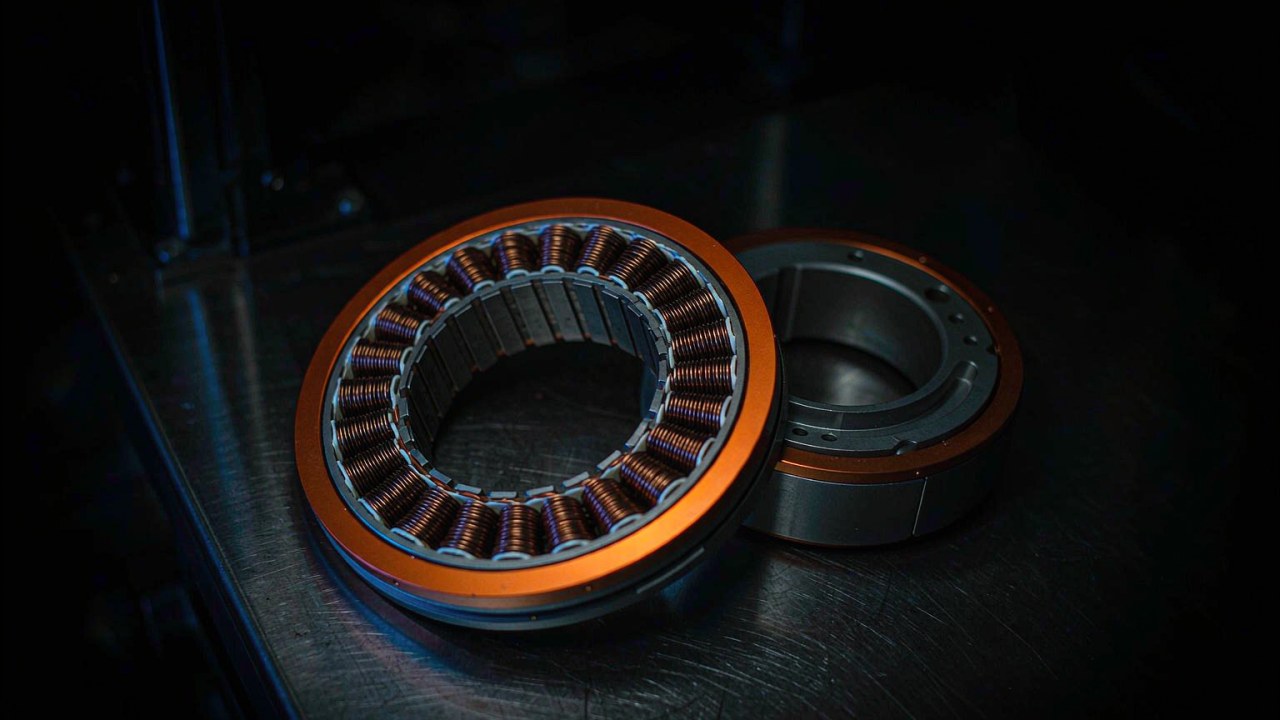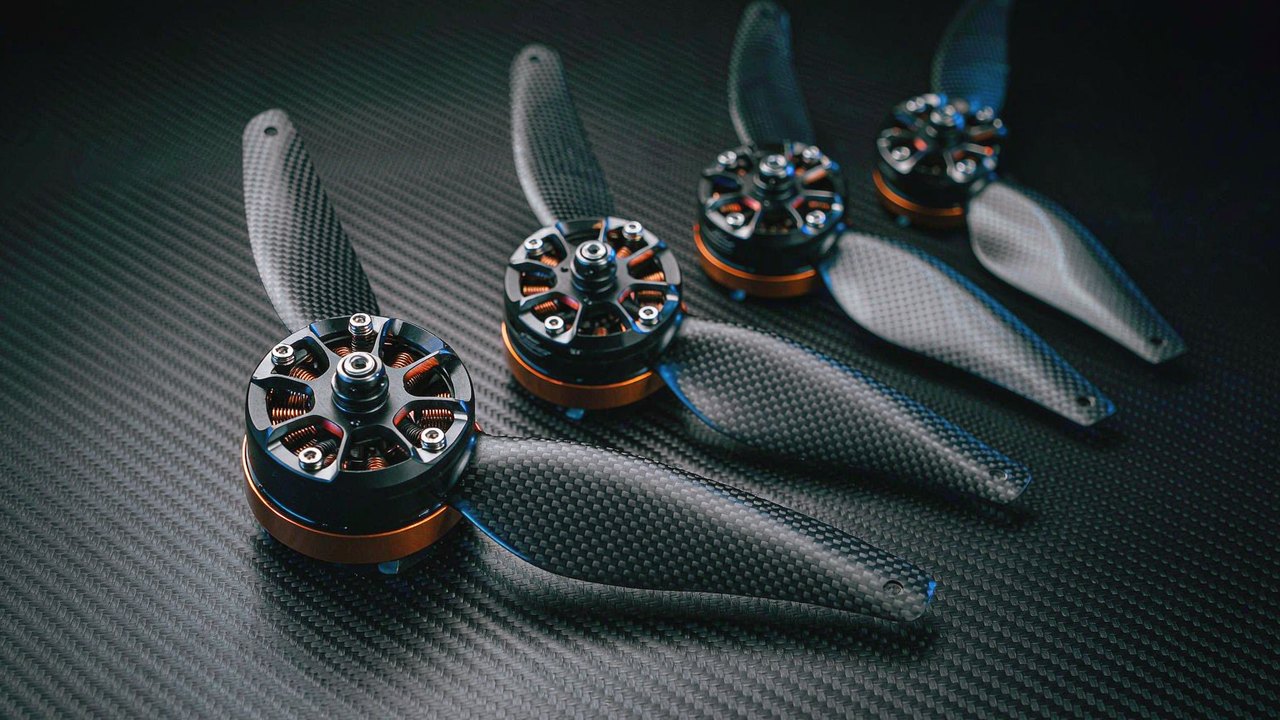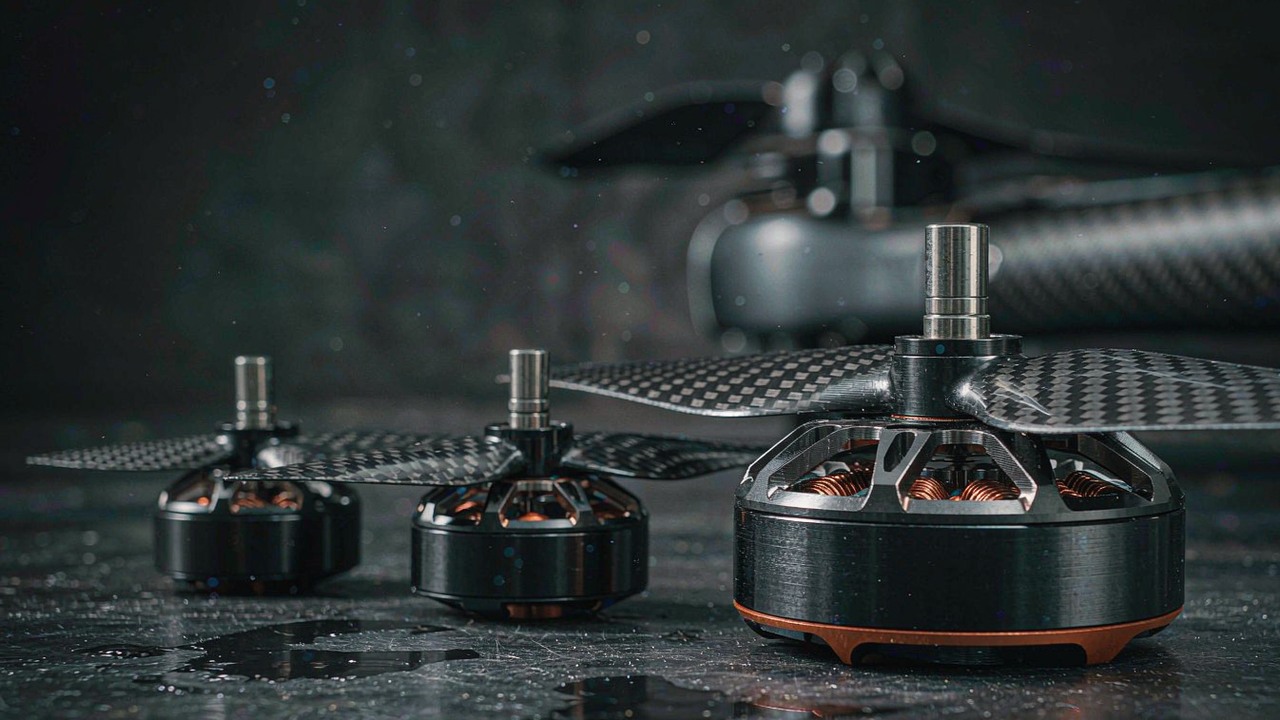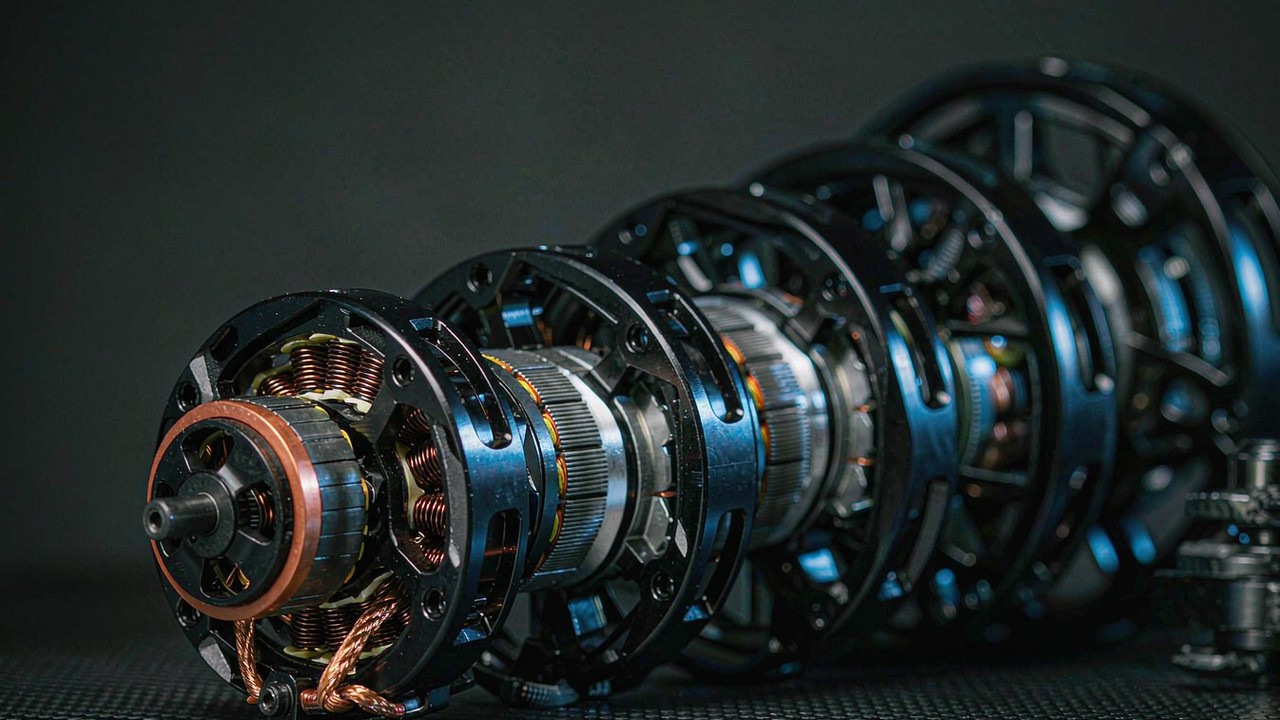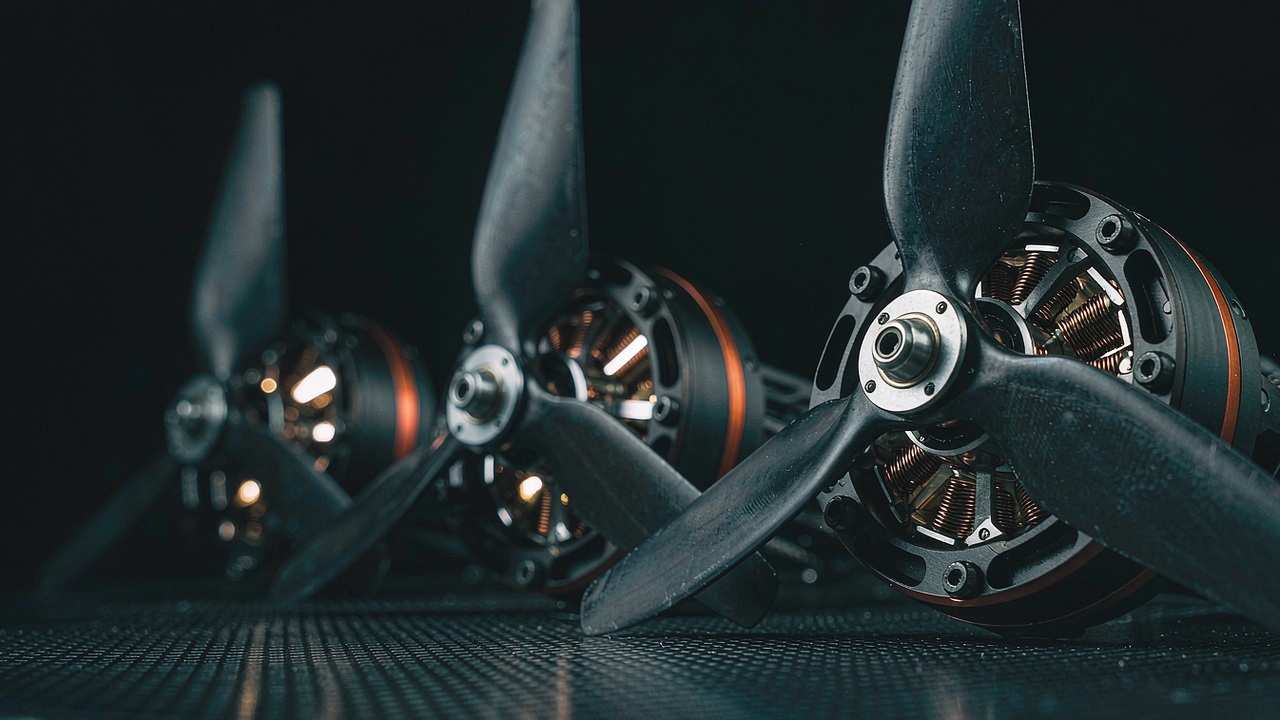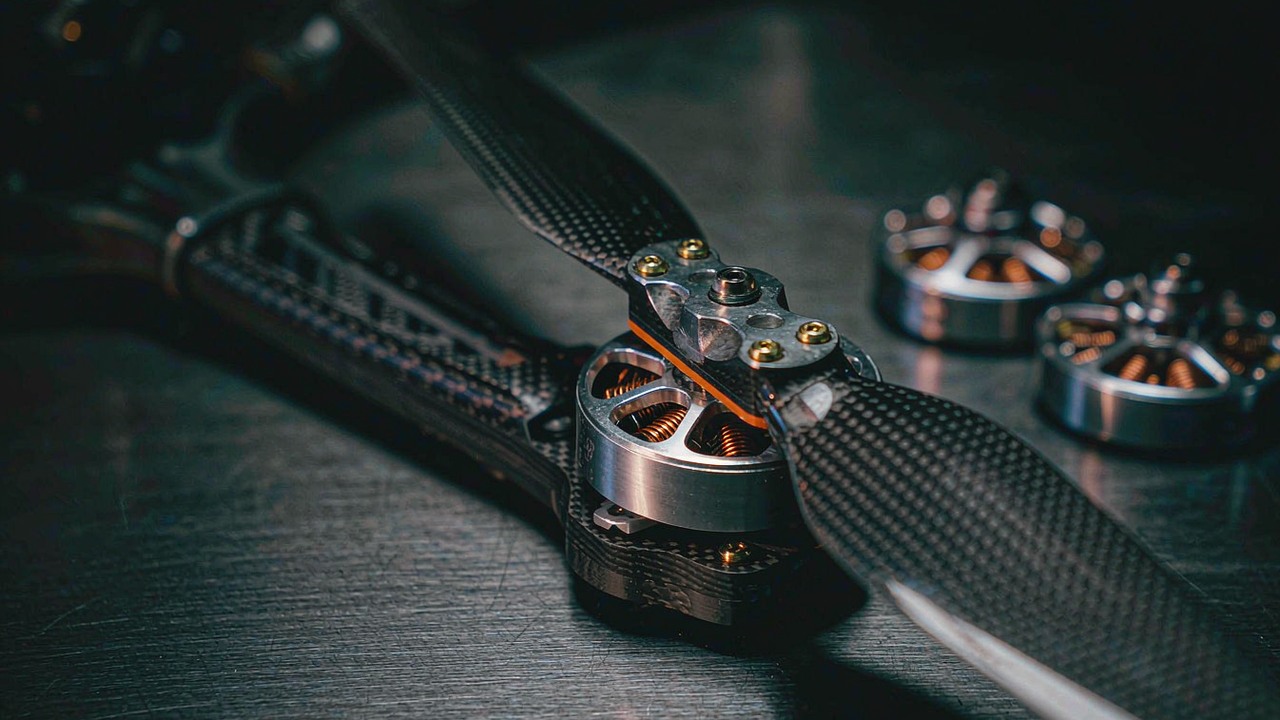
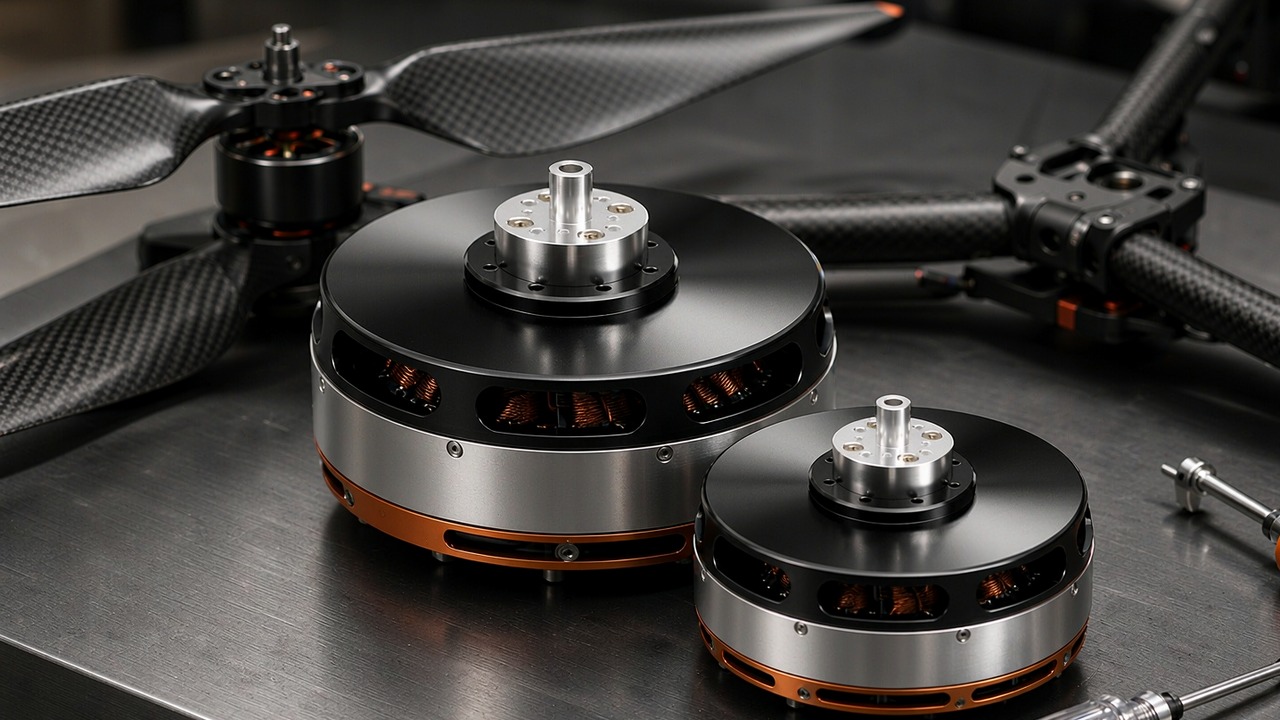
A Heavy Lift Drone is sized backwards from the payload, not forwards from the motor. All-up weight sets how much thrust the propulsion system has to make, the rotor count divides that thrust between arms, and the duty the aircraft actually flies decides how much of the motor's rating is left for control transients. Choosing one therefore starts with two numbers that have nothing to do with KV: the mass being lifted, and the mass of the motors doing the lifting. This guide works through three T-Motor outrunners that span 2.85 kg to 101.4 kg of recorded maximum thrust and 195 g to 5130 g of motor mass, and explains which specification settles the choice in each payload class.
The three units below share one architecture - a large-stator brushless outrunner driven by an external electronic speed controller - and they sit in a single ToBMS category, UAV Motors. What separates them is thrust class, stator geometry, bus window and envelope, and those differences map onto small cargo multirotors, industrial heavy lift and manned-class platforms. Every figure here comes from the ToBMS product records or the manufacturer's published specification; the unit conversions and the ratios derived from them are labelled as derived where they appear, and where a value is not recorded it is marked as missing rather than filled in.
Quick answer
The choice follows payload class and rotor count, not a ranking. For an airframe carrying a few kilograms of camera or sensor payload on six or eight arms, the U5 KV400 is the smallest of the three at 195 g with 2850 g of recorded maximum thrust and a 3-8S window, which suits modest pack sizes and short arms. For freight, spraying and general industrial heavy lift, the U15 II KV80 is the unit most heavy-lift programs converge on: 36500 g of recorded maximum thrust and 8580 W for 180 s in a 1740 g package on a 12-24S bus.
Where the payload moves into tens of kilograms per arm or the platform is manned, the U15XXL KV29 is the recorded match: 101449 g of thrust, 210 A peak current and a 5130 g mass. At that size the motor stops being a component and becomes a structural item, so the airframe, the arms and the landing gear are usually designed around the mounting rather than the other way round.
The single most useful check before any of this is whether the recorded thrust figure is being read as a continuous number. None of these records carries a hover-rated thrust value, and the power figures that are published are stated over a 180 s window. A propulsion budget that spends the whole margin on the motors has no headroom left for attitude control, gust response or a single rotor out.
What makes a motor a heavy-lift drone motor
Nothing about the construction changes at the heavy end. What changes is which part of the specification becomes the binding constraint. On a small airframe the limiting factor is usually the pack and the wiring; on a heavy-lift platform it is thermal duty and motor mass, and both of those scale with the payload rather than with the motor.
The thrust budget is a whole-aircraft number
Recorded maximum thrust belongs to a single motor on the manufacturer's test stand at a stated voltage, propeller and throttle. The aircraft only ever sees the sum over its arms, and multirotor practice budgets that sum at a multiple of all-up weight so that attitude control still has authority when one rotor has to be commanded hard or drops out entirely. Six arms on the U15 II, for instance, would total 219 kg if every motor were run to its recorded maximum - a derived figure, and one that no design can actually use, because control margin, thermal duty and pack sag all take a share of it. The practical reading is that the motor count and the payload, not the motor's headline number, decide how much of the recorded thrust is available to lift anything.
Every gram of motor is also payload the aircraft did not want
Motor mass compounds in a way that is easy to miss. Eight U15 II units weigh 13920 g, and eight U15XXL units weigh 41040 g before a single battery, arm or flight controller is added - both derived from the recorded masses. Moving up a thrust class therefore buys thrust and costs thrust at the same time, which is why the ratio of maximum thrust to the motor's own mass is a more useful first filter than thrust alone. On the recorded figures the three units come out at about 14.6, 21.0 and 19.8 times their own mass respectively - derived values, and a reminder that the mid-sized unit is not automatically the compromise.
The 180 s number is a duty window, not a continuous rating
Where a ToBMS record states a maximum power, it states it for 180 s, and the U5 record goes further by giving its 30 A figure the same 180 s window. That framing matters in a heavy-lift context because the mission profile is not a single burst: a cargo multirotor holds altitude for minutes, and the hover point draws current the whole time. A 180 s window is a useful check on whether the hover current sits comfortably inside the thermal envelope, but it is not the number to size a continuous climb against. Where a design spends most of its flight near the recorded maximum, the manufacturer's thermal test data, not the headline power figure, is the document that decides the answer.
Bus voltage follows the pack, not the motor
At a given power, raising the bus lowers the current, and lower current means thinner cable, smaller connector losses and less copper loss inside the winding. That is the whole argument for the cell counts the larger U-series motors are rated at (12-24S on the U15 II, 24S on the U15XXL), and it is why heavy-lift platforms tend to run high cell counts even when a lower voltage would produce the same thrust. The trade is on the other side of the ledger: more cells means more series elements to monitor, a larger and heavier pack, and a higher-voltage ESC with its own derating. On this article's three motors the record is not uniform - the U5 carries a 3-8S window, the U15 II carries 12-24S, and the U15XXL carries a 24S rating for its LiPo supply. Sizing a pack against the cell range rather than against a single voltage figure is the safer reading in every case.
Propeller choice sets the operating point as firmly as the motor does
KV describes how fast the motor turns per volt with no load; the propeller decides how much of that speed survives under load. Heavy-lift airframes use large, slow-turning propellers for efficiency, and large propellers want low KV. That is why the three units here step from 400 to 80 to 29 KV as their thrust class rises, and why the manufacturer's own pairing guidance matters more than a KV comparison across sizes. The U5 is published with 14 to 16 inch propellers on a 6S recommendation, while the U15 II is matched to a 40 inch class propeller and an HV controller. Reading the recorded 8580 W of the U15 II as a motor property, without the propeller that produced it, is the most common way a thrust budget goes wrong.
The numbers that decide the pick
Six values carry almost all of the decision. Most of them are published for all three motors, and the rest are only partly published, which is worth knowing before a shortlist is drawn.
Thrust per motor, and how many motors share it
The recorded maxima are 2850 g, 36500 g and 101449 g. What makes them comparable is the number of arms under them: 2.85 kg on a hexacopter's 6 kg all-up weight is a very different proposition from 2.85 kg on a 25 kg platform. The figure to carry into a comparison is therefore thrust per unit of all-up weight, with the rotor count fixed first. This is also the point at which the heavy-lift drone application page is worth opening alongside the numbers, because the payload classes it groups are exactly the rotor-count and thrust band decisions being made here.
Mass, and what it costs the airframe
Motor mass is a fixed deduction from the payload budget, and it is paid on every flight regardless of what the mission is. Between the U5 at 195 g and the U15XXL at 5130 g there is a factor of about 26 in mass and a factor of about 36 in thrust - an exchange rate that improves slightly as the size rises. In practice the decision is driven by the smallest motor that carries the required thrust with margin, because the mass saved can go into pack capacity instead, which buys flight time rather than thrust.
KV against propeller and bus
Nothing about KV is a quality statement. KV is a match statement: it says which cell count and which propeller diameter will land the motor at a sensible operating point at hover. A 400 KV motor on a 6S pack turns a 15 inch propeller comfortably; the same motor on a 12S pack would need a much smaller propeller, and a 29 KV motor on a 6S pack would never reach a useful hover point at all. Where a comparison puts three different KV ratings side by side, the KV difference is the arithmetic of the propeller and pack difference, not an indication of capability.
Stator configuration and thermal mass
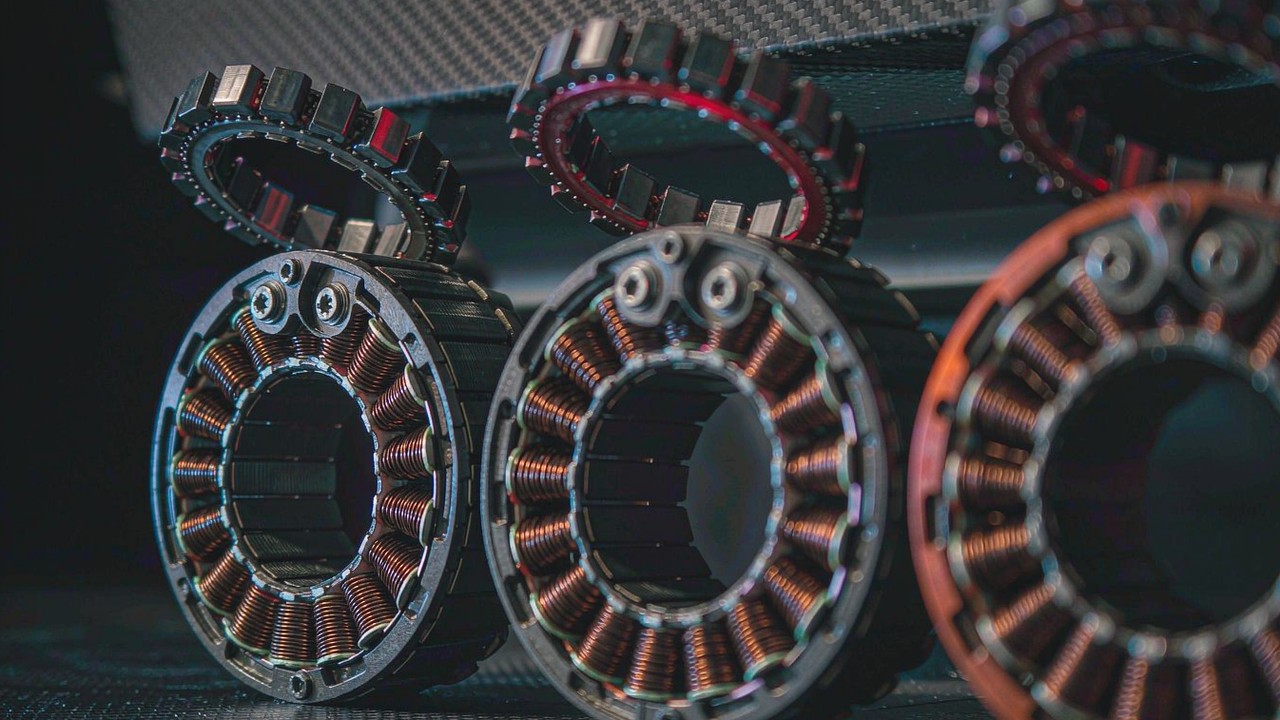
The U5 uses a 12N14P stator, while the two larger units both use 36N42P. More slots and poles generally mean smoother torque and a lower cogging contribution at low speed, and the larger stator carries more copper, which is why the internal resistance falls from 116 mΩ on the U5 to 20 mΩ on the U15XXL and 17 mΩ on the U15 II. Resistance is where the heavy-lift arithmetic gets uncomfortable: at the U15XXL's recorded 210 A peak current its 20 mΩ winding dissipates roughly 880 W as copper loss, and the U5 at its recorded 30 A figure dissipates about 104 W - both our estimate from the recorded values, uncorrected for temperature. Those losses are heat inside a motor that is already being asked to hold altitude, so the resistance and current columns belong in the same conversation as the thrust column.
Continuous current against the 180 s window
Only part of this picture is recorded. The U5 publishes 30 A for a 180 s window and a 0.3 A idle current at 10 V; the U15XXL publishes 210 A peak and a 3.3 A idle current at 10 V; for the U15 II both current figures sit with the manufacturer's datasheet. Reading the difference between a peak and a continuous figure is the whole point of the comparison: a peak current says what the winding can survive briefly, a continuous figure says what the motor can hold while the aircraft hovers, and the gap between the two is the control margin the flight controller gets to work with.
Envelope, shaft and cable
The mechanical column looks trivial until the motor mass passes a kilogram. The three units measure Ø42.5 × 37.5 mm, Ø147.5 × 55 mm and Ø151.5 × 106 mm, with 5 mm, 20 mm and 25 mm shafts and cable lengths of 600 mm, 100 mm and 200 mm respectively. On the U15XXL the arm has to carry 5130 g of rotating assembly plus thrust loads, and the 25 mm shaft and 200 mm lead set where the mount and the routing can sit. Cable length is not a detail either: a 600 mm lead on the U5 reaches across a small airframe, while the U15 II's 100 mm lead assumes an ESC mounted immediately at the arm root.
Three heavy-lift drone motors compared
The table below collects the three units in ascending thrust order. Every value is as published in each ToBMS product record.
| Model | Stator | Maximum Thrust | Max Power 180 s | Weight | Envelope |
|---|---|---|---|---|---|
| U5 KV400 | 12N14P | 2.85 kg | 850 W | 195 g | Ø42.5 × 37.5 mm |
| U15 II KV80 | 36N42P | 36.5 kg | 8580 W | 1740 g | Ø147.5 × 55 mm |
| U15XXL KV29 | 36N42P | 101.4 kg | Not listed | 5130 g | Ø151.5 × 106 mm |
All three motors are listed in the ToBMS UAV Motors category. Thrust, mass and envelope values are taken from each product record, where thrust is stored in grams and converted to kilograms here; those conversions are derived. No maximum power figure is recorded for the U15XXL, so none is quoted - the manufacturer's datasheet is the place to close that gap where a continuous power budget depends on it. The U15XXL record also carries a 24S LiPo rating, which is the bus to size a pack against for that unit. Current figures are not available uniformly across the three: the U5 and U15XXL records publish them and the U15 II figures sit with the manufacturer's datasheet, so no current column is shown.
The first pattern is that thrust and mass do not move at the same rate. Going from the U5 to the U15 II multiplies thrust by roughly 13 while multiplying mass by roughly 9, and going from the U15 II to the U15XXL multiplies thrust by roughly 2.8 while multiplying mass by roughly 2.9. The exchange rate improves sharply at the first step and then flattens, which is why the middle of a range - not the top - is usually where a payload class settles.
The second pattern is that the two larger motors are separated by architecture rather than by size. They share a 36N42P stator and land within a few millimetres of each other in diameter, at 147.5 mm and 151.5 mm, yet they differ by a factor of roughly three in mass and roughly 2.8 in thrust, because the U15XXL is nearly twice as long and carries a 25 mm shaft against 20 mm. A comparison that reads only the diameter column would conclude the two are nearly the same motor; the length, mass and current columns say otherwise.
The third pattern is the one that decides most projects: the mass penalty per unit of thrust is lowest in the middle of the range. On recorded figures the U15 II returns about 21 g of thrust for every gram of its own mass, against about 19.8 for the U15XXL and about 14.6 for the U5 - all three derived. Where a payload can be spread across more arms, that middle ground is where a heavy-lift airframe gets the highest return, and the U15XXL only becomes the rational choice once the payload per arm passes what the smaller unit can lift with margin.
Three payload classes, three motors
The recorded numbers only become a decision once they are read against a class of aircraft. Each of the three units below is a reasonable fit for one payload band and a poor fit for the band above it.
U5 KV400 - small payloads on modest pack sizes
At 195 g with 2850 g of recorded maximum thrust, a 3-8S window, 12N14P stator and 116 mΩ of winding resistance, this is a light-airframe motor that still appears in heavy-lift conversations because multirotors carrying a few kilograms of sensor or delivery payload on six to eight arms land squarely in its band. Its published pairing is 14 to 16 inch propellers on a 6S recommendation, which keeps the airframe compact and the pack small. The 30 A recorded for a 180 s window and 850 W of maximum power for the same window mean the hover point of a lightweight cargo aircraft sits well inside the rating, and the 600 mm cable is long enough to reach an ESC mounted inboard. Where a design starts adding arms or payload beyond a few kilograms, this is the unit that runs out of margin first.
U15 II KV80 - the industrial heavy-lift workhorse
The U15 II KV80 is the unit most heavy-lift programs end up specifying. It records 36500 g of maximum thrust and 8580 W for 180 s in a 1740 g package measuring Ø147.5 × 55 mm, with a 36N42P stator, 17 mΩ of internal resistance and a 12-24S bus window. That bus window is what makes it practical: a high cell count keeps the current for a given power low, which keeps cable and connector losses manageable on an airframe where every arm already carries its share of the payload.
Its mass sits at the useful point in the range. At about 21 g of thrust per gram of motor mass - a derived figure - it returns more thrust for its own weight than either of the other two, and it is small enough that eight of them still leave room in the mass budget for a serious pack. The 17 mΩ winding keeps copper loss moderate relative to its thrust class, and the 100 mm cable length assumes the ESC is mounted at the arm root, which is where heavy-lift builders put it anyway to keep the high-current path short.
What the record does not publish is a current figure, so the ratio between what the motor can hold while hovering and what it can survive in a transient cannot be read off the ToBMS entry for this unit. That is the first question to put to the manufacturer when a propulsion budget depends on hover current over a long flight.
U15XXL KV29 - manned-class and per-arm payloads
The U15XXL KV29 records 101449 g of maximum thrust and 210 A of peak current in a 5130 g motor measuring Ø151.5 × 106 mm. The manufacturer positions this unit for manned aircraft propulsion and for heavy-lift platforms in the 100 kg thrust class, which is a different engineering problem from the unit below it: at 5130 g per motor, the mounting, the arm structure and the rotor loads have to be designed around the motor rather than adapted to it.
Two recorded values set the integration envelope. The 20 mΩ winding resistance means about 880 W of copper loss at the recorded 210 A peak - our estimate from the recorded values, uncorrected for temperature, and a reminder that peak current is a transient state rather than a place to cruise. The 25 mm shaft and 200 mm lead length fix where the mount and the power routing can sit, and both are larger than on the U15 II, which is consistent with the much greater thrust the unit produces. A 36N42P stator, 29 KV and a 3.3 A idle current at 10 V complete the picture.
The record here carries a 24S LiPo rating, so a pack can be sized from the ToBMS entry directly: the manufacturer's specification table lists the same 24S rating for this unit. This is also the unit where a maximum power figure is absent, so any continuous power budget has to come from the datasheet rather than from the comparison above.
Where these motors get used
The three units sit in one ToBMS category but in three different kinds of aircraft. Recognising which kind is being designed settles the choice faster than any specification comparison, because the payload class fixes the thrust per arm and the rotor count fixes everything downstream of it. The band a Heavy Lift Drone is being chosen for decides the rest of the list.
Freight, delivery and cargo multirotors
This is the main heavy-lift band and the one the U15 II serves. The characteristic mission carries a few kilograms to tens of kilograms of cargo, flies for minutes rather than hours, and is judged on whether it can complete the route with margin. Motor mass matters here because every kilogram of propulsion is a kilogram not available to the package or the pack. Designs in this band typically sit on six to eight arms to keep the single-rotor-out case flyable.
Manned and passenger-class platforms
Where the payload becomes a person or an equivalent mass, the U15XXL's 101.4 kg of recorded thrust and 210 A peak current place it in the propulsion conversation, and the manufacturer's own positioning of the unit is for manned aircraft rather than uncrewed cargo. The engineering emphasis shifts: redundancy, mounting stiffness and thermal margin dominate, and the propulsion system is generally sized against a continuous climb case rather than a hover point. Regulatory and airworthiness requirements sit outside anything a product record can express, and those are the conversations that decide whether a platform proceeds, not the thrust figure.
Industrial inspection and long-endurance airframes
Not every heavy-lift airframe lifts heavy payloads. Some carry modest sensors for a long time, which pushes thrust requirements down and efficiency requirements up, and that is where the U5's 850 W maximum power and 3-8S window make sense. The related industrial UAV and long-endurance UAV groupings collect the motors recorded against those briefs, and they overlap with heavy lift at the small end rather than at the large end.
VTOL, agricultural and mixed fleets
Two further bands sit adjacent to heavy lift and often share motors with it. Agricultural airframes carry a heavy, changing payload - a full tank - and therefore hover at their heaviest point in the mission, which is a severe duty case; the agricultural UAV page gathers the recorded matches. VTOL platforms use part of their propulsion for vertical lift and part for cruise, so the lift motors see heavy thrust at low speed and the cruise motor sees the opposite, and the VTOL drone grouping covers that split. For platforms where the lift system is sized for a person rather than a package, the manned aircraft propulsion group is the closest match to the U15XXL's stated brief.
Selection checklist
Three checks cover most of the ground, and they are best done in order, because each one narrows the field for the next.
Duty and payload
Start from the all-up weight, not the payload figure. Add the pack, the airframe, the avionics and the motors themselves, because on a heavy-lift design the propulsion mass is a meaningful part of the total. Then fix the rotor count, check that the recorded maximum thrust per motor covers the weight with margin for control authority, and confirm that the hover point sits comfortably inside the 180 s window rather than at its edge. Where the mission holds altitude for minutes, question whether any continuous power figure is published at all.
Mechanics and envelope
Check the motor's diameter, length, shaft and mass against the arm it has to sit on. Past a kilogram of motor mass the mount becomes a structural design exercise, and the shaft diameter and lead length determine how the assembly can be built. Confirm the cable reaches the ESC without an extension joint on a high-current path, and confirm the propeller diameter that the KV and bus imply actually fits the airframe's geometry.
Power and control
Size the pack against the cell range, not against a single voltage, and check the ESC's current rating against the peak figure with the propeller that will be used. Cross-check the winding resistance against the current the design expects to draw, because the losses become heat in a motor that is already holding an aircraft up. Where the record is silent on currents, idle current or continuous power, treat those as open items to close with the manufacturer rather than as values to assume.
- Total the all-up weight including motors and pack, then divide by the number of rotors to get thrust per arm at the control margin the design needs.
- Pick the smallest motor whose recorded maximum thrust covers that figure with margin, since the mass saved can be spent on pack capacity instead.
- Fix the bus from the pack decision, then check that the chosen KV and propeller land at a sensible hover point on that bus.
- Verify the hover current sits well inside the 180 s window and that a continuous figure exists where the mission needs one.
- Multiply winding resistance by the square of the expected hover current to estimate copper loss before committing to the thermal design.
- Check shaft diameter, mounting pattern, envelope and cable length against the arm and the ESC location.
- Confirm the propeller diameter implied by KV and bus fits the airframe, and that the ESC is rated for the recorded peak current.
- Record every value that came from a datasheet rather than from a product record, so the propulsion budget can be re-checked when a field is filled in.
Frequently asked questions
QWhat separates a heavy-lift drone motor from an ordinary UAV motor?
The construction is the same; the binding constraint moves. On a small airframe the limits usually come from the pack and the wiring, while on a heavy-lift platform thermal duty and motor mass dominate, and both scale with the payload rather than with the motor. That is why the heavier end of a range is characterised by large stators, low KV, high cell counts and long leads, and why the ratio of thrust to the motor's own mass becomes a more useful filter than the thrust figure itself.
QHow much thrust per motor is needed for a given payload?
Work from all-up weight rather than payload, which is the sequence a Heavy Lift Drone comparison runs on: add the airframe, the pack, the avionics and the motors, then divide by the rotor count. Multirotor practice budgets the total at a multiple of all-up weight so that attitude control keeps authority when one rotor is commanded hard or lost, which means the recorded maximum thrust per motor is a ceiling rather than a working point. None of the records in this article publishes a hover-rated thrust figure, so the hover point has to be confirmed from the manufacturer's test data at the intended voltage, propeller and throttle.
QIs the 8580 W figure on the U15 II KV80 a continuous rating?
No. It is recorded as a maximum power for 180 s, which is a duty window rather than a continuous thermal rating. The same convention appears on the U5, whose 30 A figure is also recorded for a 180 s window. A 180 s number is a useful check on whether the hover current sits inside the envelope, but a mission that holds altitude for minutes needs a continuous figure as well, and where a record does not publish one the datasheet is the place to look.
QWhy does motor mass matter so much on a heavy-lift airframe?
Because it is paid on every flight and it multiplies with the rotor count. Eight U15 II units weigh 13920 g and eight U15XXL units weigh 41040 g, both derived from the recorded masses, before a battery or an arm is added. Moving up a thrust class therefore buys thrust and consumes thrust at once. On the recorded figures the U15 II returns roughly 21 g of thrust per gram of its own mass, against roughly 19.8 for the U15XXL and roughly 14.6 for the U5, all three derived - which is why the middle of a range often turns out to be the efficient choice.
QCan a smaller motor such as the U5 KV400 be used on a heavy-lift platform?
Yes, within its band. At 195 g with 2850 g of recorded maximum thrust, a 3-8S window and 850 W of maximum power for 180 s, it suits airframes carrying a few kilograms of sensor or delivery payload on six to eight arms, and its published pairing with 14 to 16 inch propellers keeps the airframe compact. It becomes the wrong choice as soon as arm count or payload pushes the required thrust per arm past its recorded maximum with margin, because the remaining margin is what the flight controller uses for control.
QWhat bus voltage should a heavy-lift platform use?
The one the pack can supply with the current the motors need at a manageable copper loss. Raising the cell count lowers current for a given power, which cuts wiring and winding losses, and it is why the larger units in this comparison carry high cell counts - 12-24S on the U15 II and 24S on the U15XXL - while the U5 records 3-8S. The cost is on the pack and controller side: more series elements to manage, more mass, and a higher-voltage ESC with its own derating. Note that the U15XXL record carries a 24S LiPo rating, so the cell range is available as the basis for sizing a pack.
QHow does KV interact with propeller choice on a heavy-lift motor?
KV sets how fast the motor turns per volt with no load, and the propeller decides how much speed remains under load. Large, slow-turning propellers are what make heavy lift efficient, and they need low KV to reach a sensible hover point on a usable cell count. That is why the three units here step from 400 KV to 80 KV to 29 KV as the thrust class rises, and why the manufacturer's own pairing guidance - 14 to 16 inch propellers with the U5, a 40 inch class propeller with the U15 II - matters more than a KV comparison taken across different sizes.
Official resources
The three motors are published by T-Motor, and the manufacturer's own pages carry the datasheets, test data and matching guidance that the ToBMS records do not reproduce: the U5 KV400, the U15 II KV80 and the U15XXL KV29, with the wider range at the T-Motor official site. Where a ToBMS record is silent - the U15XXL's maximum power, the U15 II's current figures, and any hover-rated thrust value at all - those pages or the corresponding datasheet are the place to close the gap.
Where to go next
To move from reading to a shortlist, three tools work in sequence: every motor in this comparison sits in the UAV Motors category, candidates can be narrowed by thrust class, KV and mass in Select, and chosen units can be set against each other in Compare Products. The application side of the same decision is collected on the BLDC motors for heavy-lift drones page, which groups the recorded matches by payload class.
Three existing guides extend sideways from here. The UAV Motors: Matching KV, Thrust and Mass to Your Airframe works through the same category from the airframe side, covering KV, stator configuration, resistance and thrust across the wider U, Navigator, P and AT ranges, and is the counterpart to this payload-led view. The Drone Motors: FPV, Fixed-Wing and VTOL Motor Selection covers the smaller end of the same family where battery life and response dominate, and the BLDC Motors: A Complete Guide to Brushless DC Motor Types, Specs and Selection places all of these categories - UAV motors, drone motors, gimbal motors, thrusters and actuators - in one frame for anyone starting from the technology rather than from an airframe. The manned-class branch of that same question is compared on its own terms in Manned Aircraft Propulsion Systems: Three T-Motor U15 Motors Compared, where the U15 II, U15XL and U15XXL are set against each other for the loads and duty cycles a crewed platform adds.
The short version: fix the all-up weight and the rotor count first, use them to derive the thrust required per arm with control margin, choose the smallest motor whose recorded maximum thrust covers it, and then let KV, cell count and propeller settle the operating point. On this range that sequence usually lands on the U15 II for industrial heavy lift, the U15XXL once the payload per arm passes what the middle unit can lift with margin, and the U5 where the payload stays in the low single kilograms.