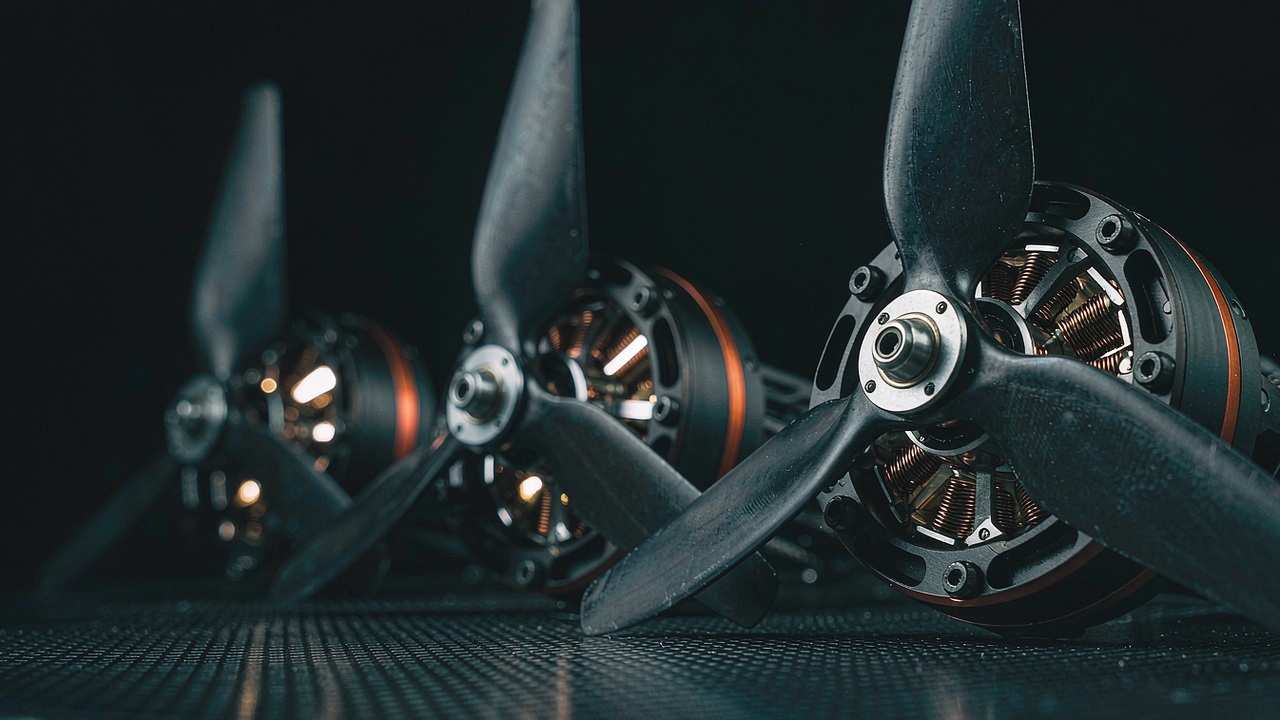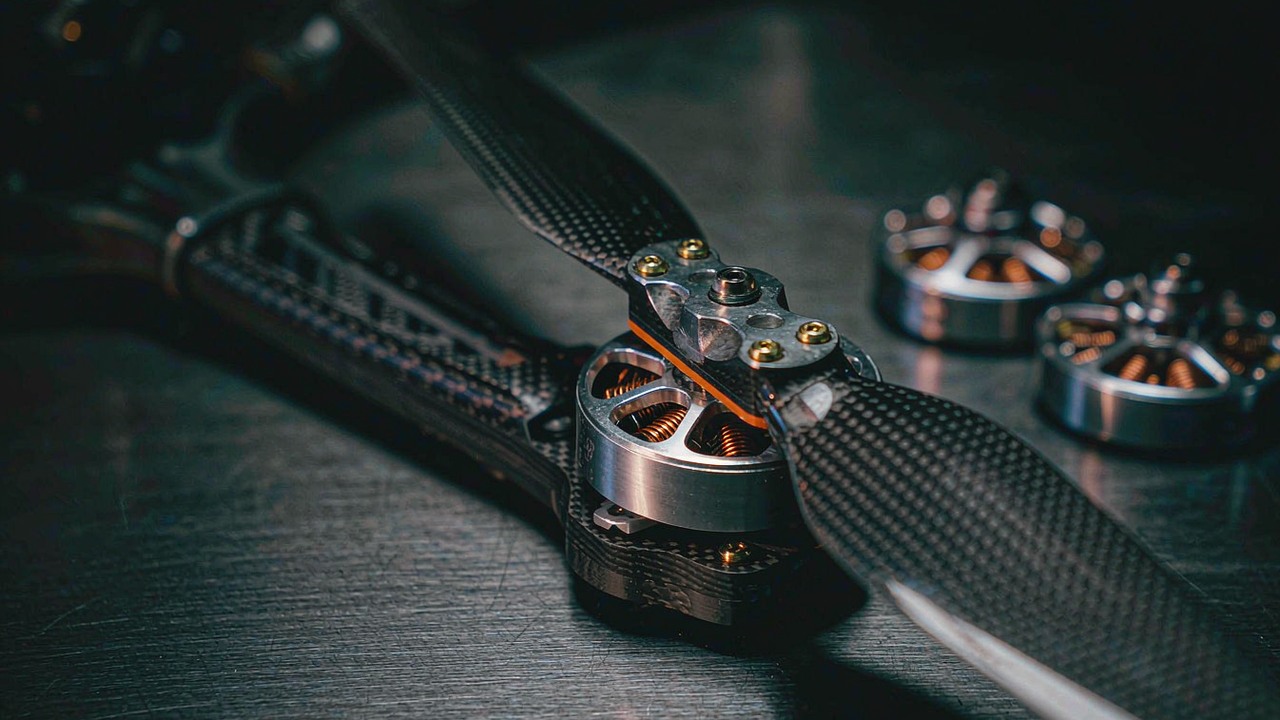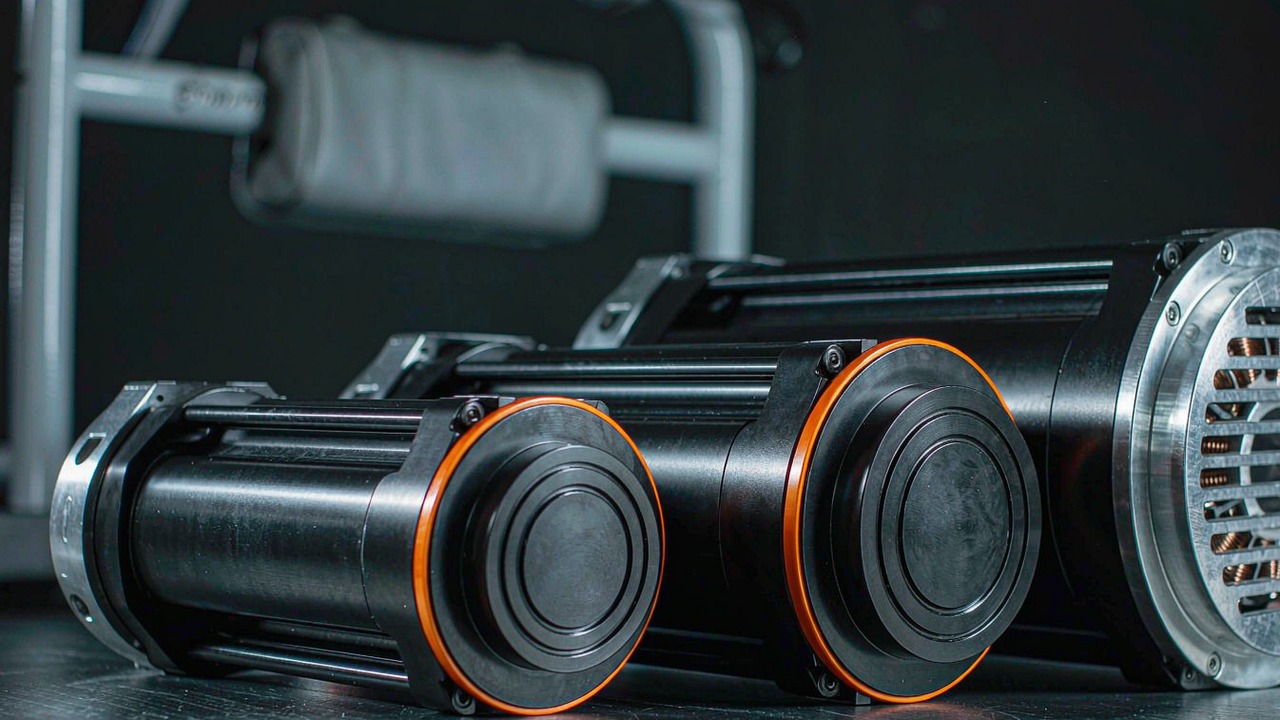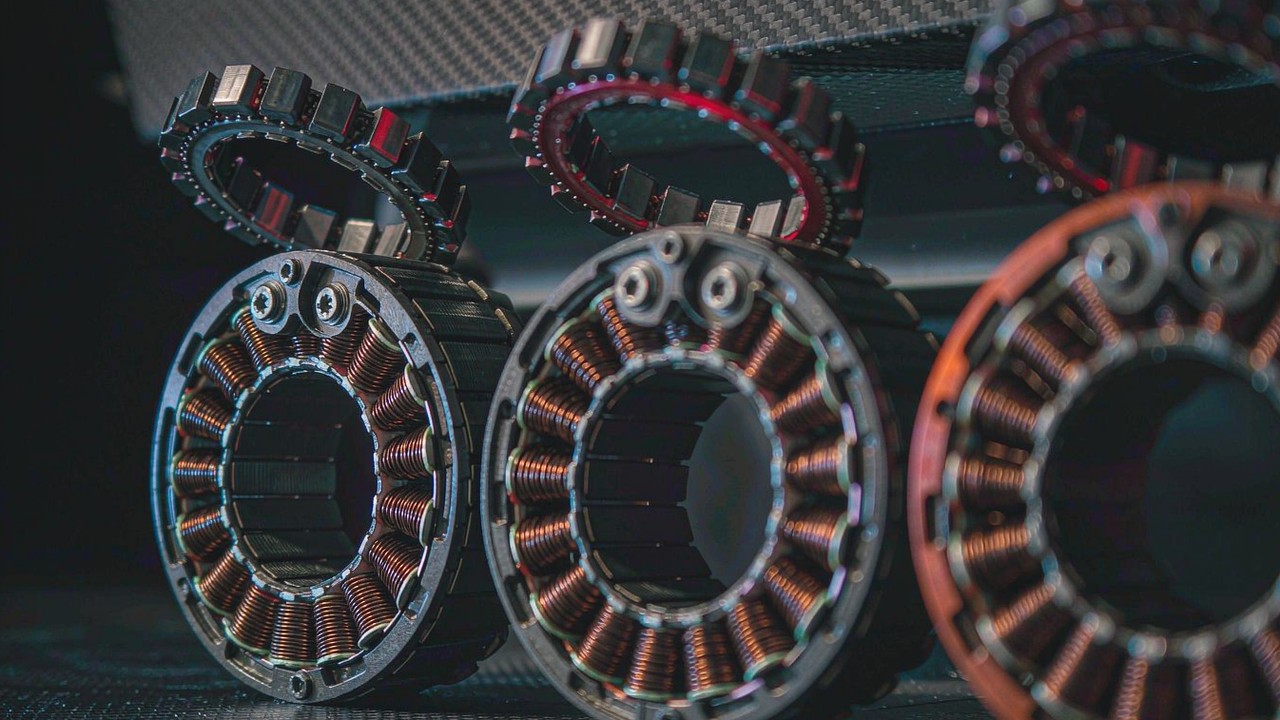
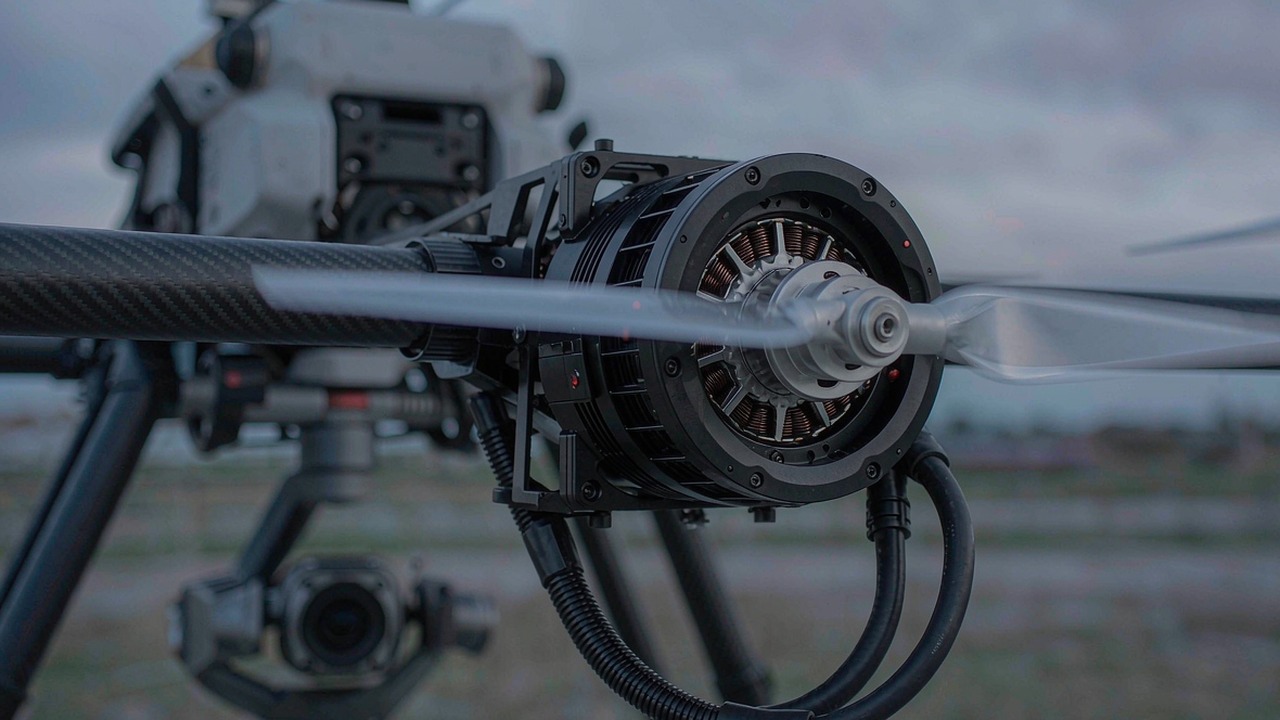
A UAV motor is asked to do one thing well: turn a propeller at the efficiency that keeps the airframe in the air for the duration the mission requires. Everything else in the propulsion system - ESC, propeller pitch, battery pack - is chosen around it, which is why a motor shortlist usually starts from thrust and mass and then narrows on KV, stator configuration and winding resistance.
This guide covers how outrunner propulsion motors are specified, which numbers genuinely change a design decision, and how thirteen of the models currently listed in the ToBMS UAV Motors category compare. Every figure below is taken from ToBMS product data or the manufacturer's published specification - none of it is estimated.
Quick Answer
A UAV propulsion motor is an outer-rotor brushless motor whose KV is matched to the propeller diameter and battery voltage, whose stator configuration and winding resistance set how much current it can turn into thrust without overheating, and whose shaft and mounting pattern decide whether it fits the airframe. Selection usually runs in one direction: fix the propeller and the pack voltage, read off the thrust and current from the manufacturer's test data, then pick the motor whose KV, mass and maximum power match that operating point. Mass matters twice on a multirotor - it is payload that is not available for batteries or sensors.
What actually decides a UAV motor
The datasheet lines below are the ones that change an outcome; the rest are consequences.
KV and the propeller it has to turn
KV is the speed constant - roughly how fast the motor turns per volt applied with no load. It is not a quality figure, and a higher KV is not a better motor. What it does is set the relationship between voltage, propeller load and current draw: a low-KV motor on a high cell count turns a large propeller slowly and efficiently, while a high-KV motor on a low cell count spins a small propeller fast. Matching KV to the airframe usually means choosing the cell count and propeller first and treating KV as the bridge between them.
Stator configuration: 12N14P, 18N24P, 24N28P, 36N42P
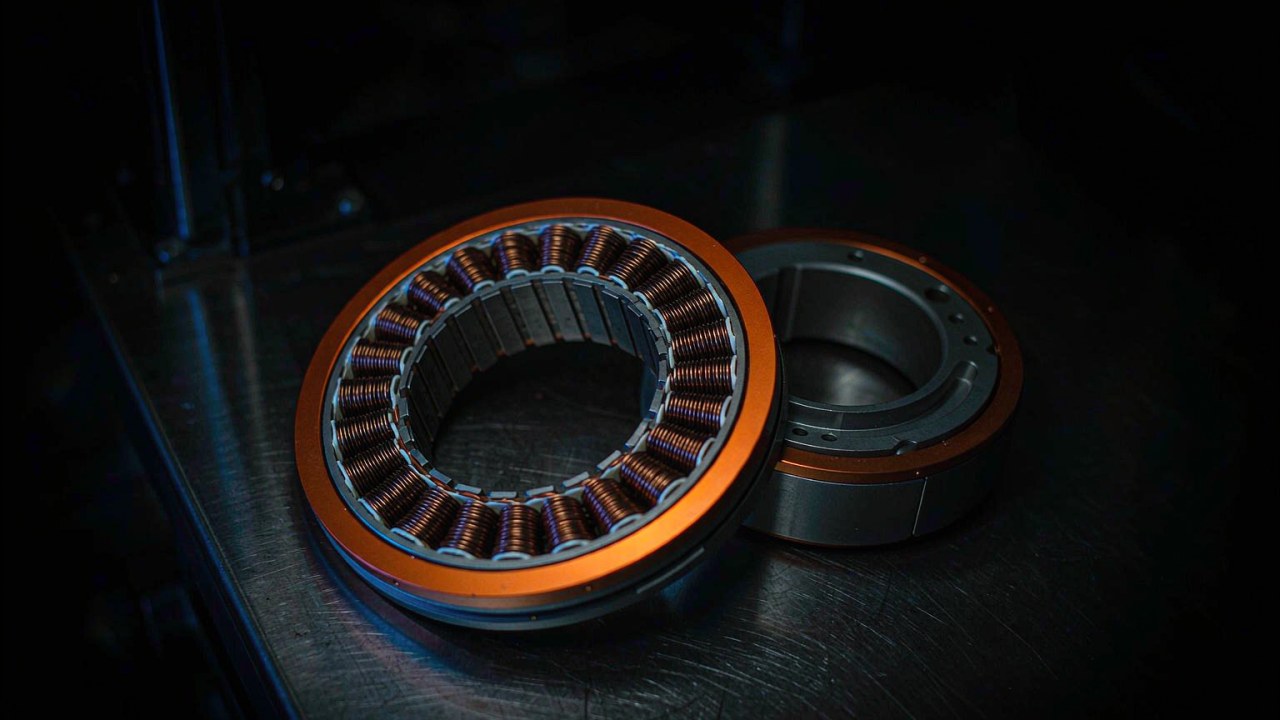
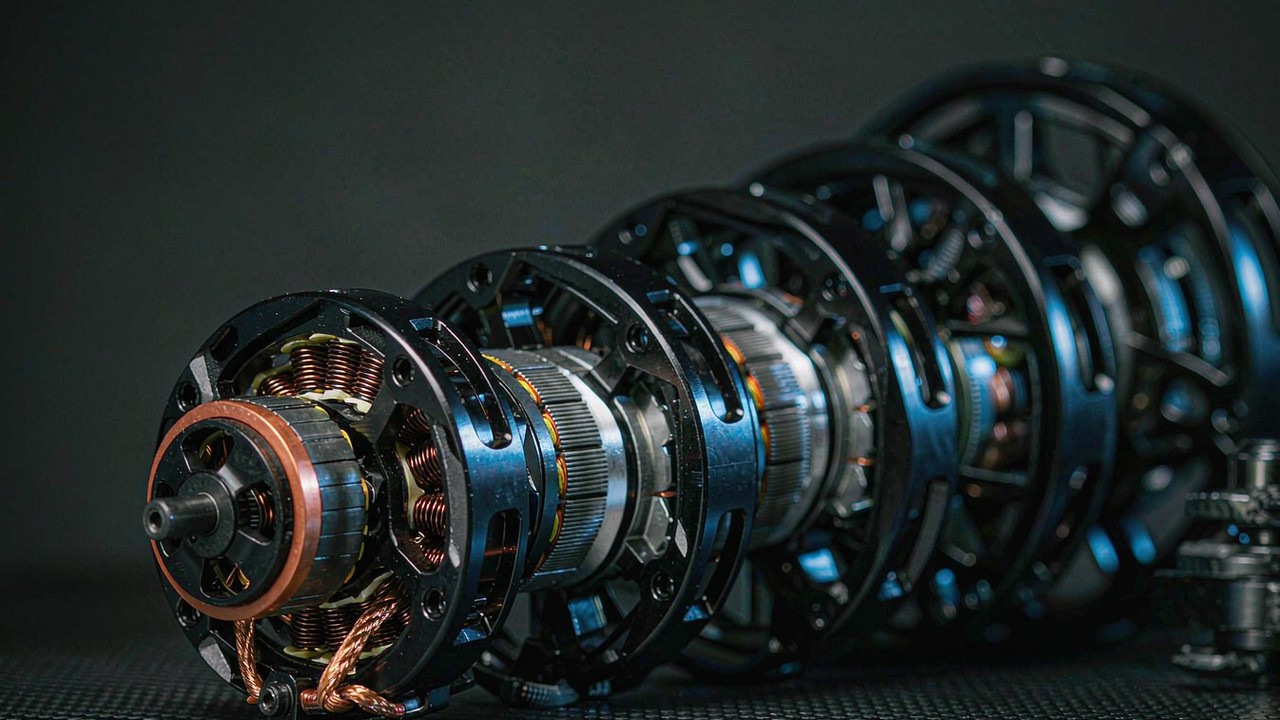
The stator notation describes slots and poles - 12 slots with 14 magnets, 36 with 42. More slots and poles generally mean smoother torque delivery and a lower cogging step for a given rotation, which suits larger, slower propellers and the low-KV end of the range. Higher pole counts also raise the electrical frequency the ESC has to commutate at a given mechanical speed, so the ESC timing and maximum electrical rpm have to be checked whenever a design moves up the pole-count range.
Internal resistance and efficiency
Winding resistance decides how much of the electrical power turns into heat rather than thrust. It is also the figure most sensitive to size: the models here run from 17 mΩ on the U15 II and U15XL to 194 mΩ on the smallest Navigator unit. When two motors of similar mass differ by tens of milliohms, the lower-resistance one generally runs cooler at the same current - which is exactly the margin that decides whether a long-endurance mission is possible on a given pack.
Maximum power and the 180 s window
The maximum power figures in this category are quoted over a 180 second window. That is a short-duration rating, not a continuous one, and it exists because multirotor duty is dominated by hover: the motor spends most of the flight at part throttle and only reaches its limit during climb, wind rejection or a hard recovery. Sizing an airframe on the maximum power figure alone, without checking the current at the actual hover point, is the most common way to end up with a hot motor and a short flight. Where a continuous current figure is published it is listed separately in the comparison below.
Shaft, mounting and cable
Shaft diameter and mounting pattern are the specifications that turn a good motor into an unusable one when they are overlooked. The agricultural and heavy-lift models here use pin or large-bore shaft mounts for high-torque prop adapters; the smaller aerial-photography units use 4 mm shafts with conventional propeller mounts. Cable length and gauge matter on airframes where the ESC sits on the arm rather than at the hub - several models are listed with cable lengths from 80 to 600 mm and with a separate weight without cable, which is the figure worth using when comparing against an airframe mass budget.
Thrust and the operating point
Thrust is not a motor property on its own; it is a property of the motor, propeller and voltage together. That is why the manufacturer's test tables are more useful than any single number on a specification sheet. The overview text on ToBMS records the published thrust where available, and those figures are cited model by model below rather than summarised as a single range.
Thirteen UAV motors compared
The table covers thirteen of the propulsion motors currently listed in the UAV Motors category, ordered from lightest to heaviest. Maximum power is the manufacturer's 180 second figure; internal resistance is the published phase value.
| Model | Stator | Max Power 180 s | Internal Resistance | Shaft Diameter | Weight |
|---|---|---|---|---|---|
| MN4006 KV380 | 18N24P | 380 W | 194 mΩ | Not listed | 68 g |
| MN3110 KV470 | 12N14P | 330 W | 135 mΩ | 4 mm | 98 g |
| MN3510 KV360 | 12N14P | 330 W | 188 mΩ | 4 mm | 117 g |
| U3 KV700 | 12N14P | 500 W | 50 mΩ | Not listed | 128 g |
| MN5008 KV340 | 24N28P | 760 W | 55 mΩ | 6 mm | 135 g |
| MN4014 KV400 | 18N24P | 900 W | 67 mΩ | 4 mm | 171 g |
| U5 KV400 | 12N14P | 850 W | 116 mΩ | 5 mm | 195 g |
| U8 Lite L KV110 | 36N42P | 2140 W | 105 mΩ | 15 mm | 282 g |
| P60 Pin KV170 | 24N28P | 1800 W | 80 mΩ | Not listed | 375 g |
| P80 III Pin KV100 | 36N42P | 2700 W | 45 mΩ | Not listed | 649 g |
| U15 II KV80 | 36N42P | 8580 W | 17 mΩ | 20 mm | 1740 g |
| U15XL KV38 | 36N42P | Not listed | 17 mΩ | 25 mm | 4408 g |
| U15XXL KV29 | 36N42P | Not listed | 20 mΩ | 25 mm | 5130 g |
Stator configuration, 180 second maximum power, internal resistance, shaft diameter and mass as published by the manufacturer. Shaft diameters are marked "Not listed" where the ToBMS record does not carry a value rather than being inferred from a drawing.
Two clusters are visible. Below 300 g the motors are 12N14P to 24N28P aerial-photography and general-purpose units with resistances between 50 and 194 mΩ and mass under 200 g. Above 600 g they are all 36N42P - the same configuration scaled up - with much lower resistance and power figures that climb into the kilowatt range. The step change in stator configuration between the two groups is not a coincidence: it is what allows a large propeller to be turned slowly with acceptable torque ripple.
Peak-to-mass is not the useful ratio here; resistance-to-mass and the published thrust figures are. The U3 KV700, for example, is listed with up to 1.8 kg of thrust at 128 g on 3-4S, while the MN3110 KV470 reaches 1.2 kg at 98 g and the MN3510 KV360 reaches 1.9 kg at 117 g. Reading those three together is what turns a mass budget into a propulsion decision, and none of them can be ranked without the propeller and cell count they were measured with.
Navigator series: MN3110, MN3510, MN4006, MN4014 and MN5008
The Navigator range is the aerial-photography and light industrial end of this category, and it is the group with the most published thrust data on ToBMS.
MN3110 KV470 and MN3510 KV360
The MN3110 KV470 is a 98 g, 12N14P motor listed with up to 1.2 kg of thrust and 330 W maximum power on 3-6S, a 4 mm shaft and 600 mm of cable - with a separate 80 g figure excluding cable, which is the number to use in a mass budget. The MN3510 KV360 moves to 117 g and 330 W with a higher published thrust of 1.9 kg on 3-6S. The pair illustrates why KV cannot be compared across propellers: the lower-KV, larger-diameter motor carries the heavier airframe.
T-Motor's own release footage covering the MN3110, MN3510, MN4006, MN4014 and MN5008 - the five Navigator models in this category. It is the shortest way to see the physical difference between a 68 g aerial-photography motor and a 171 g unit of the same family.
ToBMS video pageWatch on YouTubeMN4006 KV380, MN4014 KV400 and MN5008 KV340
The MN4006 KV380 is the lightest motor in this category at 68 g, with 380 W maximum power and 16 A peak current on 4-6S. Its shaft diameter should be checked against the manufacturer's drawing before a propeller adapter is ordered, since a single misread dimension can stall a build. The MN4014 KV400 is the middle of the family at 171 g, 900 W and up to 3.3 kg of thrust on 4-8S, while the MN5008 KV340 uses a 24N28P stator and a 6 mm shaft, with 760 W and 35 A peak current on 6S. The 24N28P configuration in an airframe that will mostly hover is a deliberate choice: more poles generally mean smoother torque and lower cogging at the low speeds where the motor spends its flight.
U series: U3 KV700 and U5 KV400
The U-series motors are the general-purpose multirotor units, and both are 12N14P designs.
U3 KV700: light airframes, high KV
The U3 KV700 is a 128 g motor listed with up to 1.8 kg of thrust and 500 W maximum power on 3-4S, with a 25 A continuous current figure and 600 mm of cable. Its ToBMS overview describes a 12N14P stator with efficient cooling, aimed at industrial and agricultural airframes - although at this KV and mass it is really a small-to-mid multirotor unit, and the continuous current figure is the one to size against, since 500 W is a 180 second rating.
U5 KV400: wider voltage window
The U5 KV400 is the more flexible of the two: 195 g with 850 W maximum power, rated across 3-8S, a 5 mm shaft and 116 mΩ of internal resistance. The 30 A continuous figure and the 3-8S window make it a candidate for airframes that will be flown on more than one pack configuration - a common requirement when a prototype is first flown on a small battery and then moved to its production pack.
Heavy-lift and manned-class: U8 Lite L, U15 II, U15XL and U15XXL
Above 280 g the category changes character: these are 36N42P motors built for high thrust at low KV, with shafts measured in tens of millimetres and current figures that dominate the power distribution design.
U8 Lite L KV110
The U8 Lite L KV110 weighs 282 g and delivers a published 11.2 kg of thrust with 2140 W maximum power on a 12S bus, drawing up to 45.8 A at peak with 105 mΩ of internal resistance. Its ToBMS overview cites a 1000 hour service life, which is a different kind of specification from the others in this table and worth noting: on an inspection or survey airframe, service interval is a cost line, not a footnote. A 15 mm shaft at this mass also signals the propeller loads the mount is expected to carry.
U15 II KV80, U15XL KV38 and U15XXL KV29
These three share a 151 mm-class stator and 36N42P configuration and differ mainly in KV, mass and current. The U15 II KV80 is the lightest at 1740 g, with 8580 W maximum power on 12-24S and a published 36.5 kg of thrust. The U15XL KV38 moves to 4408 g and a 180 A peak current figure, listed with up to 81 kg of thrust on 24S, and the U15XXL KV29 reaches 5130 g and 210 A peak with a published 100 kg of thrust.
At these currents the motor is no longer the limiting component in the design: connector rating, cable cross-section and battery C-rate have to be specified together with it. The resistance figures - 17 and 20 mΩ - show how tightly the windings are wound to keep losses manageable at 200 A, and they are the reason these motors cannot simply be substituted for a lower-current model without revisiting the ESC.
Agricultural and high-payload: P60 Pin and P80 III Pin
The P-series is the spray-drone end of the range, where the motor has to hold a heavy, poorly balanced load through continuous manoeuvring.
P60 Pin KV170
The P60 Pin KV170 is a 375 g, 24N28P motor with 1800 W maximum power across 6-14S, 80 mΩ of internal resistance and a 38 A continuous current rating. Its ToBMS overview targets agricultural multirotors turning large propellers, and the pin mounting is what allows a high-torque prop adapter to be fitted without relying on a small threaded shaft.
P80 III Pin KV100
The P80 III Pin KV100 is the largest P-series unit at 649 g, with a 36N42P stator and 2700 W maximum power. It carries the highest peak current figure in the agriculture group at 60 A, and 45 mΩ of winding resistance - low for its mass, which is what sustains the 2700 W window without the winding temperature running away. Its ToBMS overview describes it as driving large propellers for heavy spray payloads, which is the duty that combines continuous load with constant attitude correction.
Which motor for which airframe
On ToBMS these motors are grouped against a consistent set of applications, and the application decides which specification dominates.
Photography, inspection and industrial multirotors
Aerial photography, inspection, industrial and long-endurance airframes are represented in this category. Here efficiency and low vibration dominate, because a gimbal has to stabilise against whatever the propulsion system transmits into the frame; internal resistance and stator configuration matter more than peak thrust.
Agriculture, heavy lift and manned platforms
Agricultural UAVs, heavy-lift drones and manned aircraft propulsion systems push thrust and reliability to the front. At this end the continuous current rating, the shaft and mounting interface, and the thermal behaviour over repeated sorties set the real limit - and the published 180 second power figure has to be read as a transient, not as a working rating. The three motors that serve the last of those groups - U15 II, U15XL and U15XXL - are compared directly, including the trade-offs a crewed platform adds, in Manned Aircraft Propulsion Systems: Three T-Motor U15 Motors Compared.
Selection checklist
Propulsion motors are hard to change late in an airframe programme, so these checks are worth running before the arm geometry and ESC are specified.
Airframe and operating point
- Fix the propeller and cell count first, then read the manufacturer's thrust and current table at the hover point rather than at full throttle.
- Confirm the hover current against the continuous current rating, and treat maximum power figures as 180 second windows.
- Calculate the total propulsion mass, including cable, and compare it against the payload and battery mass the airframe can carry.
- Check the thrust headroom needed for wind rejection and a controlled descent, not just for hover.
Electrical and mechanical integration
- Match KV, pole count and maximum speed against the ESC's commutation limit and timing requirements.
- Verify winding resistance and maximum current against the pack, connectors and cable cross-section.
- Confirm shaft diameter, mounting pattern and adapter compatibility before ordering propellers.
- Check cable length and routing against where the ESC will sit on the arm, and use the without-cable mass figure where one is published.
Frequently asked questions
QDoes a higher KV mean a more powerful motor?
No. KV is the speed constant - it describes how fast the motor turns per volt with no load, not how much torque or thrust it can produce. A high-KV motor on a low cell count turns a small propeller fast; a low-KV motor on a high cell count turns a large propeller slowly. What decides usable thrust is the combination of KV, propeller, voltage and the motor's current capability. In this category the highest KV (700 on the U3) belongs to a 128 g general-purpose unit, while the heaviest and most powerful motors run at 29 to 80 KV.
QWhat does the 180 second maximum power rating mean?
It is a short-duration rating published by the manufacturer, not a continuous one. Multirotor duty is mostly hover at part throttle, with full power needed only during climb, wind rejection or recovery, so a 180 second window is a realistic description of the burst case. Sizing an airframe on that figure alone - without checking the current at the actual hover point against the continuous rating - is how motors end up running hot and flights end short.
QWhy do larger UAV motors use 36N42P stators?
Slot and pole count affects torque smoothness and cogging. More slots and poles generally deliver smoother torque with a smaller cogging step, which suits large, slow-turning propellers where vibration is transmitted into the airframe and camera payload. The trade is electrical frequency: a high pole count at a given mechanical speed produces a higher commutation frequency, so ESC timing and maximum electrical speed have to be checked. In this category every motor above 600 g uses 36N42P, while the sub-200 g units use 12N14P to 24N28P.
QHow important is internal resistance?
It decides how much of the electrical power becomes heat instead of thrust, so it directly affects both efficiency and how hot the motor runs at a given current. The models in this category range from 17 mΩ on the U15 II and U15XL to 194 mΩ on the smallest Navigator unit. Where two candidates are otherwise similar, the lower-resistance motor generally runs cooler at the same thrust - which is the margin that makes a longer flight possible on a given pack.
QWhat is the difference between the P series and the MN series?
They cover different duties within the same family. The Navigator MN series runs from a 68 g aerial-photography motor up to a 171 g unit with published thrust figures around 1.2 to 3.3 kg, with 12N14P to 24N28P stators. The P series is the higher-power agricultural end: the P60 Pin KV170 and P80 III Pin KV100 use 24N28P and 36N42P stators with pin mounting for large prop adapters, and their published power figures are 1800 W and 2700 W respectively.
QHow do I choose between the U15 II, U15XL and U15XXL?
By thrust requirement and current budget rather than by mass. All three share a 151 mm-class 36N42P design: the U15 II KV80 is 1740 g with a published 36.5 kg of thrust and 8580 W maximum power, the U15XL KV38 is 4408 g at 180 A peak with up to 81 kg of thrust, and the U15XXL KV29 is 5130 g at 210 A peak with up to 100 kg. Above roughly 100 A the connectors, cable gauge and battery C-rate have to be specified together with the motor.
Official resources
T-Motor publishes a full product catalogue covering the U, MN, P and AT ranges, and each model has an official product page with its complete specification, thrust tables and drawings - for example the T-Motor official site. The manufacturer remains the source of truth for thrust data, winding specifications and propeller recommendations; ToBMS keeps the discovery layer searchable and comparable.
Where to go next
If the goal is to shortlist rather than to research, three tools on the platform do the work in sequence. Explore the full UAV Motors category to see every model and specification side by side, filter candidates by KV, mass and power in Select, then place them against each other in Compare Products. For airframes built around racing or fixed-wing duty rather than propulsion for lift, the Drone Motors category covers that range separately.
The short version: fix the propeller and pack voltage, read the thrust and current at the hover point, size against continuous current rather than the 180 second peak, then confirm mass, shaft and mounting against the airframe. Everything else - cable length, adapter type, ESC timing - is downstream of those four.