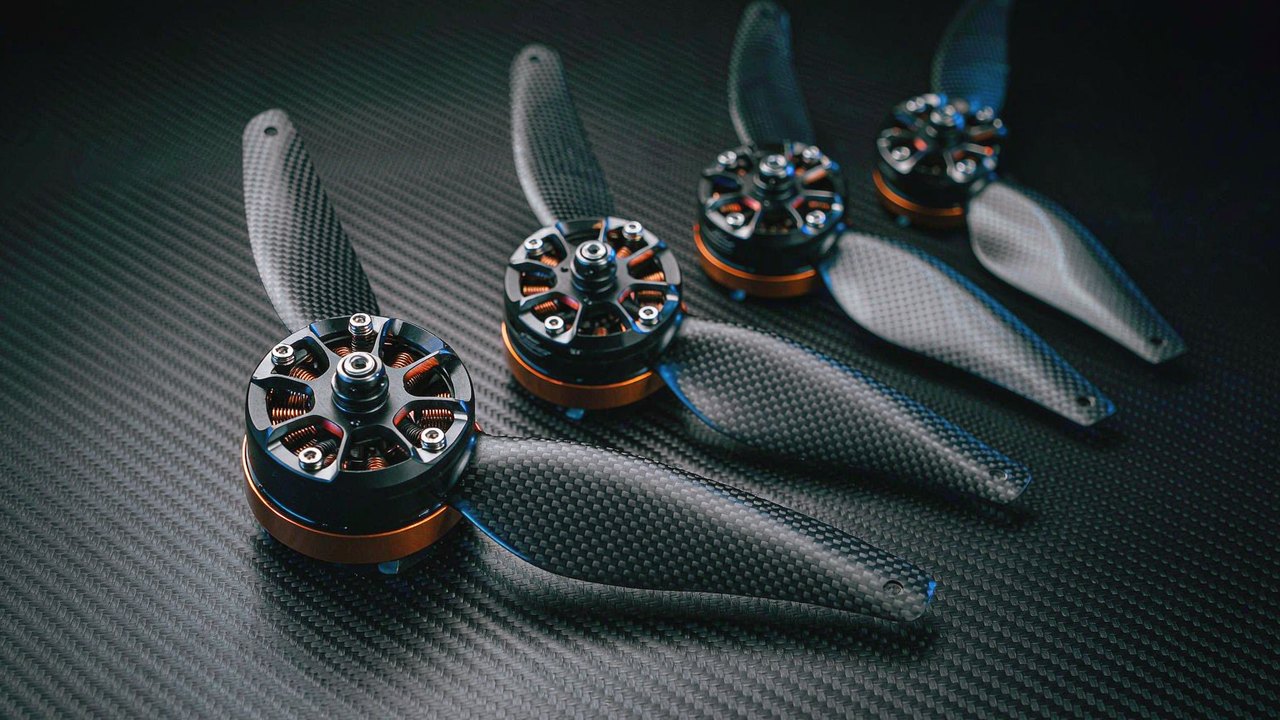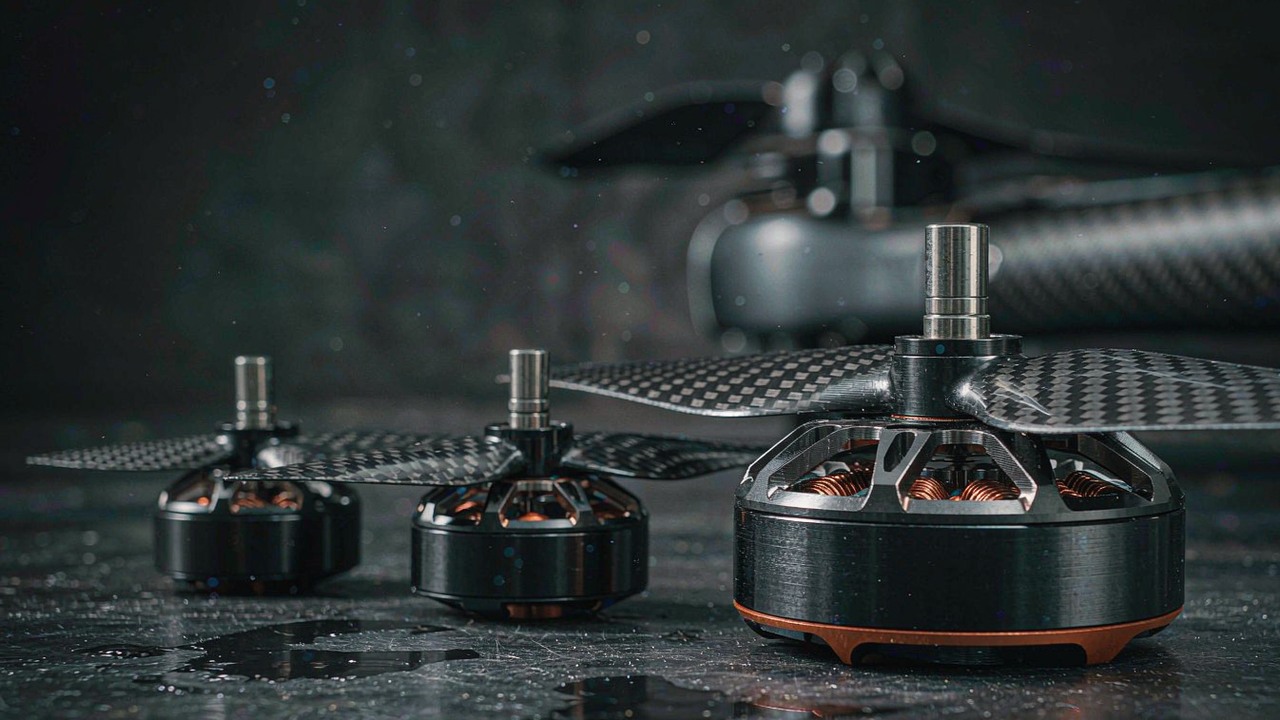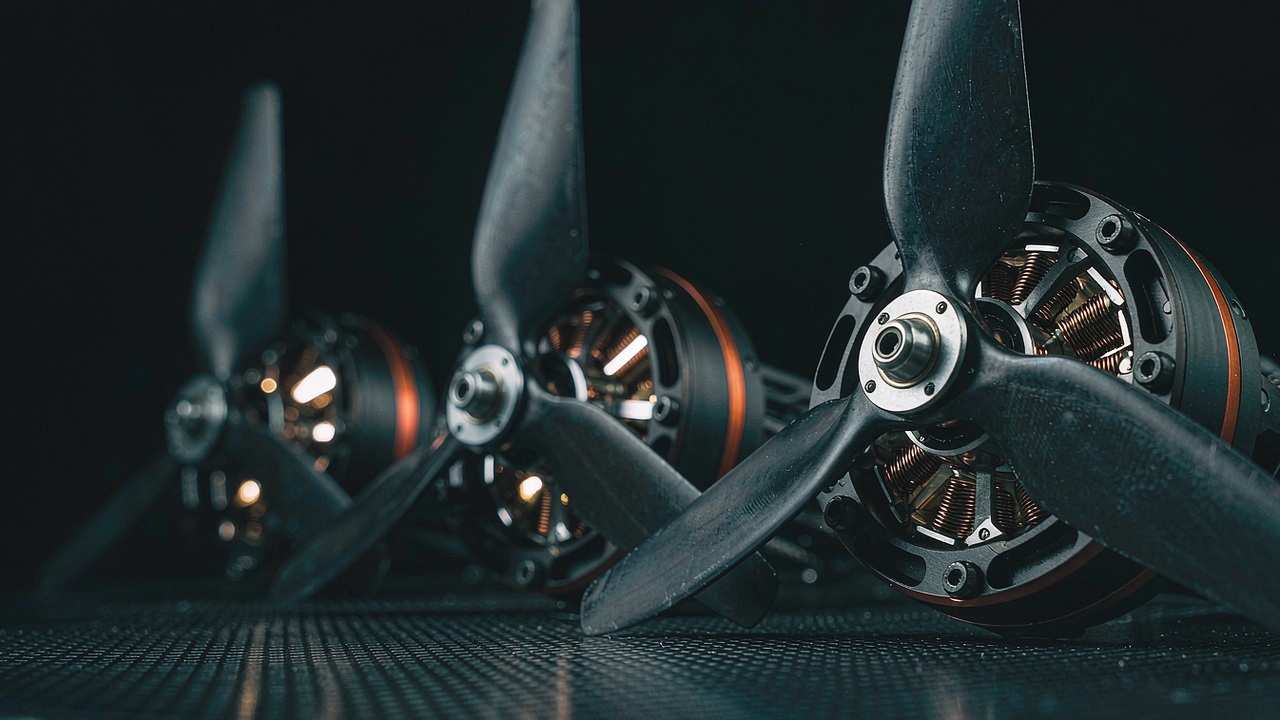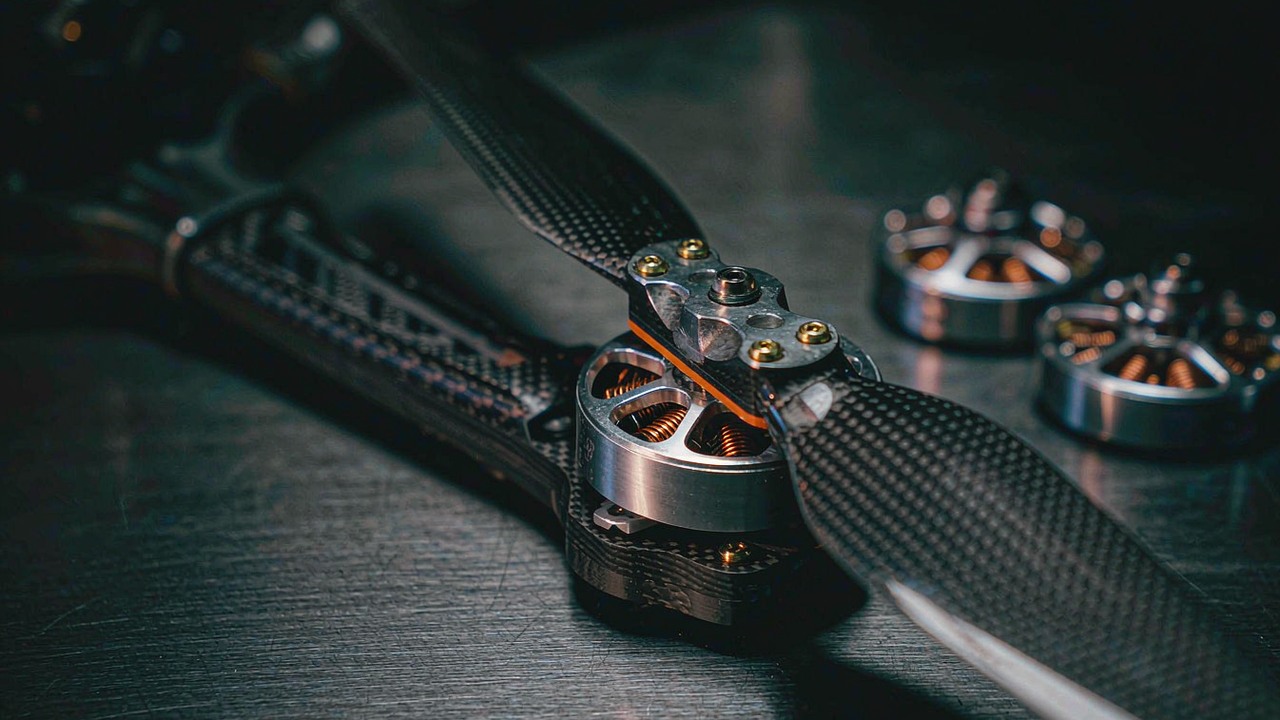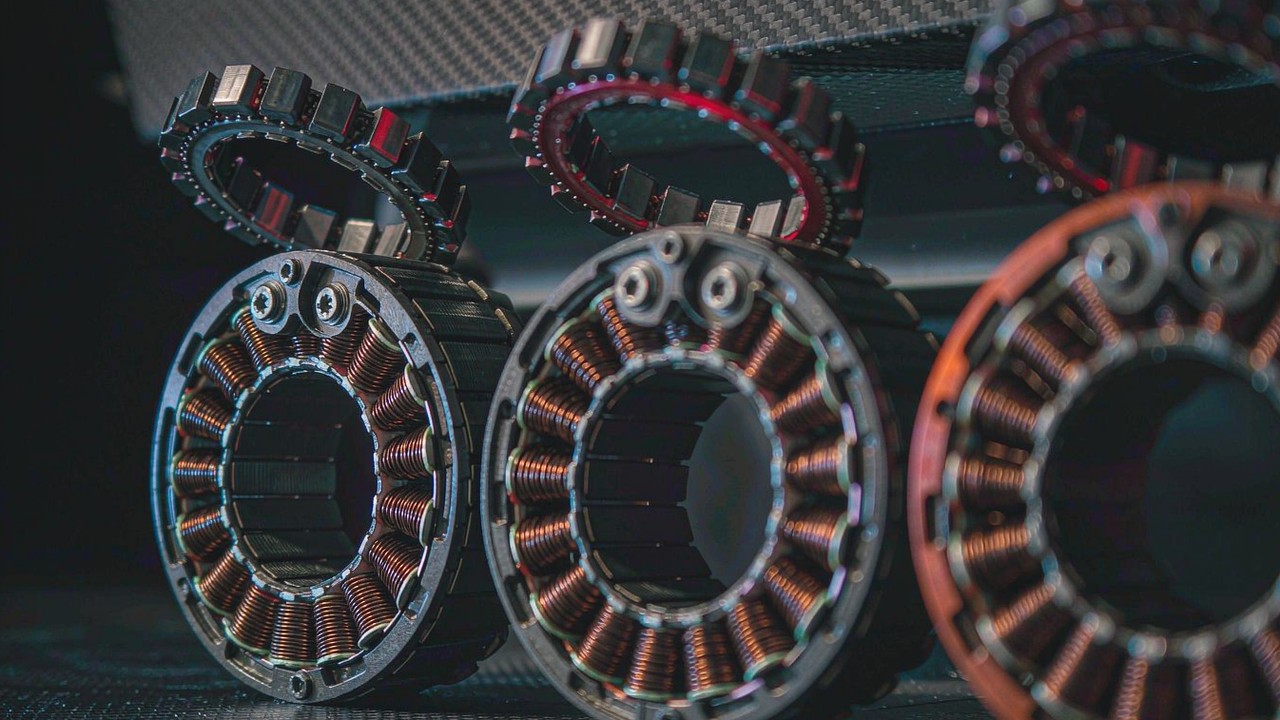
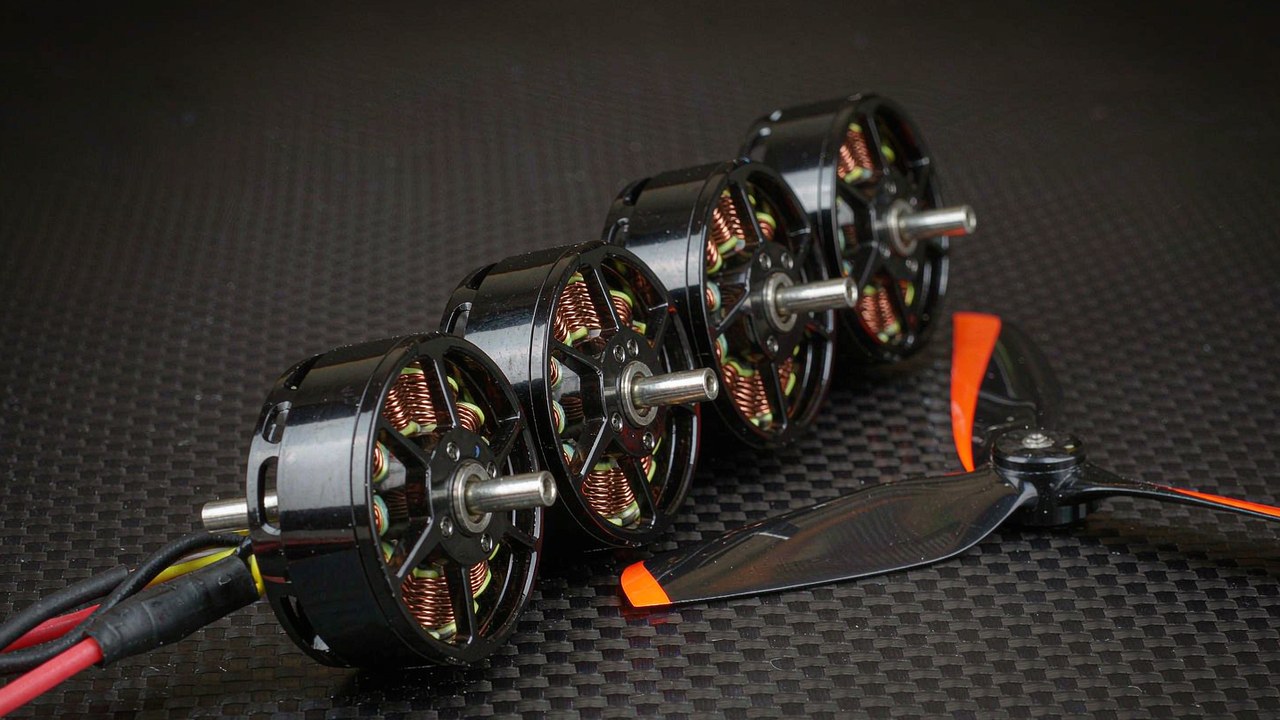
An FPV racing drone motor is chosen for what happens in the two seconds after a corner exit, not for what it does on a test stand. The duty cycle of a race is a sequence of punch-outs, hard direction changes and propwash recoveries, all inside one pack, and every one of those events is a transient: the rotor has to change speed quickly, hold that speed while the propeller bites again, and do it without the winding leaving its thermal envelope before the buzzer. That makes the useful specifications different from the ones that decide a long-endurance or heavy-lift build. This guide works through four T-Hobby motors that span two racing classes - a 9.8 g unit built for 3-inch frames and three 2207-class units for 5-inch frames - and explains which recorded value settles the choice in each case.
All four are outrunner brushless motors driven by an external ESC, and all four sit in a single ToBMS category, Drone Motors. What separates them is propeller class, KV, stator geometry, bus window and mass, and those differences map onto whoop-class racing, 5-inch spec racing and freestyle. Every figure quoted here comes from the corresponding ToBMS product record; conversions between grams and kilograms and any ratio built from two recorded values are labelled as derived, and where a field carries no value it is marked as missing rather than filled in. Three of the four records do not carry every column in full, and knowing which column is missing from which record is part of making the choice.
Quick answer
The first decision is propeller class, because everything else follows from it. For a 3-inch frame where every gram sits at the end of an arm and the propeller is small enough that motor inertia dominates, the F30 is the only one of the four built for the job: 9.8 g, a 17.9 × 17.4 mm body with a 9N12P stator, 351 g of recorded maximum thrust and a 4S rating. Nothing else here is in its class, and putting a 33 g motor on a 3-inch airframe costs more in agility than it returns in thrust.
For 5-inch racing the choice comes down to what the pack is. Where the build runs 4S and wants the highest recorded thrust available, the F60PRO V KV1750 records 1883 g of thrust at 34.3 g on a 12N14P stator. Where the same airframe may be flown on 4S one day and 6S the next, the F60PRO IV V2 KV1750 carries a 4-6S window and is the only unit here that publishes a continuous current figure - 36 A over a 180 s window, alongside 819 W for the same window. Where the build stays on a lower cell count and wants maximum rotor speed rather than maximum torque, the F50 KV2150 is the outlier at 2150 KV, 28.56 g and 1273 W of recorded maximum power - the highest power and the lowest mass of the three 5-inch units.
What none of the four records give is a response figure in milliseconds. Response has to be read indirectly, from rotating mass, winding resistance, stator geometry and the inertia of the propeller that will be bolted on. A comparison built only on thrust therefore ranks these motors almost backwards: the highest recorded thrust here belongs to a 5-inch motor, while the largest thrust-to-mass ratio belongs to a different one, and neither of those rankings predicts which unit recovers cleanest out of a propwash event.
What a racing duty cycle asks of a motor
Nothing about the construction of a racing motor distinguishes it from any other small brushless outrunner. What differs is the shape of the load, and the shape of the load decides which part of the specification becomes binding.
Punch-outs, not cruise
An endurance or heavy-lift airframe spends most of its flight at a roughly steady operating point, and the sizing question is whether that point sits inside a continuous rating. A racing quad spends almost none of its flight there. Throttle varies across nearly the whole range several times per lap, the average sits well below the peak, and the peak is visited often and briefly. The relevant envelope is therefore a repeated transient one: how much thrust is available while the aircraft is already moving, how quickly the rotor can be accelerated into it, and how much heat each excursion leaves behind.
That reframes thrust. Maximum thrust is recorded by ToBMS as a single figure taken from the manufacturer's own test data, and it describes one propeller at one throttle and one voltage. On a racing airframe the first question it answers is whether each motor can lift its quarter of the all-up weight with enough left over for control authority, and the second is whether the whole propulsion system can deliver that repeatedly without cooking. The largest thrust figure is rarely the fastest lap.
The propeller sets the stator size
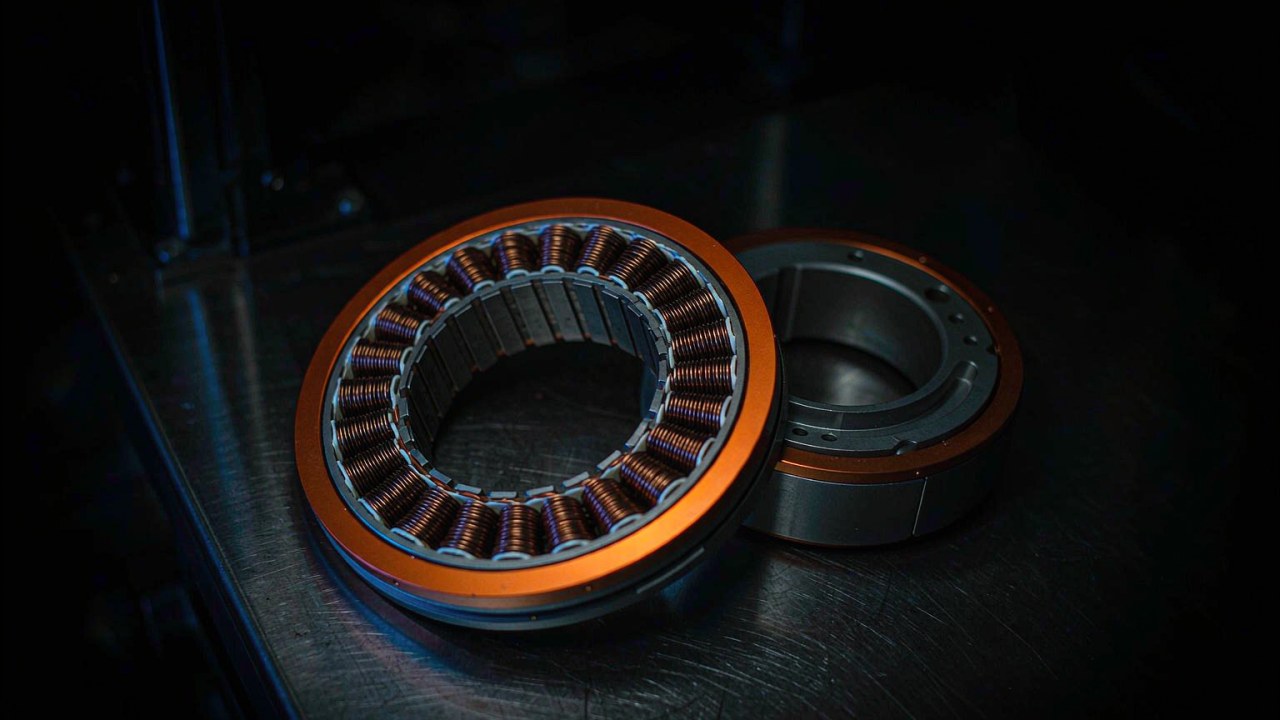
Propeller diameter comes first in practice because the frame decides it. A 3-inch frame cannot swing a 5-inch propeller, so the motor that drives it has to be small, light and wound for very high rotor speed; a 5-inch frame can absorb far more torque, so its motor can use a larger stator and more copper. The four records show this directly: the 3-inch unit measures Ø17.9 × 17.4 mm with a 9N12P stator, and the three 5-inch units cluster around Ø26.8-27 mm with 12N14P stators and far greater length.
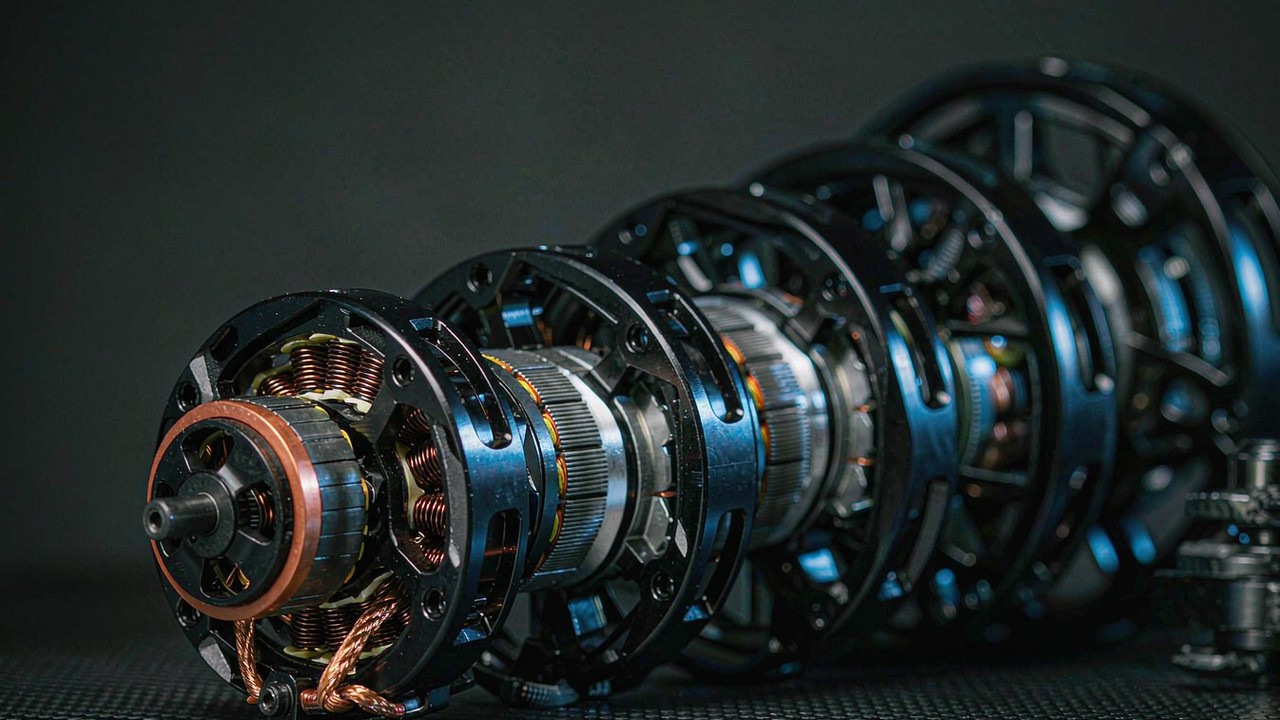
Two consequences follow, and both matter more than KV. Rotating mass at the tip of an arm adds to the airframe's roll and pitch moment of inertia, so heavy motors make an aircraft feel sluggish even where they make plenty of thrust. And a larger stator carries more copper at lower resistance, which turns more of the pack into thrust instead of heat. Both effects are why the whole FPV class sits far below any fixed-wing motor of similar thrust in mass - the comparison is entirely about what the race asks the rotor to do ten times a lap.
KV is a statement about the pack
KV describes how fast a motor turns per volt with no load, so on its own it says nothing about capability - it says which combination of cell count and propeller lands the rotor at a usable speed. A 2150 KV unit on 4S reaches roughly the same unloaded speed as a 1750 KV unit on a higher cell count, which is why the two KV values in this group cannot be compared as if one were stronger than the other. They are two answers to the same question, asked with different packs.
The practical reading is that a KV change usually forces a pack change or a propeller change, and it is those two components that determine whether the swap is an improvement. This is also why a record with no KV value is genuinely hard to place: the F30 record's KV figure sits with the manufacturer's datasheet, so matching it to a pack and propeller starts there rather than from this comparison.
Response, resistance and what the idle current records
Two recorded fields stand in for response, and neither of them is a timing measurement. Winding resistance says how much of the applied voltage is lost across the copper as current rises; lower resistance means more torque available per amp during acceleration and less of the pack ending up as heat. Idle current at 10 V is the no-load current a motor draws to spin itself, so it is a proxy for the iron, bearing and switching losses that are paid continuously regardless of what the propeller is doing.
Together they describe how a motor behaves in the part of the throttle range where a race is decided: coming off a low-throttle corner into full power. Where those columns are recorded at all, they belong in the same comparison as thrust. Where they are not - and two of the four units here have gaps in this area - the honest response is to treat them as open questions for the manufacturer rather than to assume a value from a neighbouring model.
The numbers that decide the pick
Six groups of values carry nearly all of the decision. Three are published for all four motors, and three do not carry every column, which is worth knowing before a shortlist is drawn up.
Class and propeller diameter
This is the filter that removes candidates rather than ranking them. A motor sized for a 5-inch propeller is not a weak choice on a 3-inch frame; it is simply the wrong part, because the mass sits where the airframe can least tolerate it and the airframe cannot supply the disc area that would justify that mass. Conversely a 3-inch motor on a 5-inch frame cannot spin a large propeller to a useful speed without exceeding what its stator is built to shed. The class assignment here is explicit in the records: the F30 carries a 4S rating and a 17.9 mm body for 3-inch work, and the three heavier units are 2207-class motors for 5-inch frames, with the manufacturer's own product slugs carrying that stator designation.
KV against cell count
With the class fixed, KV and the recorded cell range jointly say where the operating point lands. Two of the four publish a voltage window - the F30 at 4S, the F60PRO IV V2 at 4-6S - and one, the F60PRO V, records 4S only. The F50's cell figure sits with the manufacturer's datasheet, and KV cannot be interpreted without it.
Two of the three 5-inch units share the same 1750 KV rating, and comparing them is where the arithmetic gets interesting. They are close to each other in diameter at 26.8 mm, and they differ by 1 mm in length and 0.8 g in mass, yet their recorded maximum thrust differs by roughly 9 per cent - a derived figure. Same KV, same stator configuration, similar envelope, materially different thrust: the remaining differences are in the winding, the magnet and the intended bus, which is exactly why the two units are not interchangeable even though the KV figures in a spec table would suggest they are.
Thrust against mass
The most useful single derived ratio for a racing comparison is maximum thrust divided by the motor's own mass, because it says how much of the aircraft's lifting capability is being bought with mass that has to be accelerated on every direction change. On the recorded figures the four units come out very differently: roughly 36, 75, 52 and 55 times their own mass for the F30, F50, F60PRO IV V2 and F60PRO V respectively - all derived.
The pattern is worth dwelling on, because it is not what the thrust column alone suggests. The F50 has both the lowest mass of the three 5-inch units and the highest recorded thrust-to-mass ratio, while the F60PRO V has the highest recorded thrust and a middling ratio. The F30, at the other end of the size range, has the lowest ratio of the four - which is what happens when a stator is made small enough to sit on a 3-inch frame, and it is a price that class pays deliberately in exchange for agility rather than a defect.
Bus window and pack choice
Cell count is usually set by the pack a builder already owns, but it interacts with everything else. Higher voltage at a given power means lower current, so losses in the winding, the leads and the ESC fall; lower voltage needs thicker copper and larger connectors to move the same power. This is why the widest recorded window in the group is interesting: the F60PRO IV V2's 4-6S range means the same motor can sit on a mild 4S practice pack or a high-discharge 6S race pack, which is genuinely useful where one airframe serves both roles.
One derived check is available here and it is the kind of arithmetic worth doing before trusting a power column. If the F60PRO IV V2's 819 W maximum power for 180 s and its 36 A continuous current for the same window were produced by the same test, the implied bus is about 23 V by our estimate from the two recorded figures, which sits near the top of its 4-6S window rather than at 4S. Read that way, the 819 W figure describes what the motor does high in its cell range, and a 4S build should not expect it.
Idle current and winding resistance
Idle current at 10 V is published for three of the four: 0.8 A on the F30, 1.2 A on the F60PRO IV V2 and 1.0 A on the F60PRO V, with the F50 figure sitting with the manufacturer's datasheet. The ordering is what the sizes predict - a larger stator spinning a larger propeller draws more no-load current - and none of the three is large in absolute terms. Resistance is recorded for three of the four as well: 47 mΩ on the F50, 70 mΩ on the F60PRO IV V2 and no value on the F60PRO V.
The loss arithmetic is worth one line. At its recorded 36 A continuous current, the F60PRO IV V2's 70 mΩ winding dissipates roughly 91 W as copper loss - our estimate, uncorrected for temperature, and about 11 per cent of the 819 W the same window records. That loss is heat inside a motor that is being asked to give full power repeatedly on one pack, so the resistance and current columns belong in the same sentence as the thrust column.
Envelope, shaft and leads
The mechanical columns decide whether a motor can actually be mounted, and in this class they also say something about how it will survive. The two smaller 5-inch dimensions are close together - Ø26.8 × 32.7 mm on the F60PRO IV V2 and Ø26.8 × 31.7 mm on the F60PRO V - while the F50 measures Ø27 × 29.5 mm, making it the widest and shortest of the three. The F30, at Ø17.9 × 17.4 mm, is roughly a third of their volume.
Shaft diameter splits the group: the F50 records a 5 mm shaft where the two F60PRO units record 4 mm, which affects prop compatibility and how much abuse the hub takes in a crash. Both F60PRO units record 20 AWG leads, and the F60PRO IV V2 publishes a 150 mm lead length, which is enough to reach a 4-in-1 ESC mounted centrally on the stack. Where a lead length is not recorded, the assumption should be checked against the part rather than against a sibling model.
Four FPV racing drone motors compared
The table below collects the four units in ascending mass order. Every value is as published in each ToBMS product record.
| Model | Class | Stator | Maximum Thrust | Weight | No. of Cells (LiPo) |
|---|---|---|---|---|---|
| T-Hobby F30 | 3-inch | 9N12P | 351 g | 9.8 g | 4S |
| T-Hobby F50 KV2150 | 5-inch | 12N14P | 2136 g | 28.56 g | Not listed |
| T-Hobby F60PRO IV V2 KV1750 | 5-inch | 12N14P | 1730 g | 33.5 g | 4-6S |
| T-Hobby F60PRO V KV1750 | 5-inch | 12N14P | 1883 g | 34.3 g | 4S |
All four motors are listed in the ToBMS Drone Motors category, and all are published by T-Hobby. Thrust is stored in grams in each record and shown here as recorded; the thrust-to-mass ratios quoted elsewhere in this article are derived from these figures and identified as derived where they appear. Three values sit with the manufacturer's datasheet rather than in the record: KV for the F30, the cell figure for the F50, and the F60PRO V stator diameter, winding resistance and power.
The first thing the table shows is that class, not quality, explains most of the spread. Across the 9.8 g to 34.3 g range every relevant figure moves together: thrust rises by a factor of roughly five from the smallest to the largest recorded unit, while mass rises by a factor of about 3.5 - both derived. That gap is the whole argument between the classes, and it is why the F30 appears in a racing comparison at all: it is not a weak 5-inch motor, it is a small one.
The second pattern sits inside the 5-inch group and is the more useful one. The three 2207-class units are within 0.2 mm of each other in diameter and within 5.8 g in mass, yet they record 1730 g, 1883 g and 2136 g of thrust - a spread of roughly 23 per cent from the lowest to the highest, derived from the recorded values. Nothing in the shared columns explains it. The answer is in what differs: KV, bus window, length and winding, which means the choice between them is a question about what the airframe and pack do, not about which unit is objectively better.
The third pattern concerns what is missing. The unit with the highest recorded thrust - the F60PRO V - carries no resistance, no power and no current figure in its record, and the unit with the highest power - the F50 - carries no cell count and no current in its record. A comparison that needed both columns complete would have to discard two of the four, which is a reasonable argument for treating these two gaps as the first questions to put to the manufacturer.
Reading the four against a race
Recorded numbers only become a decision once they are read against what the aircraft does. Each of the four below suits one kind of flying, and none of them suits all four.
F30 - the 3-inch answer, at 9.8 g
The F30 is the lightest motor recorded anywhere in this category at 9.8 g, measuring Ø17.9 × 17.4 mm with a 9N12P stator, 351 g of maximum thrust and a 4S rating. Its idle current of 0.8 A at 10 V is the lowest of the group, which is consistent with the smallest stator doing the least work to spin itself. Its KV value sits with the manufacturer's datasheet, so pairing it with a pack and propeller begins there.
What the numbers do show is the consequence of the class. Its recorded resistance is the highest in the group by a wide margin, its thrust is roughly a fifth of the larger units, and its thrust-to-mass ratio is the lowest of the four - all of which is what happens when a stator is shrunk to fit a 3-inch frame. None of that is a criticism. On a 3-inch airframe the alternative is not a better 3-inch motor, it is a 34 g motor whose mass sits at the ends of arms that were never designed to carry it, and the agility lost would exceed the thrust gained.
The manufacturer publishes this unit for 3-inch racing applications and quotes over 300 g of thrust per motor, which is consistent with the 351 g recorded value, together with a single-screw propeller lock and a universal base shaft. That propeller-lock detail is not a specification column, but on a racing airframe that is regularly disassembled it matters as much as one.
F50 KV2150 - maximum rotor speed at minimum mass
At 28.56 g with a 2150 KV winding, a 12N14P stator and 47 mΩ of resistance, the F50 is the extreme of the 5-inch group in two directions at once: the highest KV and the lowest mass, and the only one of the three whose recorded maximum power reaches 1273 W for 180 s. Its 2136 g maximum thrust is the highest figure recorded here, and its diameter of 27 mm is marginally the widest while its 29.5 mm length is the shortest - a squat, fast-turning geometry.
The 47 mΩ winding is the lowest recorded in this group, which is the part of the specification that supports the way this motor is meant to be flown. Low resistance means less voltage lost to copper as current spikes during a punch-out, so more of the pack reaches the rotor during exactly the transient that racing consists of. Its manufacturer description frames it for competitive 5-inch racing, where torque and response are what decide lap times, and nothing in the recorded values contradicts that.
The gap is the bus. The cell figure for this unit sits with the manufacturer's datasheet, so although 2150 KV points strongly towards a low cell count, that inference should be confirmed there before a pack is chosen. Its continuous current sits with the manufacturer's datasheet as well, which leaves the thermal side of the picture to be closed there.
F60PRO IV V2 KV1750 - the 4-6S crossover
The F60PRO IV V2 KV1750 records 1730 g of maximum thrust, 819 W of maximum power for 180 s and 36 A of continuous current for the same window, in a 33.5 g motor measuring Ø26.8 × 32.7 mm with a 12N14P stator, 70 mΩ of resistance, a 1.2 A idle current at 10 V, a 4 mm shaft, 20 AWG leads and a 150 mm lead length. It is the most completely documented unit of the four, and that is itself worth something when a build is being sized rather than guessed at.
Its distinguishing feature is the recorded 4-6S window. No other motor here publishes a range that wide, and it changes what the unit is for: one airframe can run a docile 4S pack for practice and a high-output 6S pack on race day without changing motors, which spreads the cost of spare motors across both roles. The trade is visible in the thrust column - 1730 g is the lowest recorded figure of the three 5-inch units, some 18 per cent below the F50 - and in the resistance column, where 70 mΩ is the highest of the two units that publish one.
As noted above, its two power-related figures together imply a bus of roughly 23 V, so its headline power should be read as a 6S-class number. The manufacturer's own summary for this unit emphasises mid-range pull and smooth control rather than outright peak output, which is consistent with that reading.
F60PRO V KV1750 - the highest thrust figure on 4S
The F60PRO V KV1750 records 1883 g of maximum thrust at 34.3 g, on a 4S bus, measuring Ø26.8 × 31.7 mm with a 12N14P stator, a 22 mm stator diameter, a 4 mm shaft, 20 AWG leads and a 1.0 A idle current at 10 V. Against the IV V2 it is 0.8 g heavier, 1 mm shorter, and about 9 per cent higher in recorded thrust - all derived comparisons from two records that otherwise agree on KV, stator configuration, diameter and shaft size.
That comparison is the most instructive one in this article. Two motors that look nearly identical on a spec sheet differ by almost a tenth in thrust, and the differences that remain are the bus window and the winding details that are not recorded. For a 4S racing build staying on 4S, the F60PRO V is therefore the direct answer among these four: it gives up the flexibility of the 4-6S unit and pays eight tenths of a gram, in exchange for the largest thrust figure either of them records.
The record here is thin on the electrical columns. No resistance, no power and no current figures are published, so the two things a racer most wants to know - how much of the pack reaches the rotor, and where the thermal limit sits - have to come from the manufacturer. Its idle current of 1.0 A at 10 V versus 1.2 A on the IV V2 hints at a different winding, but one recorded field is not enough to build a conclusion on.
Where these classes compete
Two of the four units below belong to different classes and are never really alternatives to each other; the real competition is inside the 5-inch group. Recognising which kind of flying the airframe is for settles the choice faster than any table.
3-inch whoop-class racing
This is the F30's class and no other unit here competes in it. The characteristic airframe is built around small propellers, uses light everywhere, and rewards direction changes over top speed. Rotating mass dominates the whole decision - hence a motor whose recorded mass is roughly a quarter of the lightest 5-inch alternative - and the manufacturer's published guidance is explicit that intended combinations include small tri-blade propellers and compact high-discharge packs.
5-inch spec racing
All three 2207-class units belong here, and the split between them is about the pack and about what the pilot wants out of the throttle curve: the F50 for maximum rotor speed and minimum prop-side mass on a low cell count, the F60PRO V for the largest recorded thrust at 4S, and the F60PRO IV V2 for an airframe that has to span 4S and 6S without a motor change. What all three share is a class where thrust figures around 1.7 to 2.1 kg per motor sit against an all-up weight that is typically comparable to the four motors' combined thrust, which is why control authority rather than peak thrust is what makes an airframe feel fast.
Freestyle and practice airframes
Not every airframe with an FPV drone motor on it is raced. Freestyle and daily-practice builds see far more crashes per hour and far fewer sustainable triple-digit throttle transients, which pushes crash tolerance, hub strength and replacement cost up the list and peak thrust down. The 5 mm shaft on the F50 and the lead specification on both F60PRO units are the recorded parts of that story; the rest is mechanical, and sits outside what a product record expresses.
Where efficiency takes over
Racing motors are not efficient motors, and the crossover is worth naming. The moment an airframe's job becomes duration rather than lap time - carrying a camera for twenty minutes instead of completing six laps - the whole ranking above stops applying, because the operating point moves to the part of the map where a large, slow propeller and a low-KV winding win. That is a different selection problem, and it is the one the Long Endurance UAV grouping is built around rather than anything in this class.
Selection checklist
Three checks cover most of the ground, and they work better in this order because each one narrows the field for the next.
Class first
Fix the propeller diameter the frame accepts, then discard every motor not built for it. This removes more candidates than any other step and prevents the most common mistake in this category - choosing between thrust figures that belong to different classes. Check the mounting pattern, the shaft diameter and whether the lead length reaches the ESC.
Pack second
Decide whether the build is a 4S-only airframe, a high cell count airframe, or one that has to do both, and read KV against that decision rather than as a ranking. Where a record publishes a cell range, prefer the unit whose range brackets the packs actually in use. Where it does not, treat the bus as an open question.
Transients last
Only once the class and the pack are fixed do the thrust and power columns mean anything, and even then they are ceiling figures rather than working points. Check the thrust the four motors would make together against all-up weight with margin for control authority, check whether continuous current and resistance are published at all, and check what the gaps are before assuming a value from a neighbouring model.
- Fix the frame and propeller class first, and discard any motor whose stator size was not built for it.
- Decide the cell count the packs actually supply, then read KV against it rather than comparing KV values directly.
- Prefer a unit whose recorded bus window brackets the packs in use, and treat a missing cell figure as an open item.
- Compare maximum thrust across four motors against all-up weight, leaving margin for control authority rather than just lift.
- Read any 180 s power figure as a duty window, not a continuous rating, and check whether a continuous current figure exists alongside it.
- Use winding resistance and idle current as the available proxies for response, and do not fill either one from a sibling model.
- Check shaft diameter, mounting pattern, lead gauge and lead length against the frame and the ESC location.
- Record which values came from a datasheet rather than from a product record, so the selection can be re-checked when a field is completed.
Frequently asked questions
QWhat makes a motor suitable for FPV racing rather than for general drone use?
The construction is the same; the duty cycle is not. A racing quad spends its pack cycling across most of the throttle range several times a lap, so rotor speed has to change quickly and repeatedly, while cooling depends on airflow that depends on airspeed. That pushes mass, winding resistance and bus window to the front of the list and pushes steady-state efficiency well down it. Nothing in a racing motor is exotic - it is a small outrunner optimised for repeated transients rather than for a fixed operating point.
QIs a higher KV always faster?
No. KV states how fast a motor turns per volt with no load, so a higher figure only means faster if the propeller and the pack stay the same, and those two usually cannot. A 2150 KV unit on a low cell count and a 1750 KV unit on a higher cell count can reach comparable rotor speeds with very different current and torque behaviour. Changing KV normally changes the appropriate propeller or pack, and that combination - not the KV number - is what decides speed.
QWhich of the four has the best thrust-to-mass ratio?
On the recorded figures the F50 KV2150 does, at roughly 75 times its own mass - derived from its 2136 g maximum thrust and 28.56 g mass. Then come the F60PRO V at roughly 55, the F60PRO IV V2 at roughly 52, and the F30 at roughly 36, all derived the same way. The ratio is a useful filter rather than a verdict: the F30's comparatively lower ratio reflects what happens when a stator is shrunk to fit a 3-inch frame, which is the entire point of that class.
QWhat does a 180 s power figure mean on a motor used for racing?
It is a duty window, not a continuous rating. Where a ToBMS record states a maximum power for 180 s, it says the unit sustained that power for three minutes on a test stand - which is a useful indication of thermal capability, and not a definition of what can be held indefinitely or repeated every lap. Two units here publish it, the F50 at 1273 W and the F60PRO IV V2 at 819 W, and the accompanying 36 A continuous current on the latter is what makes the second figure interpretable at all.
QCan the same 5-inch motor be flown on 4S and 6S?
Only where the record publishes a window that covers both, and only with the propeller appropriate to each. The F60PRO IV V2 KV1750 is the single unit here carrying a 4-6S range; the F60PRO V records 4S and the F30 records 4S, while the F50 carries no cell figure in its record at all. Running outside a recorded window is the fastest way to find the limits of a winding, so an unrecorded bus should be treated as an unknown rather than assumed.
QHow much does motor mass actually matter on a racing airframe?
More than the thrust figures suggest, because the mass sits at the ends of the arms. It counts twice: once against the thrust available to accelerate the aircraft, and once against the airframe's rotational inertia, which determines how quickly it can change direction. Four F50 motors total about 114 g and four F60PRO V units about 137 g - derived from the recorded masses - so the spread across this whole group is under 100 g of aircraft, yet it is felt on every direction change rather than once.
QWhy do some cells in the comparison say "Not listed"?
Because no value is carried for that column, and filling it in from a neighbouring model is exactly the kind of inference that produces a wrong build. Three gaps are material here: no KV for the F30, no cell figure for the F50, and no resistance, power or current figures for the F60PRO V. In each case the manufacturer's datasheet is the reference to close the gap, and the F30's recorded resistance additionally differs from the value quoted in an earlier ToBMS guide, which is why that column carries a note.
Official resources
All four motors are published by T-Hobby, and the manufacturer's own pages carry the datasheets and test data that the ToBMS records do not reproduce: the F30, the F50 KV2150, the F60PRO IV V2 KV1750 and the F60PRO V KV1750, with the wider range at the T-Hobby official site. Where a ToBMS record is silent - the F30's KV, the F50's cell count, the F60PRO V's resistance, power and current, and any hover-rated thrust value at all - those pages or the corresponding datasheet are the place to close the gap.
Where to go next
Reading this far produces a shortlist rather than a decision, and three tools turn that shortlist into one: every motor here sits in the Drone Motors category, candidates can be narrowed by class, KV and mass in Select, and two or three units can be set against each other in Compare Products. The application side of the same decision is collected on the BLDC motors for FPV racing drones page, which groups the recorded matches by class rather than by specification.
Three existing guides extend sideways from here. The drone motor selection guide covers the same category from the whole-class side, putting these FPV units alongside fixed-wing and VTOL motors, and is the counterpart to this race-led view. The UAV motor selection guide moves up to larger airframes where the questions change shape entirely, and the complete BLDC motor guide places every one of these classes in a single frame for anyone starting from the technology rather than from an airframe. A more recent companion piece, FPV Racing Drone Motors: Four T-Hobby Options from 9.8 g to 34.3 g, approaches the same class from the specification side.
The short version: fix the propeller class the frame allows first and discard everything outside it, then read KV against the packs actually in use, then compare thrust and thermal figures with the knowledge that the largest thrust number here belongs to a different class from the highest recorded thrust-to-mass ratio. On this group that sequence usually lands on the F30 for anything 3-inch, the F50 where minimum mass and maximum rotor speed are the priority, the F60PRO V for a dedicated 4S build, and the F60PRO IV V2 wherever one airframe has to span 4S and 6S.