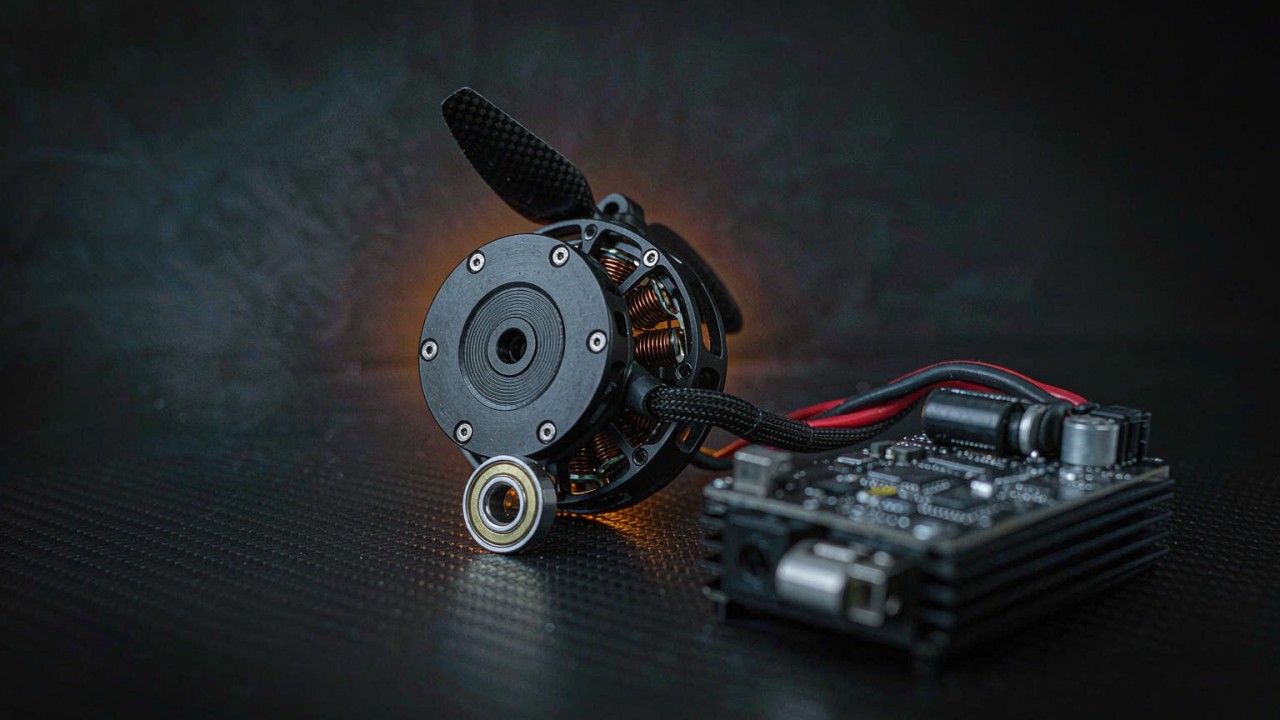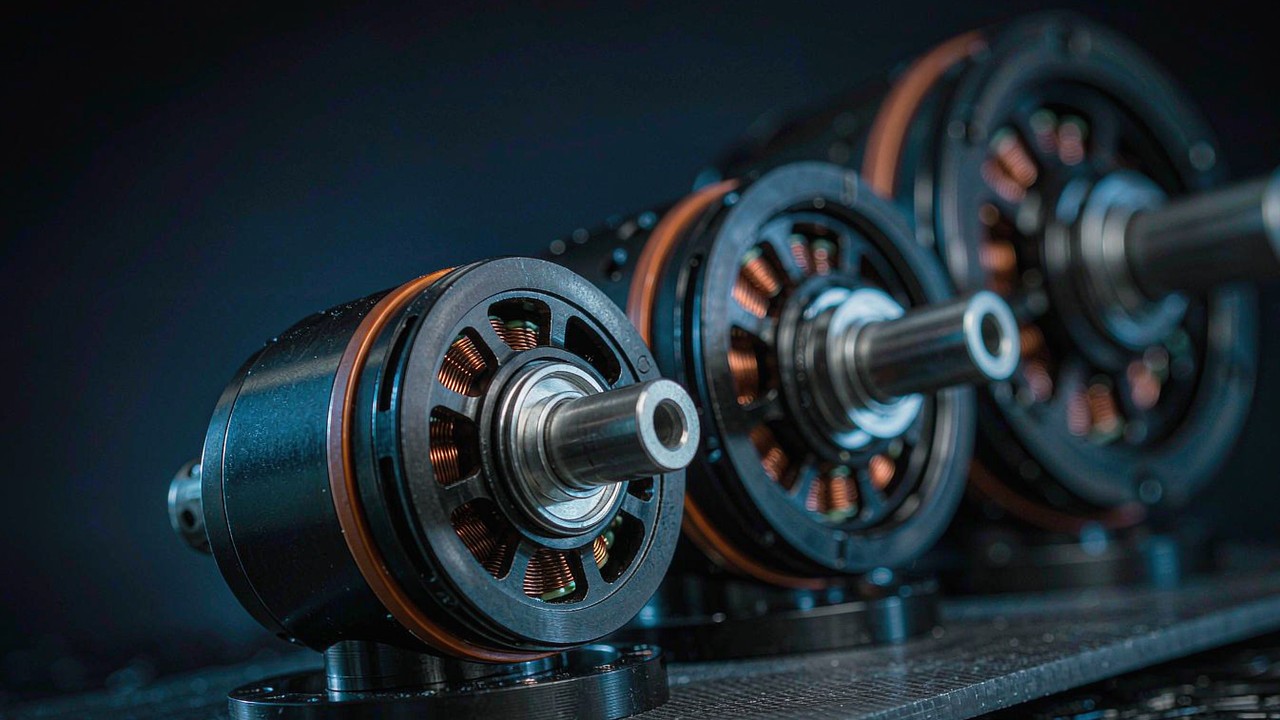
Drone motors divide into three duties that share almost no selection logic: fixed-wing motors that push an airframe through the air for twenty minutes at a time, VTOL lift motors that have to hoist a wing-borne aircraft off the ground and then stop, and FPV motors that spend their life at high current and high rpm with no interest in efficiency per gram. Buying the wrong class for the airframe is a common and expensive mistake, because the numbers that matter in one group are close to irrelevant in the others.
This guide covers how each class is specified, which figures actually decide a pick, and how thirteen of the models currently listed in the ToBMS Drone Motors category compare. Every figure below is taken from ToBMS product data or the manufacturer's published specification - none of it is estimated.
Quick Answer
A drone motor is selected by first deciding the class - fixed-wing, VTOL lift or FPV - because each is optimised against a different operating point. Fixed-wing motors are chosen for efficiency at a sustained cruise current on a given prop; VTOL lift motors for thrust per gram with a short, high-current duty cycle; FPV motors for torque and response at high rpm on small props. KV, stator size, winding resistance and mass are then read against that duty. On all three classes the published maximum power is a 180 second figure rather than a continuous rating, so the current at the realistic operating point is the figure to size against.
How the three classes differ
The table below is worth reading before any individual model, because it explains why a 47 g fixed-wing motor and a 47 g FPV motor have almost nothing in common.
Fixed-wing: efficiency at cruise
A fixed-wing motor spends most of its flight at a single operating point - cruise - and the airframe only needs full power for take-off and climb. That puts a premium on efficiency at moderate current rather than peak output, and it makes the prop-and-KV match decisive: the AT4130 KV230 and the AT2308 KV1450 both belong to this class and differ by a factor of six in KV because they are built for airframes weighing 320 g and several kilograms respectively.
VTOL lift: thrust over a short window
A VTOL lift motor works hard for a short part of every flight. It has to produce maximum thrust at take-off and transition, then sit idle while the wing carries the aircraft. That changes the optimisation: thrust per gram and thermal mass dominate, and the continuous rating matters less than how the motor behaves after repeated vertical cycles. The two V-series models in this category use 24N28P stators and 6 mm shafts, which is a lift-motor signature rather than a cruise one.
FPV and racing: response at high rpm
An FPV motor is judged on how fast it accelerates a small propeller and how much current it can take for the length of a race or a freestyle line. Efficiency is a secondary concern, weight is a primary one, and the relevant specifications are stator volume, KV and winding resistance. The T-Hobby F30 is a 9.8 g unit with a 9N12P stator; the largest in this group is under 47 g. Both are far lighter than the lightest fixed-wing motor of comparable thrust, because they are built for a different duty entirely.
Stator notation and what it implies
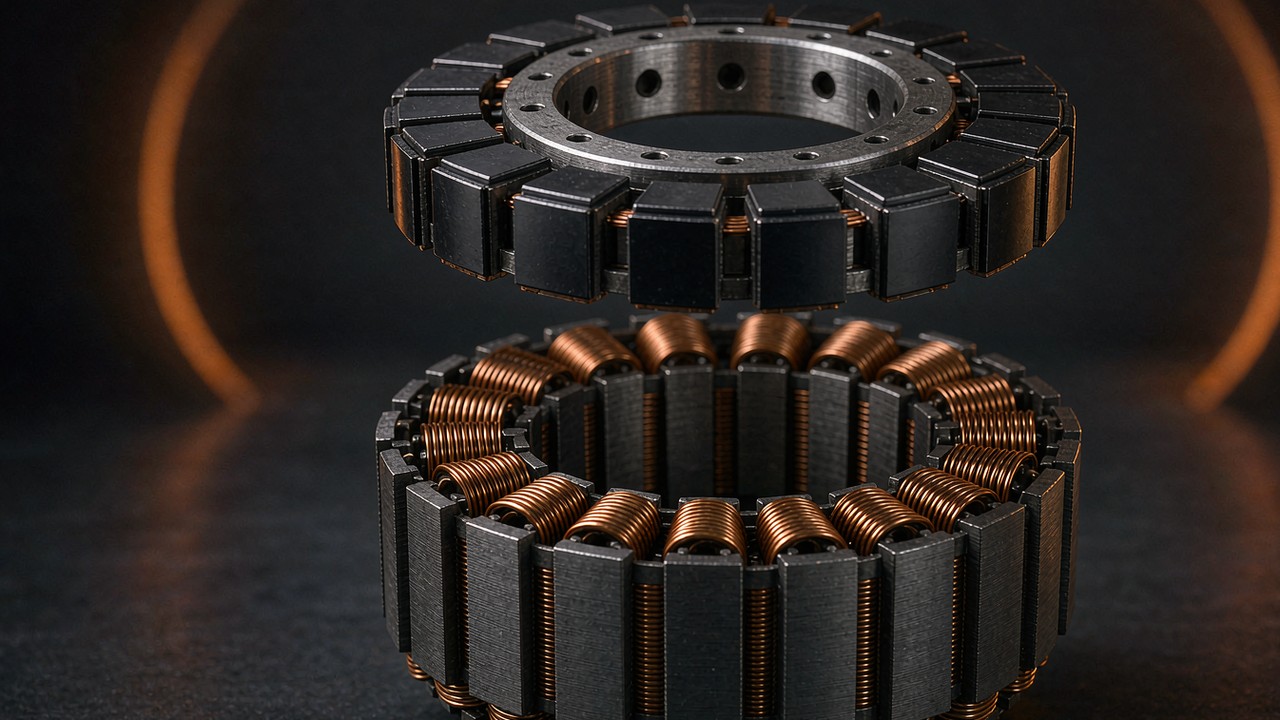
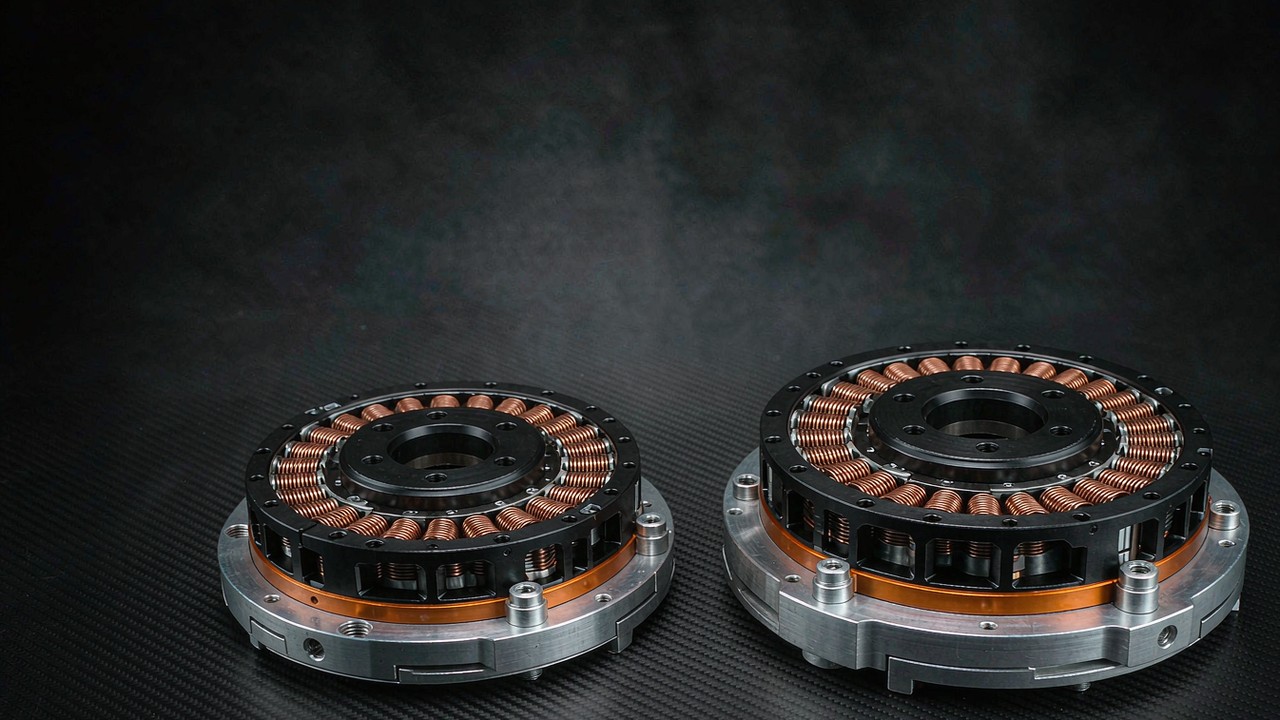
The slot-and-pole notation - 9N12P, 12N14P, 24N28P - describes the winding layout. Lower counts are typical of small, fast-turning motors; higher counts smooth out torque delivery at low speed, which is why the VTOL lift motors here use 24N28P while every FPV and fixed-wing model in the category uses 12N14P or 9N12P. As with any high-pole-count motor, the electrical commutation frequency rises with mechanical speed, so ESC timing and maximum electrical rpm have to be checked against it.
Internal resistance, current and heat
Winding resistance is what turns current into heat rather than rotation. In this category it spans roughly an order of magnitude, from 18 mΩ to 152 mΩ, and it is the specification that decides whether a motor can sustain its published duty without the magnets reaching a temperature that costs them their strength. The published maximum power figures are 180 second values, so a design that holds full throttle for longer than that - a climbing multirotor, a sustained vertical VTOL transition - needs the continuous current figure, not the peak.
Thirteen drone motors compared
The table covers thirteen of the motors currently listed in the Drone Motors category, grouped by class and then ordered from lightest to heaviest. Maximum power is the manufacturer's 180 second figure.
| Model | Class | Stator | Internal Resistance | Max Power 180 s | Weight |
|---|---|---|---|---|---|
| T-Hobby F30 | FPV, 3 inch | 9N12P | 152 mΩ | Not listed | 9.8 g |
| T-Hobby F60PRO IV V2 KV1750 | FPV, 5 inch | 12N14P | 70 mΩ | 819 W | 33.5 g |
| T-Hobby F80 PRO KV1900 | FPV, 7 inch | 12N14P | 42 mΩ | 1122 W | 39.7 g |
| T-Hobby F90 KV1300 | FPV, long range | 12N14P | 76 mΩ | 1059 W | 46.6 g |
| T-Motor AT2308 KV1450 | Fixed wing | 12N18P | 90 mΩ | 250 W | 47 g |
| T-Hobby F50 KV2150 | FPV, 5 inch | 12N14P | 47 mΩ | 1273 W | Not listed |
| T-Hobby F60PRO V KV1750 | FPV, 5 inch | 12N14P | Not listed | Not listed | Not listed |
| T-Motor AT2814 KV900 | Fixed wing | 12N14P | 82 mΩ | 650 W | 108 g |
| T-Motor V505 KV260 | VTOL lift | 24N28P | 58 mΩ | Not listed | 215 g |
| T-Motor AT3520 KV550 | Fixed wing | 12N14P | 31 mΩ | 1100 W | 218 g |
| T-Motor AT3530 KV580 | Fixed wing | 12N14P | 18 mΩ | 1400 W | 298 g |
| T-Motor V602 KV180 | VTOL lift | 24N28P | 88 mΩ | Not listed | 300 g |
| T-Motor AT4130 KV230 | Fixed wing | 12N14P | 60 mΩ | 2500 W | 408 g |
Stator configuration, internal resistance, 180 second maximum power and mass as published by the manufacturer. Cells are marked "Not listed" where no value is carried rather than being estimated; the F50 mass and the F60PRO V specifications sit with the manufacturer's current datasheet and should be taken from there before a build is committed to.
Read down the resistance column and the class structure becomes visible. The fixed-wing AT motors hold resistance in the 14 to 90 mΩ band while delivering 250 to 2100 W - low resistance for their mass, because they are built to run continuously at cruise without heat accumulating. The FPV motors reach the same power class at a fifth of the mass but with resistance two to six times higher, which is the explicit trade: light and fast, with heat as the limiting factor rather than a design margin.
The two VTOL lift motors sit apart from both. At 215 g and 300 g with 24N28P stators they are heavier than the FPV units of similar kV, and their resistance is higher than the fixed-wing motors at comparable power. That is consistent with a lift duty: the motor has to deliver thrust at relatively low rpm with a large propeller, and it is not expected to sustain that output for more than a fraction of the flight.
Fixed-wing: the AT series
The AT motors are the fixed-wing and glider end of this category, and the range covers everything from a 320 g sailplane to a large mapping airframe.
AT2308 KV1450: the light end
The AT2308 KV1450 is a 47 g, Ø28.8 × 40.5 mm motor with 250 W maximum power and 23 A peak current, listed for 320-500 g sailplanes and trainers. Its 90 mΩ of winding resistance is high in absolute terms, which is what a 2S-class airframe expects: at those voltages the current stays modest and the priority is a light, responsive motor rather than one that can dissipate kilowatts. As with any motor in this class, the published power figure is a 180 second value.
AT2814 KV900 and AT3520 KV550
The AT2814 KV900 targets 1.3-1.4 kg 3D and F3A aerobatic airframes, with 650 W maximum power and 45 A peak current on 3-4S in a 108 g package. Its 82 mΩ of resistance is the direct consequence of sizing the winding for sustained current rather than for a light airframe. The AT3520 KV550 steps up to a 218 g body with 1100 W and 50 A peak on 4-6S, aimed at 1.8-2.0 kg mapping and payload airframes - and its 31 mΩ is among the lowest in the fixed-wing group, which is precisely what a long mapping sortie at steady throttle needs.
AT3530 KV580 and AT4130 KV230
The AT3530 KV580 covers 2.2-2.4 kg airframes with 1400 W maximum power, 65 A peak and 18 mΩ of resistance on 4-6S. The AT4130 KV230 is the largest fixed-wing motor in the category at 408 g, with 2500 W maximum power, 60 A peak current and a 6 mm shaft. Its KV of 230 is the lowest in the fixed-wing set, which is the pairing to expect: a heavier airframe on a higher cell count turns a larger propeller slowly, and the 50 mm stator is sized to deliver the torque that requires. ToBMS describes it as a long-axis motor for large multi-rotors and fixed-wing UAVs, which is a reminder that the line between a heavy fixed-wing motor and a multirotor lift motor is one of mounting and duty rather than of construction.
VTOL lift: V505 KV260 and V602 KV180
Two models cover the vertical-lift duty, and both use the same 24N28P stator layout and 6 mm shaft.
V505 KV260
The V505 KV260 weighs 215 g and is rated for 52 A peak current with 58 mΩ of internal resistance. Its ToBMS overview describes a lift motor paired with an efficient fixed-wing cruise profile, which is the defining characteristic of a VTOL lift unit: it exists to get the aircraft off the ground and then stop working. The 24N28P configuration is aimed at smooth torque delivery at the low rotational speeds a large lift propeller runs at.
V602 KV180
The V602 KV180 is the larger of the two at 300 g, with 45 A peak current and 88 mΩ of resistance. Lower peak current in a heavier motor looks counter-intuitive until the duty is considered: a 180 KV lift prop on a larger airframe turns slower and draws its current over a longer, gentler transient. ToBMS describes it as providing reliable climb power and efficient cruise for industrial VTOL platforms, and the design intent shows in the numbers - this is a motor specified for repeatable vertical cycles rather than for the highest possible thrust figure.
FPV and racing: the T-Hobby F series
The F-series is the racing and freestyle end of the category, and it is the group with the widest spread of KV and the narrowest mass range.
F30: 9.8 g for 3-inch builds
The T-Hobby F30 is the lightest motor in this entire category at 9.8 g, with a Ø17.9 × 17.4 mm body, a 9N12P stator and 152 mΩ of resistance on 4S. Its KV sits with the manufacturer's datasheet, which is the reference for that figure. What the recorded numbers do show is the consequence of extreme weight reduction: resistance is the highest in the category, which is exactly what a 3-inch racing build accepts in exchange for agility.
F50 KV2150 and F60PRO IV V2 KV1750
The F50 KV2150 is a 5-inch racing motor with a 12N14P stator, 1273 W maximum power, 47 mΩ of resistance and a 22 mm stator diameter; its ToBMS overview notes it as engineered for competitive racing where torque and response decide lap times. Its mass sits with the current manufacturer's datasheet. The F60PRO IV V2 KV1750 is the more conservative 5-inch option at 33.5 g: 819 W maximum power, 36 A continuous current and 70 mΩ on 4-6S, described as delivering strong mid-range punch with smooth control - a motor for freestyle and long-range 5-inch builds rather than for pure sprint duty.
F80 PRO KV1900 and F90 KV1300
The F80 PRO KV1900 moves to the 7-inch class at 39.7 g, with 1122 W maximum power, 49.2 A continuous current and the lowest resistance of any FPV motor here at 42 mΩ. The F90 KV1300 is built for X8 cinelifter and long-range airframes at 46.6 g, with 1059 W maximum power, 45.1 A continuous current and 76 mΩ on 5-6S. Running the two against each other shows the trade clearly: the F80's lower resistance and higher KV suit aggressive 7-inch freestyle, while the F90's lower KV and larger 33.4 mm stator are sized to carry a cinematic payload at cruise rather than to snap it around.
The F60PRO V KV1750 is listed in this category as the newest generation of the F60 Pro line, but its resistance, power and mass values sit with the manufacturer's datasheet, so it is not compared numerically here. Where a build depends on the difference, the manufacturer's datasheet is the only reliable source.
Which class for which airframe
On ToBMS these motors are grouped against three applications, and the application is the first decision.
FPV racing and freestyle
FPV racing drones are represented by the six T-Hobby F-series models. Mass and response dominate, and the tolerance for heat is set by the length of a race or a flight pack - not by a continuous duty requirement. Four of them are compared class by class in FPV Racing Drone Motors: Four T-Hobby Options from 9.8 g to 34.3 g.
Fixed-wing models and VTOL
Fixed-wing models and VTOL drones cover the AT and V series. Here efficiency at the cruise point, and for VTOL also thrust per gram during a short lift phase, decide the pick - and a design that spends longer in the vertical phase than expected will find the limit in winding temperature rather than in thrust.
Selection checklist
Drone motors are cheap enough to be swapped, but changing class mid-programme is not, so these checks are worth running before the airframe design is fixed.
Duty and operating point
- Classify the duty first: sustained cruise, short high-thrust lift, or high-rpm burst. The correct motor for one is usually wrong for the others.
- Fix the propeller and cell count, then read the manufacturer's test data at the current the mission actually draws.
- Check the continuous current rating where one is published; treat maximum power as a 180 second window.
- For VTOL, size the lift motors for the worst-case vertical phase including wind and a single-motor-out margin if the airframe requires it.
Mechanical and electrical integration
- Confirm KV against the propeller diameter and pack voltage before comparing any other figure.
- Check stator configuration and maximum speed against the ESC's commutation capability.
- Verify shaft diameter and mounting against the propeller or adapter being used, and confirm the mass figure includes cable where the harness will be part of the airframe mass.
- Decide whether heat or mass is the binding constraint for the airframe; on FPV it is usually heat, on long-range fixed wing it is usually mass.
Frequently asked questions
QCan a fixed-wing motor be used on a multirotor?
Mechanically it can be mounted, but the duty is wrong. A fixed-wing motor in this category is optimised for efficiency at a steady cruise current - the AT3520 KV550, for example, has 31 mΩ of winding resistance, which suits a continuous moderate load. A multirotor motor is specified for thrust per gram at higher current, often with a higher pole count for smoother low-speed torque. Using a cruise motor for hover duty usually means running it outside the operating point it was designed for, with heat as the consequence.
QWhy do VTOL lift motors use 24N28P stators while FPV motors use 12N14P?
Because the two duties run at opposite ends of the speed range. A VTOL lift propeller is large and turns slowly, so a higher slot and pole count smooths torque delivery and reduces the cogging step that would otherwise be transmitted into the airframe. An FPV motor turns a small propeller at very high rpm, where a low pole count keeps commutation frequency manageable. Both the V505 KV260 and the V602 KV180 use 24N28P, while every FPV and fixed-wing model in this category uses 12N14P or 9N12P.
QWhat KV should an FPV motor be?
It follows from the propeller size and cell count, not from preference. In this category the 5-inch motors run at 1750 to 2150 KV on 4-6S, the 7-inch unit at 1900 KV, and the long-range cinelifter motor at 1300 KV on 5-6S. The pattern is consistent: as propeller diameter and payload increase, KV falls. A lower-KV motor turning a larger prop generally produces more thrust per amp at the cost of top-end response, which is why long-range and cinematic builds sit at the bottom of the KV range and 5-inch racers at the top.
QIs lower winding resistance always better?
It is better for efficiency and heat, but it comes with mass and, at the extreme, with a winding that is harder to drive cleanly at high rpm. In this category the fixed-wing motors sit at 14 to 90 mΩ, the VTOL lift motors at 58 and 88 mΩ, and the FPV motors between 42 and 152 mΩ. The F30's 152 mΩ is not a defect - it is what a 9.8 g motor looks like when mass is the binding constraint. Resistance should be read alongside the duty, not in isolation.
QHow do I compare an FPV motor against a fixed-wing motor of the same mass?
By the operating point rather than by the specification sheet. The AT2308 KV1450 and the FPV motors around 40 g share a mass band but not a duty: the fixed-wing unit is listed at 250 W maximum power with 90 mΩ of resistance for a 320-500 g airframe, while the F80 PRO KV1900 at 39.7 g is listed at 1122 W with 42 mΩ. The second motor is designed to be run hard and briefly; the first is designed to be run gently for a long time.
QSome specification cells on ToBMS are blank - why?
Because the record does not carry a value for that field. Cells are marked "Not listed" rather than filled with an estimate, which is a deliberate choice: a figure carried on the manufacturer's datasheet is preferred to an inferred one. Where a figure is missing and matters - the F50 mass, the F60PRO V resistance and power, one MN4006 shaft diameter in the UAV category - the manufacturer's current datasheet is the reference.
Official resources
T-Motor and T-Hobby publish their own catalogues and product pages with thrust tables, winding specifications and drawings - for example the T-Motor official site. The manufacturer remains the source of truth for specifications and propeller recommendations; ToBMS keeps the discovery layer searchable and comparable across both brands.
Where to go next
If the goal is to shortlist rather than to research, three tools on the platform do the work in sequence. Explore the full Drone Motors category to see every model and specification side by side, filter candidates by KV, mass and power in Select, then place them against each other in Compare Products. For multirotor propulsion motors rather than fixed-wing, VTOL or FPV motors, the UAV Motors category covers that range separately.
The short version: decide the class from the duty, fix the propeller and cell count, read the thrust and current at the operating point rather than at the published maximum, then confirm mass, shaft and mounting against the airframe. Everything else - cable, connector, ESC timing - follows from those four.