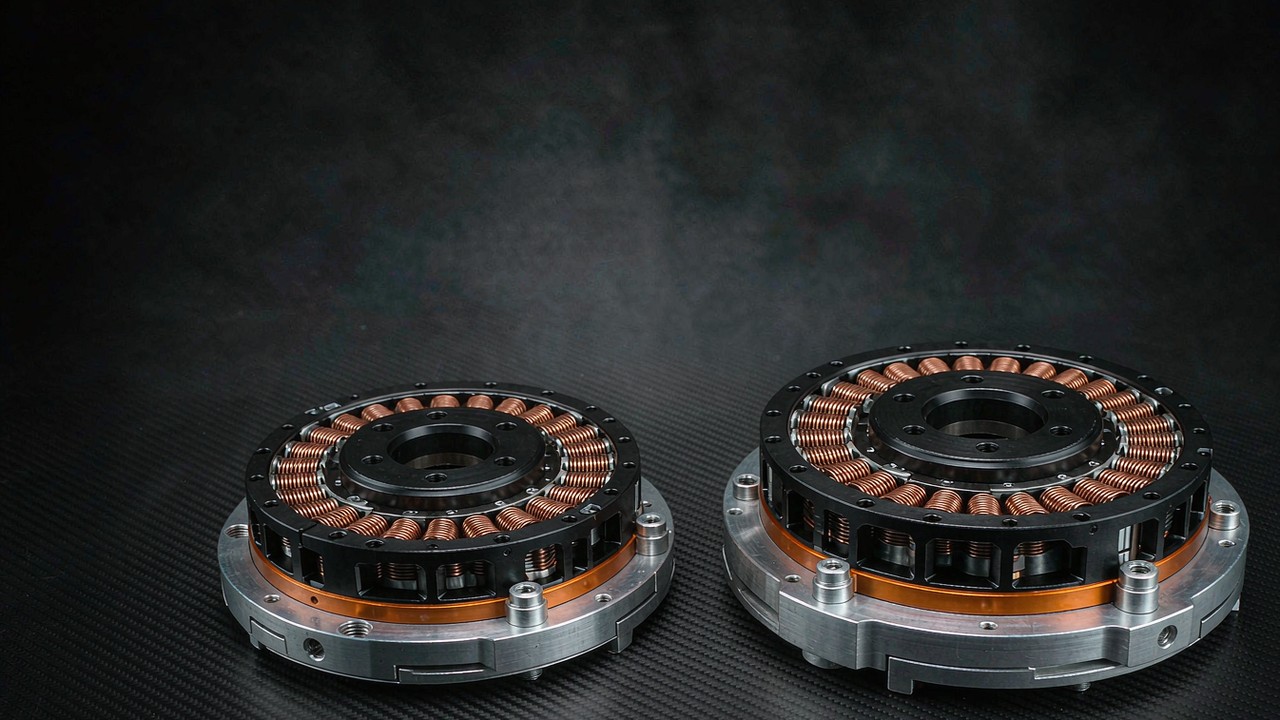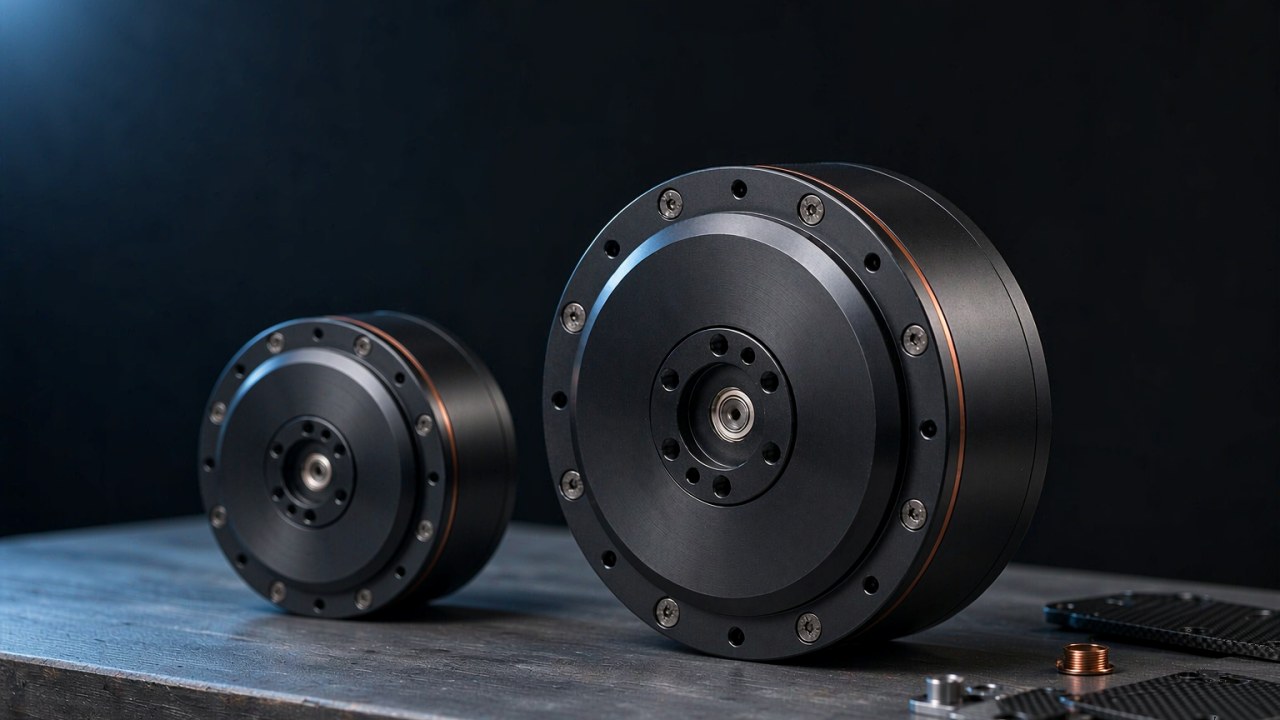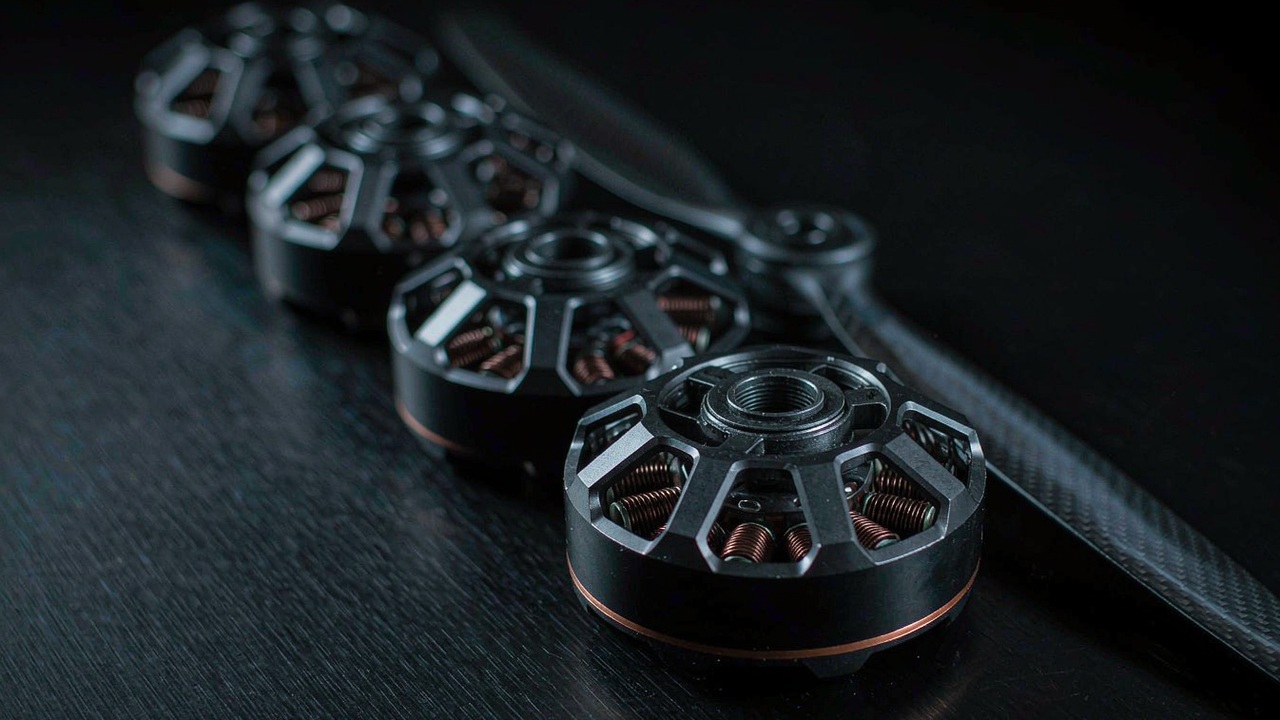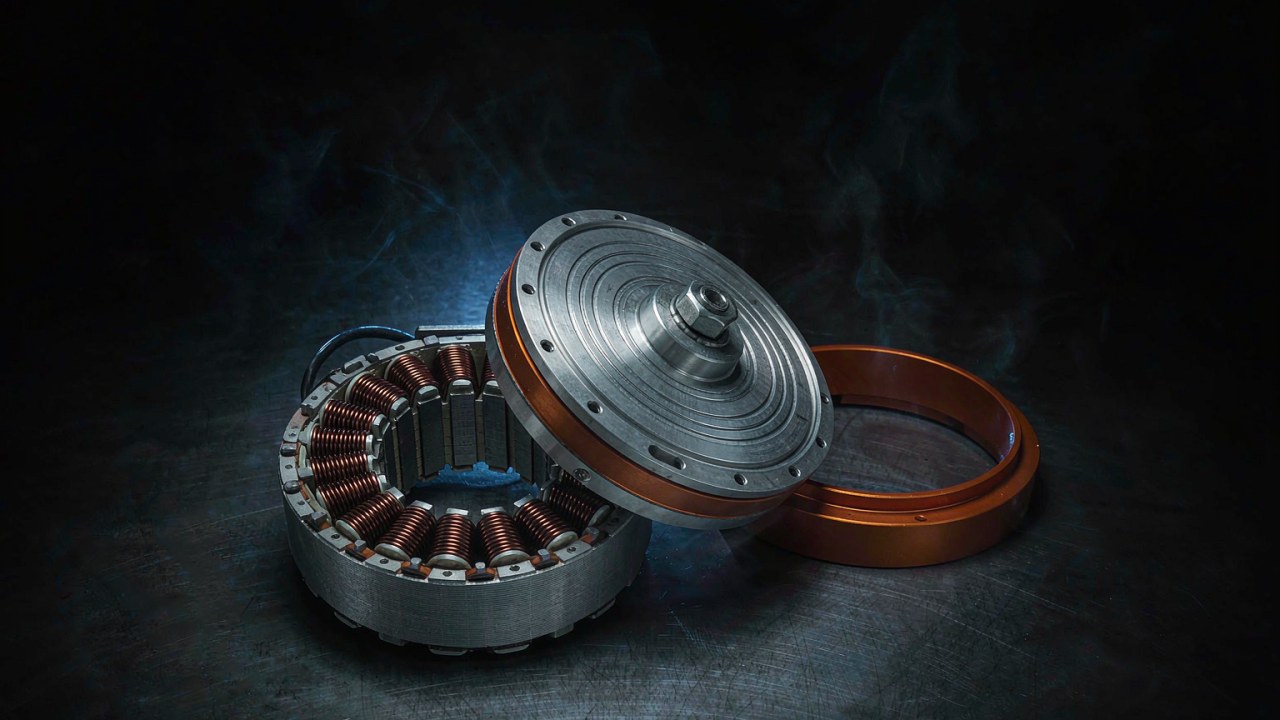

The T-Motor VL series is a family of 16 VTOL propulsion system sets built for the lift phase of fixed-wing vertical take-off and landing aircraft. Each set pairs a motor with a matched ESC and propeller, and the manufacturer publishes a recommended maximum take-off weight for a quadcopter frame at every step. This article maps those steps and shows how an airframe weight lands on one of them.
Quick Answer
The T-Motor VL series covers a published quadcopter MTOW from 12 kg to 150 kg across 16 sets, and every set is sold as a motor, an ESC and a propeller rather than as a bare motor. The range splits into three voltage bands: ten sets run on 12S, two on 14S and four on 24S. MTOW here means maximum take-off weight, and the manufacturer states the figure for a quadcopter frame, so a hexacopter or octocopter reaches the same total mass with a lower load on each arm.
Selection therefore starts from the airframe, not from the motor. Reading the T-Motor VL series from the bottom up is the shortest route from a take-off weight to a specific set, because the published steps are discrete and each one names its own VTOL propulsion system components. A platform already designed around a battery bus and a propeller diameter has narrowed the choice to a handful of steps before any model number is read. The VTOL Drone category collects the airframe duties this range serves.
What a T-Motor VL Series Propulsion Set Contains
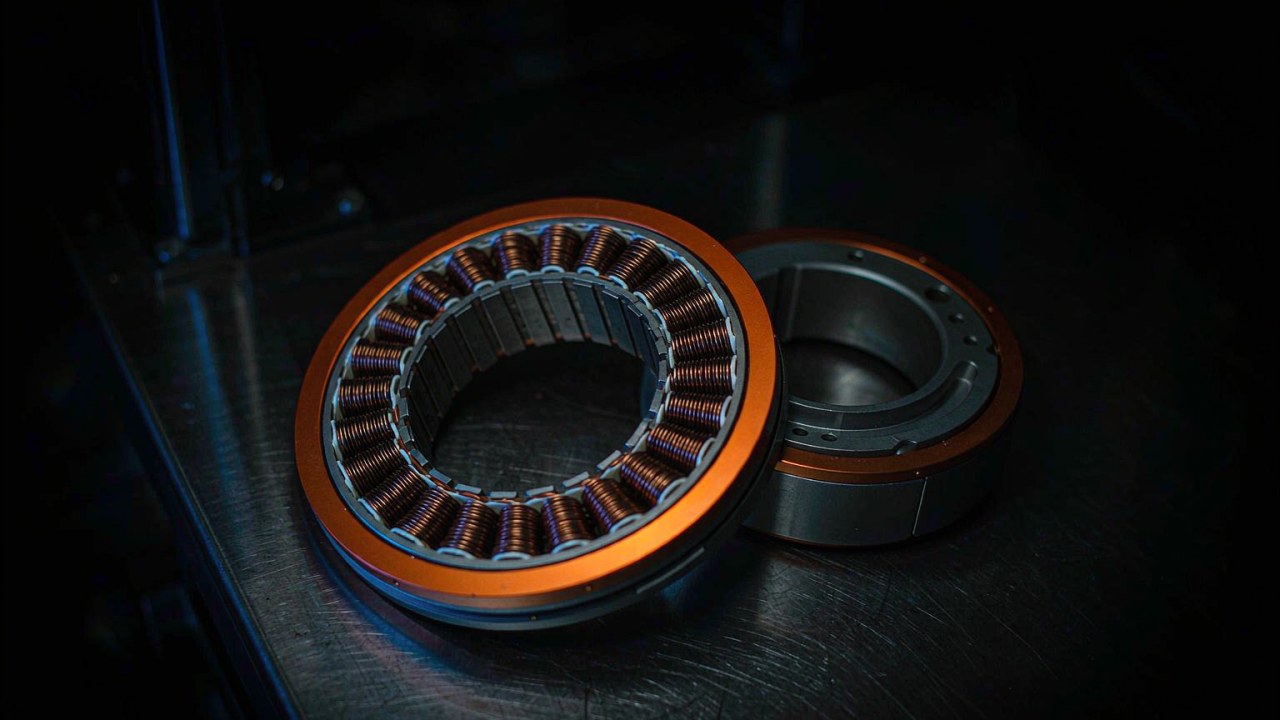
The range is not a line of standalone motors with accessories sold separately. Each entry in the T-Motor VL series is a propulsion set, and the three parts are matched at the factory: the motor, the ESC that drives it, and the propeller it was characterised with. Reading the range as a motor range misses the two components that decide whether the installation works. For a broader view of how this family sits beside fixed-wing and multirotor motors, the Drone Motors: FPV, Fixed-Wing and VTOL Motor Selection guide covers the wider field.
Motor, ESC and Propeller as One Set
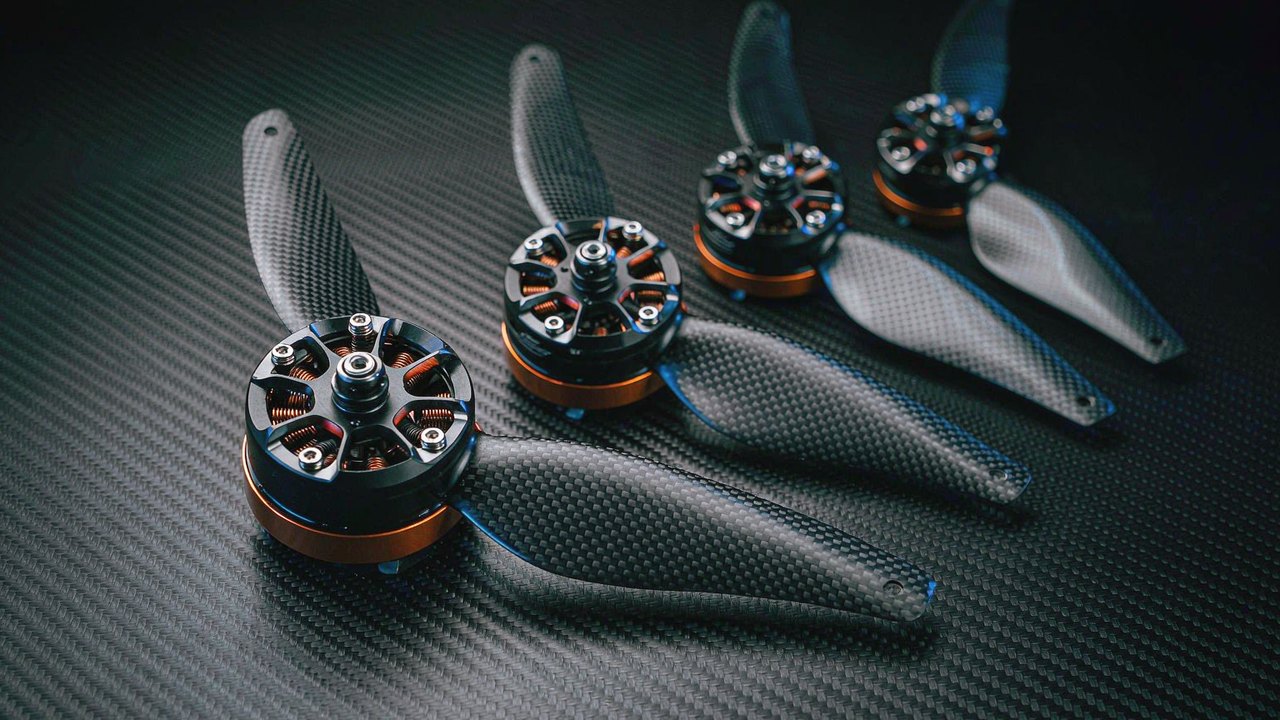
The propeller is part of the specification rather than an afterthought. The T-Motor VL series publishes a named propeller for every set, from the DZ17 × 6.2 on the smallest entry to the VZ45 × 18 on the largest, and the thrust figure quoted for that set belongs to that propeller. Fitting a different blade changes the load the motor sees, which changes the current the ESC has to deliver. The three parts move together, which is why a VTOL propulsion system is specified as a unit rather than assembled from parts chosen separately.
The ESC Mass Counts in the Empty Weight
An ESC is a separate item on the airframe, and at the top of the range a single unit is a substantial part of the lift hardware. The Motor weight column in the table below is motor mass as the manufacturer publishes it, cable included; it does not cover the ESC, the propeller, the mount or the wiring. An empty-weight budget built on that column alone understates the lift hardware, so the installed mass of the complete set is the figure the budget needs.
The MTOW Ladder: Quadcopter MTOW from 12 kg to 150 kg
The T-Motor VL series reads as a ladder because the jumps in recommended quadcopter MTOW are published and discrete. The bottom twelve entries cover 12 kg to 70 kg in steps of a few kilograms, and the four 24S entries take over from 90 kg. The steps are published bands rather than a continuous scale, so some weights fall between two entries instead of inside one. Reading the ladder from the bottom up shows where each step adds thrust and where it adds mass.
12S and 14S: 12 kg to 70 kg
Twelve sets cover the lower part of the range. The smallest, the VL5009 KV275, is published for a 12-15 kg quadcopter with 8624 g of thrust per arm and a 280 g motor. The ladder then climbs through the VL6011 KV180 and VL6013 KV210 for 15-22 kg, the VL7015 KV190 and VL8015 KV170 around 22-25 kg, the VL8018 KV180 and VL8020 KV170 for 30-35 kg, and the VL8022 KV170 at 40 kg. The 14S pair, the VL1035 KV150 and VL1040 KV150, closes this band at 55-70 kg with 36173 g and 45797 g of thrust per arm.
24S: 90 kg to 150 kg
Four sets carry the top of the ladder. The VL1155 KV65 is published for 90-105 kg with 57036 g of thrust per arm, the VL1165 KV60 for 115-125 kg with 66032 g, and the VL1180 KV60 and VL1380 KV60 both for 140-150 kg with 88075 g and 83024 g. All four run on a 24S bus and pair with the VL200A or VL300A ESC, which is a different controller family from the V60A to V200A units used lower down.
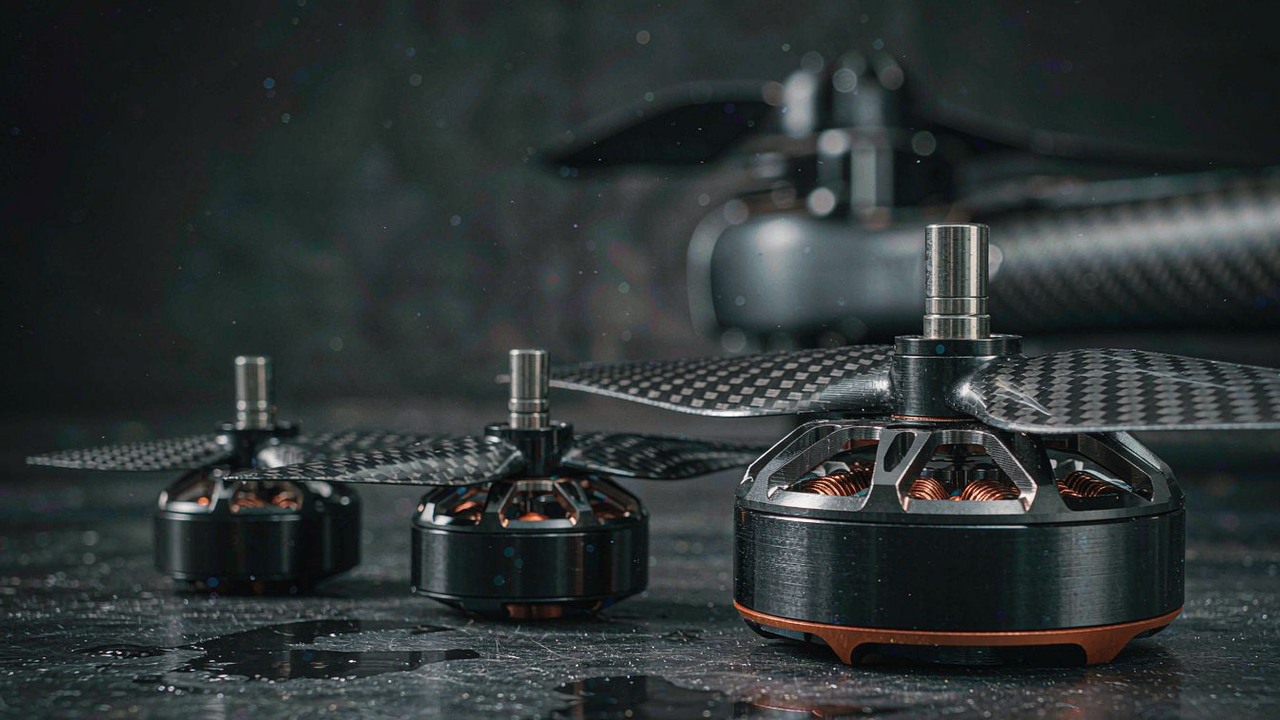
The manufacturer’s own clip shows the T-MOTOR VL Series VTOL Propulsion on Real Platforms, with the VL1155 KV65 under a salt-spray test and the VL7015 KV190 fitted as a complete set with its ESC and propeller.
The clip is worth watching before the table below, because it shows two ends of the same family under power rather than as bare hardware. T-MOTOR VL Series VTOL Propulsion on Real Platforms covers only those two models, and the ladder continues past both. Every quadcopter MTOW band in the T-Motor VL series is published for four arms, so the figure describes a complete airframe rather than a single motor.
Which End of the Range Fits Which Airframe
Take-off weight decides which end of the range a project belongs to, but rotor count and payload duty decide how much margin that end needs. A quadcopter at 40 kg and an octocopter at 40 kg do not land on the same entry: the second spreads the same mass over twice the arms, so the average load per arm falls. The published bands still describe a quadcopter, so the octocopter needs its own assessment rather than a rating carried over from the table.
Payload Duty and Rotor Count
The figures published for the T-Motor VL series assume four arms, and the MTOW bands are published for that configuration. In an idealised hover with the load shared evenly, adding lift arms lowers the average thrust each arm has to produce for a given aircraft mass, but that is an estimate rather than a step rule: a hexacopter or octocopter needs its own assessment of thrust margin, rotor interaction, control authority, transition behaviour and failure cases, and it carries more propulsion hardware than a quadcopter of the same mass. Payload mass is a separate question, because it raises the all-up weight and with it the lift requirement. Where the payload sits moves the centre of gravity and can raise the control and structural demands, but an offset payload at the same take-off weight does not by itself call for more thrust. Size the propulsion system against thrust and operating margin first, then verify centre-of-gravity limits, control authority and structural loads for the payload layout.
Rotor Count Is an Estimate, Not a Rating
The idealised relationship is inverse: doubling the arm count halves the average thrust each arm must produce for the same all-up weight. That is a first estimate for the hover case, not a conversion factor for the published MTOW, because the bands assume four arms and a set carried onto an octocopter has not been validated for that airframe. The direction that matters in practice is the other one: a set chosen around an octocopter and then fitted to a quadcopter frame is being asked for roughly twice the thrust it was specified for, and the published quadcopter MTOW is the figure that exposes the mismatch. Rotor count therefore comes before the model number in the sequence, and the complete aircraft still has to be checked in the configuration it will fly.
Why Propeller Locking Defines the Series
The capability the manufacturer leads with across the T-Motor VL series is the propeller lock, described as a 360 degree settable angle held by the ESC. On a fixed-wing aircraft that transitions from hover to wing-borne flight the lift propellers stop, and the parked blade has to sit in a known orientation rather than wherever the airflow leaves it, so the resting position belongs in the layout of the airframe rather than in the details left to chance.
360 Degree Propeller Locking
A stopped propeller that sits at an arbitrary angle sits in the airflow over the wing, and where it ends up changes from flight to flight. A lock that holds the blade at a chosen angle makes that position repeatable. The manufacturer states that the lock engages in seconds and that the angle is settable, which lets an airframe designer choose where the parked blade sits. Whether a given angle helps a particular wing depends on the airframe, the propeller and the installation, so the aerodynamic outcome is a property of the complete aircraft rather than of the lock on its own.
Holding Current in the Locked State
Holding a blade against the airflow takes torque, and the ESC supplies it as current. The manufacturer describes the ESC as adjusting the holding current to match the external load rather than holding a fixed value, and publishes a standby consumption of about 10 W in the locked state, which is what keeps the heat from the holding function low through cruise. The same ESC family is described as supporting CAN 2.0 on the controller side, the interface used to command and monitor the set from an autopilot in a T-Motor VL series installation.
Locking is only half of the transition problem. The two flight regimes ask different things of the same motor, and VTOL Drone Motors: Balancing Hover Thrust and Cruise Efficiency sets out how hover thrust and cruise efficiency pull in opposite directions once the lift phase ends.
Voltage Bands: 12S, 14S and 24S
The range is organised around three bus voltages, and the band a project sits in is usually fixed before the motor is chosen, because the battery pack and the airframe wiring are already decided by then. The manufacturer states that the series as a whole supports a 6S to 24S range, while the 16 published sets occupy 12S, 14S and 24S.
12S: Ten of the Sets
Ten sets in the T-Motor VL series run on a 12S bus, from the VL5009 KV275 up to the VL8022 KV170 and the VL1028 KV190 and VL1032 KV180 above them. This band carries the published quadcopter MTOW from 12 kg to 55 kg. The ESCs in this group run from the V60A at the bottom to the V200A at the top, and the motor mass climbs from 280 g to 1090 g across the same span.
14S: Two Sets
Two sets step up to 14S: the VL1035 KV150 at 1205 g and the VL1040 KV150 at 1100 g. Both are published for the 55-70 kg band, and both are rated at 150 KV. The 14S bus is what separates this pair from the 12S group: for a given electrical power level and comparable system efficiency, a higher bus voltage generally means lower supply current, while the current an aircraft actually draws follows its operating point rather than the voltage label.
24S: Four Sets
Four sets run on 24S and cover 90 kg to 150 kg of quadcopter MTOW. The jump from the 14S pair to the VL1155 KV65 is the largest single step in the T-Motor VL series, and it comes with a change of controller family to the VL200A and VL300A ESCs. A project that crosses that step is changing bus voltage and controller family along with the motor, so the top of the range is a different power train rather than a larger version of the one below it.
ESC and Propeller Pairing in a VTOL Propulsion System
Because each set in the T-Motor VL series is matched at the factory, the ESC and propeller published alongside a motor are the pairing the thrust figure belongs to. Replacing either part moves the set outside its published configuration, and the numbers no longer describe what the airframe will do. Treating the pairing as fixed is the simplest way to stay inside the published envelope of a VTOL propulsion system.
Eight ESC Ratings Across the Range
The T-Motor VL series uses eight ESC ratings: V60A, V80A, V120A, V150A, V200A, VL248A, VL200A and VL300A. The V-series units serve the 12S and 14S sets, while the VL-series units serve the top of the range. The step from V150A to V200A happens between the VL8022 KV170 and the VL1028 KV190, and the step to the VL-series controllers happens at the 24S boundary.
Swapping a Propeller Changes the ESC
A larger propeller absorbs more torque at the same speed, which raises current for a given thrust. If the ESC was sized for the published blade, the margin it had is consumed by the change. In practice a propeller swap on a matched set is a four-part question: whether the motor can carry the load, whether the ESC can deliver the current, whether the motor and ESC stay inside their thermal limits, and whether the airframe still has the ground clearance for the larger disc. Any of the four failing takes the installation outside the published VTOL propulsion system configuration.
T-Motor VL Series Spec Matrix
The table below lists all 16 sets in the T-Motor VL series as published, ordered by recommended quadcopter MTOW. Model names include the KV rating, and the voltage column identifies the bus each set runs on.
| Model | Voltage | Motor weight (g) | Max thrust per arm (g) | Recommended MTOW (kg) | ESC | Propeller |
|---|---|---|---|---|---|---|
| VL5009 KV275 | 12S | 280 | 8624 | 12-15 | V60A | DZ17 × 6.2 |
| VL6011 KV180 | 12S | 300 | 10464 | 15-18 | V60A | VZ22 × 7.4 |
| VL6013 KV210 | 12S | 388 | 12889 | 20-22 | V80A | VZ22 × 7.4 |
| VL7015 KV190 | 12S | 540 | 15867 | 22-24 | V80A | P24 × 7.2 |
| VL8015 KV170 | 12S | 610 | 14754 | 25 | V80A | VZ26 × 9.5 |
| VL8018 KV180 | 12S | 655 | 17129 | 30-32 | V120A | VZ26 × 9.5 |
| VL8020 KV170 | 12S | 735 | 19679 | 35 | V150A | VZ28 × 10.8 |
| VL8022 KV170 | 12S | 785 | 22268 | 40 | V150A | VZ29 × 11 |
| VL1028 KV190 | 12S | 940 | 26322 | 45-50 | V200A | VZ29 × 11 |
| VL1032 KV180 | 12S | 1090 | 31766 | 50-55 | V200A | G30 × 10.5 |
| VL1035 KV150 | 14S | 1205 | 36173 | 55-60 | V200A | PL32 × 11 |
| VL1040 KV150 | 14S | 1100 | 45797 | 65-70 | VL248A | VZ32 × 12 |
| VL1155 KV65 | 24S | 1420 | 57036 | 90-105 | VL200A | VZ40 × 16.1 |
| VL1165 KV60 | 24S | 1710 | 66032 | 115-125 | VL200A | VZ42 × 16.5 |
| VL1180 KV60 | 24S | 2680 | 88075 | 140-150 | VL300A | VZ45 × 18 |
| VL1380 KV60 | 24S | 2400 | 83024 | 140-150 | VL300A | VZ45 × 18 |
Recommended MTOW is the manufacturer’s published figure for a quadcopter. Max thrust per arm and motor weight are the manufacturer’s published values for the matched set, and the test conditions behind the thrust figure are given on each product page.
Motor mass grows from 280 g to 2680 g across the table, and thrust per arm grows from 8624 g to 88075 g, so the two ends are roughly a factor of nine apart in mass and a factor of ten apart in thrust. That comparison holds for the ends of the table rather than for every row: the ratio of published thrust per arm to motor mass runs from about 24 g/g on the VL8015 KV170 to about 42 g/g on the VL1040 KV150. The ratio is arithmetic on two published values, not a measure of efficiency and not a prediction for an installed airframe.
The 24S group is where the ladder stops being gradual. Between the VL1040 KV150 at 65-70 kg and the VL1155 KV65 at 90-105 kg there is a jump in every column at once: voltage, motor mass, ESC family and thrust. A project in that gap is not choosing between adjacent entries, it is choosing which side of a power-train change to design around.
The two 24S entries published at 140-150 kg, the VL1180 KV60 and the VL1380 KV60, share a bus voltage, an ESC and a propeller size, and differ in published motor mass and thrust per arm. The manufacturer lists them as 36N40P and 36N42P, so the difference in slot and pole count is on the specification rather than inferred from the table. The table alone does not explain the mass and thrust split, and the product pages are the place to compare the full specification and the test conditions before treating either entry as interchangeable with the other.
Matching a Set to an Airframe: A Sizing Sequence
The sequence below turns a take-off weight into one entry in the T-Motor VL series. Each step narrows the field, and the order matters because a later step can invalidate an earlier choice.
Step 1: Fix the MTOW
Start from the all-up mass the aircraft will actually fly at, including battery, payload and lift hardware. The published figures are for a quadcopter, so note the arm count alongside the mass. A mass that sits mid-band is the easiest case; a mass that sits at the top of a band has no margin left for a heavier battery.
Step 2: Divide by Arm Count
Divide the all-up mass by the number of lift arms to get the average load each arm carries in hover, assuming the load is shared evenly. That figure is an average thrust requirement rather than a sizing criterion on its own: the chosen set has to hold thrust margin for the conditions the aircraft will fly in, and the published thrust figure has to be read with the manufacturer’s test conditions attached. Compare the result against thrust per arm rather than against recommended MTOW, then check the complete aircraft across hover, transition and the rest of the flight envelope, including its structural and control limits.
Step 3: Land on a Voltage Band
If the pack is already chosen, the voltage band is fixed and the candidate list shrinks to the twelve 12S and 14S sets or to the four 24S sets. If the pack is still open, the take-off weight decides the band first: the 24S group carries every entry above 70 kg, so no 12S or 14S option reaches that part of the range.
Step 4: Check the ESC and Propeller
Confirm that the ESC published with the chosen set can carry the current the airframe will draw, and that the propeller diameter fits the ground clearance and the wing layout. A set that fits on thrust but not on propeller diameter is not a fit, and the pairing is not adjustable without leaving the published configuration.
Step 5: Check Bus Voltage and Bus Current
The last check is the power train as a whole. Bus voltage is set by the pack, and bus current is the sum of what the ESCs draw. A 24S installation at the top of the range pulls current that the wiring, connectors and distribution board all have to carry. The general sizing logic behind thrust margin and thermal margin is set out in High Thrust Drone Motor Sizing: Payload, Efficiency, and Thermal Margin, and it applies unchanged once a set has been chosen here.
Frequently Asked Questions
QWhich set in the T-Motor VL series suits a 25 kg quadcopter?
The VL8015 KV170 is the entry published at 25 kg, with 14754 g of thrust per arm and a V80A ESC. The VL7015 KV190 covers 22-24 kg and is the step below it.
QWhich set suits a 100 kg quadcopter?
The VL1155 KV65 is published for 90-105 kg with 57036 g of thrust per arm, a 1420 g motor and the VL200A ESC. It is the first step into the 24S band, and the first set in the range that runs on a VL-series ESC.
QHow many arms does the published quadcopter MTOW assume?
The figures are published for a quadcopter. A hexacopter or octocopter of the same all-up mass carries less load per arm, so the thrust per arm for the candidate set is the figure to compare against rather than the recommended MTOW.
QIs a propulsion set heavier than buying the parts separately?
The same three components are involved either way, and the ESC is the one most often left out of an empty-weight budget. What the matched set provides is a published thrust figure that belongs to that exact motor, ESC and propeller combination, together with the test data behind it.
QCan a 12S set run on a 24S bus?
Not on the same settings. The motor, ESC and propeller are matched within a voltage band, and the ESC rating is tied to the bus it was published for. Whether any part of a set can be reused on a higher bus depends on its own voltage limit and the manufacturer’s specification, so the working assumption is that the set is replaced rather than reconfigured.
QWhat changes when the propeller is swapped on a set?
Thrust, current and the load on the ESC all change together. A larger disc absorbs more torque at the same speed, so the ESC current margin is the first thing to check, the thermal margin of the motor and ESC is the second, and the ground clearance is the third.
QWhat does the fixed-angle propeller lock change for a fixed-wing airframe?
A stopped lift propeller held at a chosen angle has a repeatable position instead of sitting wherever it happened to settle, which is what makes the parked orientation something the airframe can be designed around. The manufacturer describes the lock as a 360 degree settable angle, and how much a given angle helps depends on the wing and the installation.
Official resources
The 16 product pages carry the full specification and test data for each set, and the manufacturer page links the wider programme. T-Motor is the manufacturer for every entry in the table above, and each product page repeats the VTOL propulsion system pairing for that set.
Where to go next
The ladder answers the weight question. The flight-regime question, the thrust-margin question and the transition problem are covered elsewhere on the site, and the product pages carry the detail behind each row of the matrix.
VTOL Drone Motors: Balancing Hover Thrust and Cruise Efficiency sets out the two-regime problem. Drone Motors: FPV, Fixed-Wing and VTOL Motor Selection places the T-Motor VL series beside other fixed-wing and multirotor families. High Thrust Drone Motor Sizing: Payload, Efficiency, and Thermal Margin carries the sizing logic further once a set has been chosen, and the VTOL Drone category page collects the airframe duties the range serves.