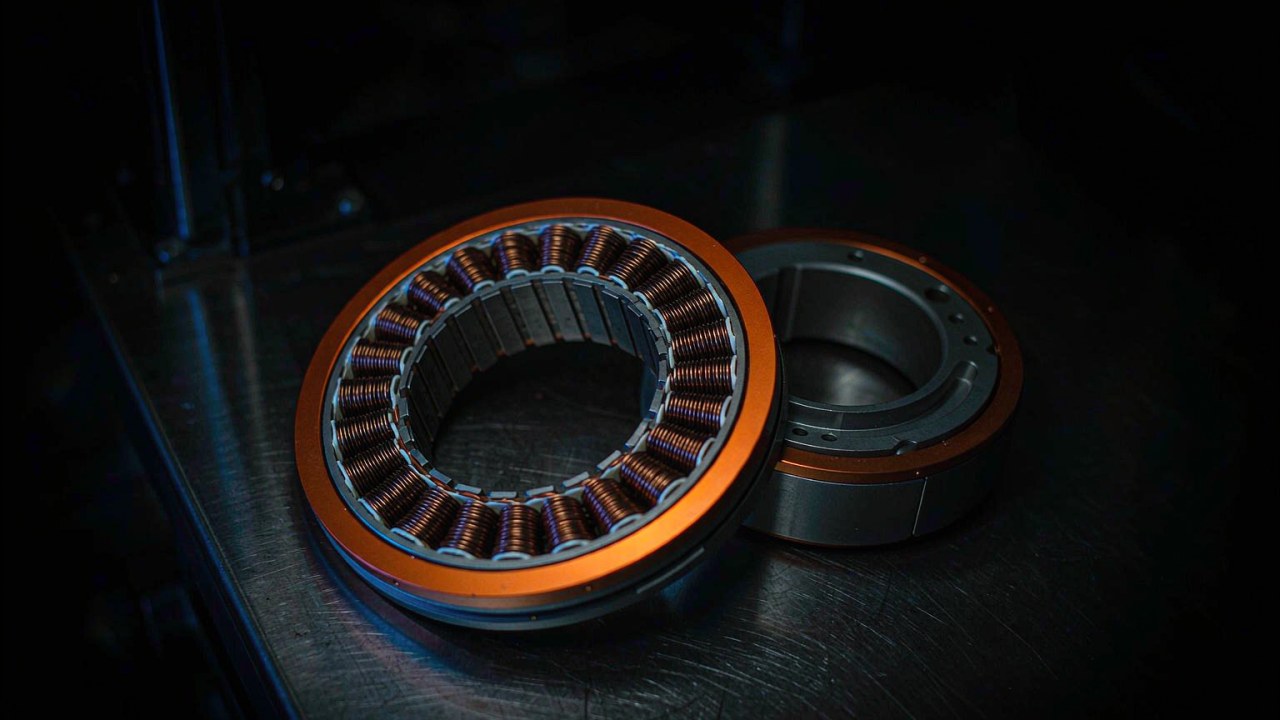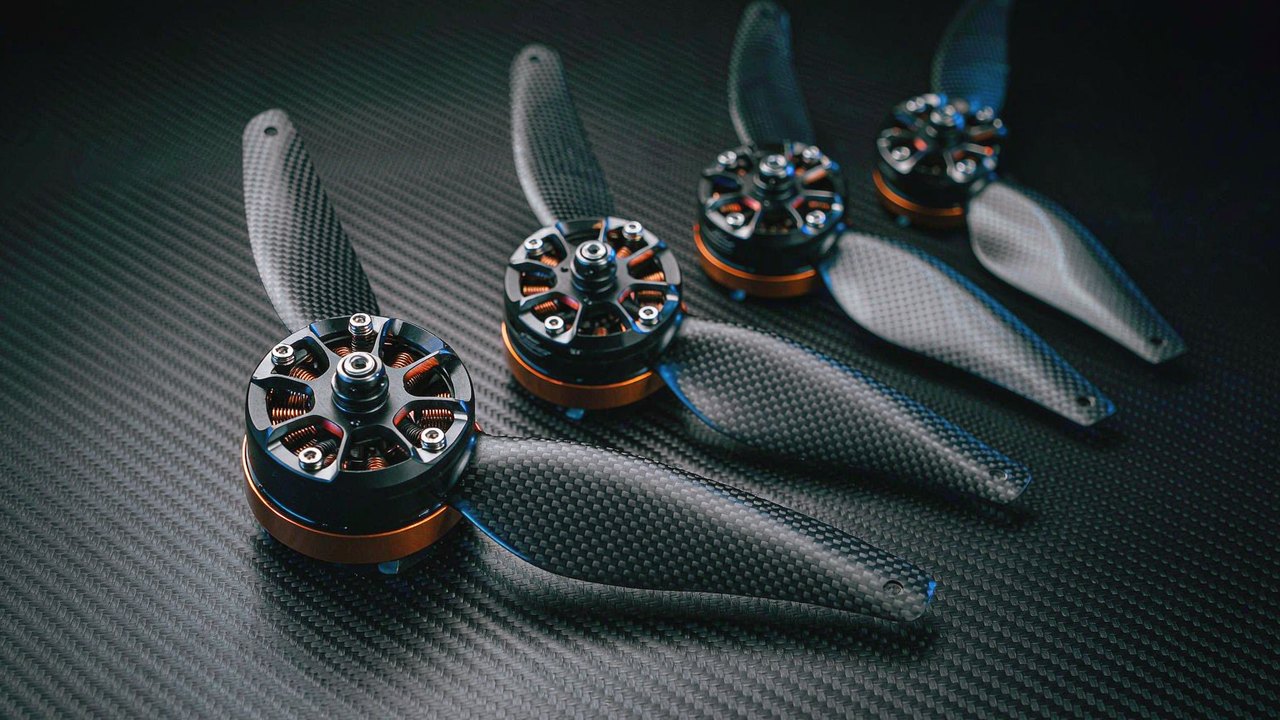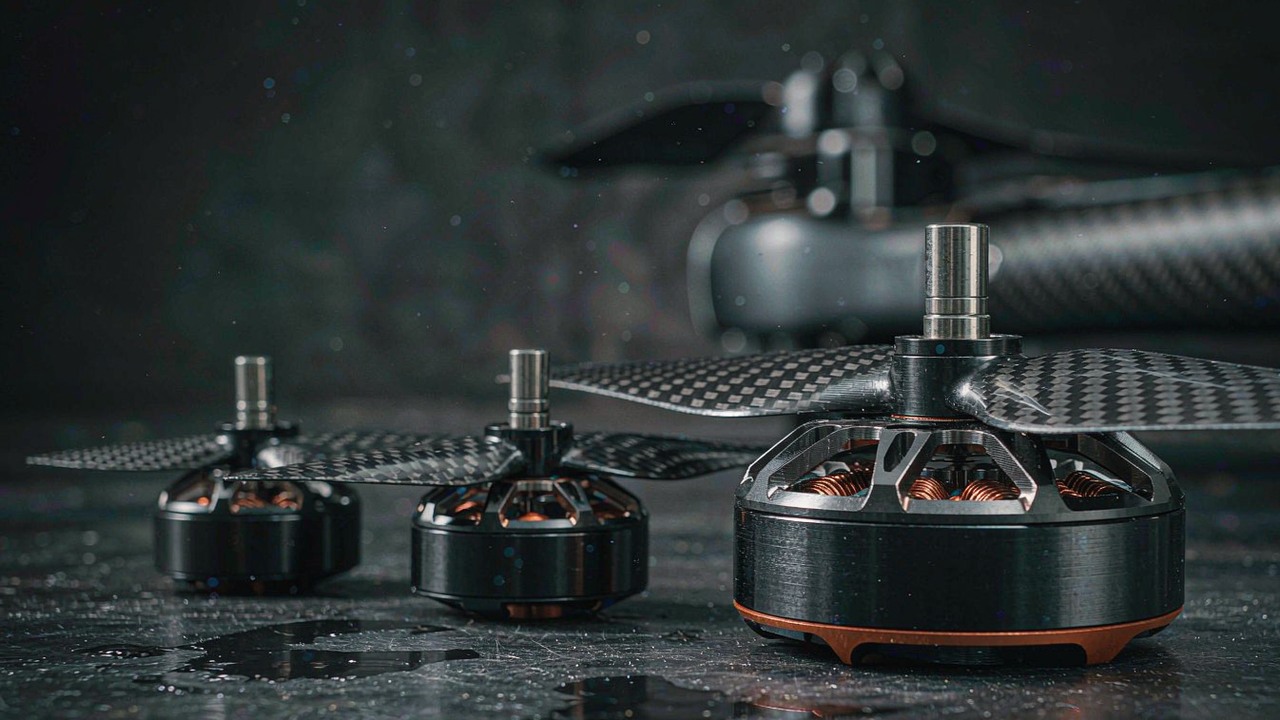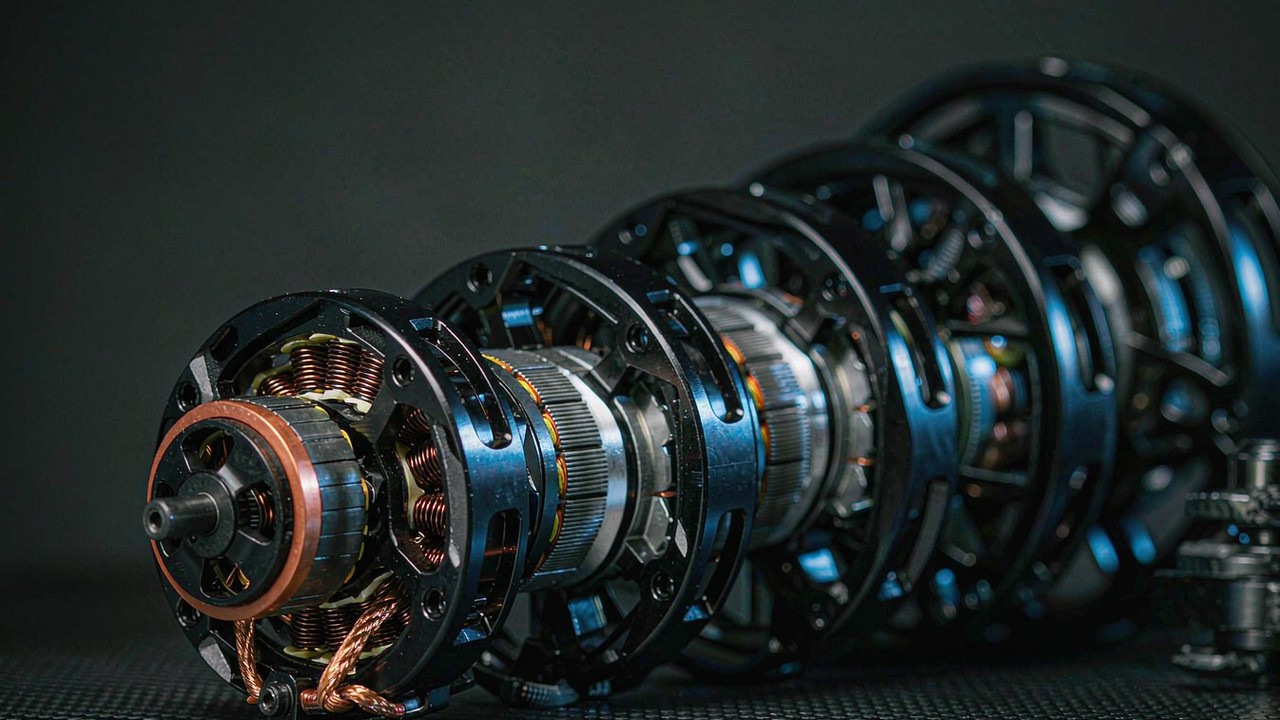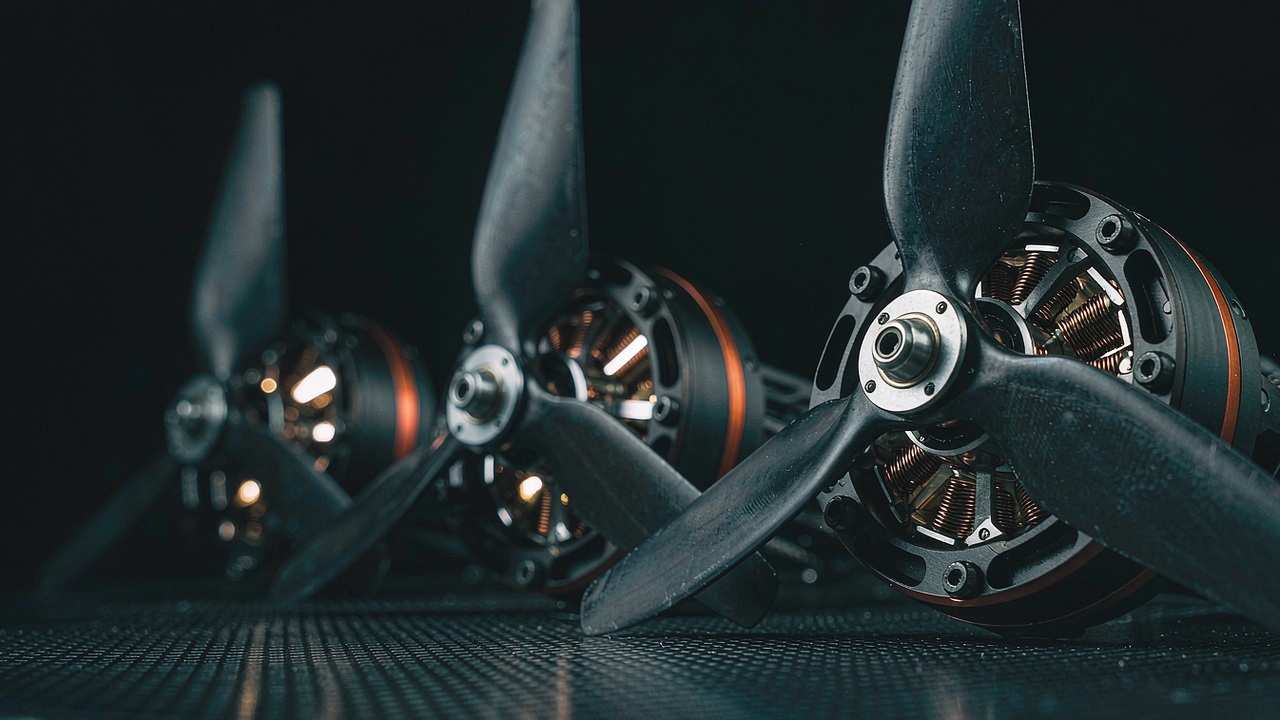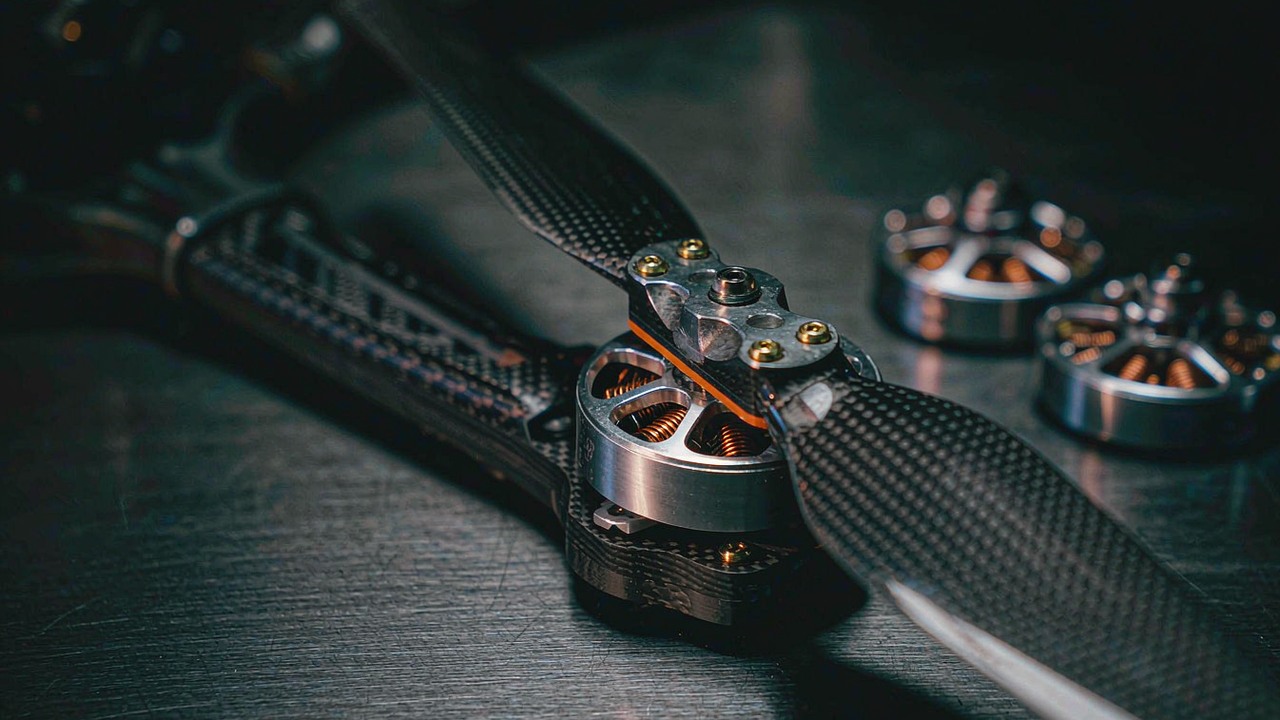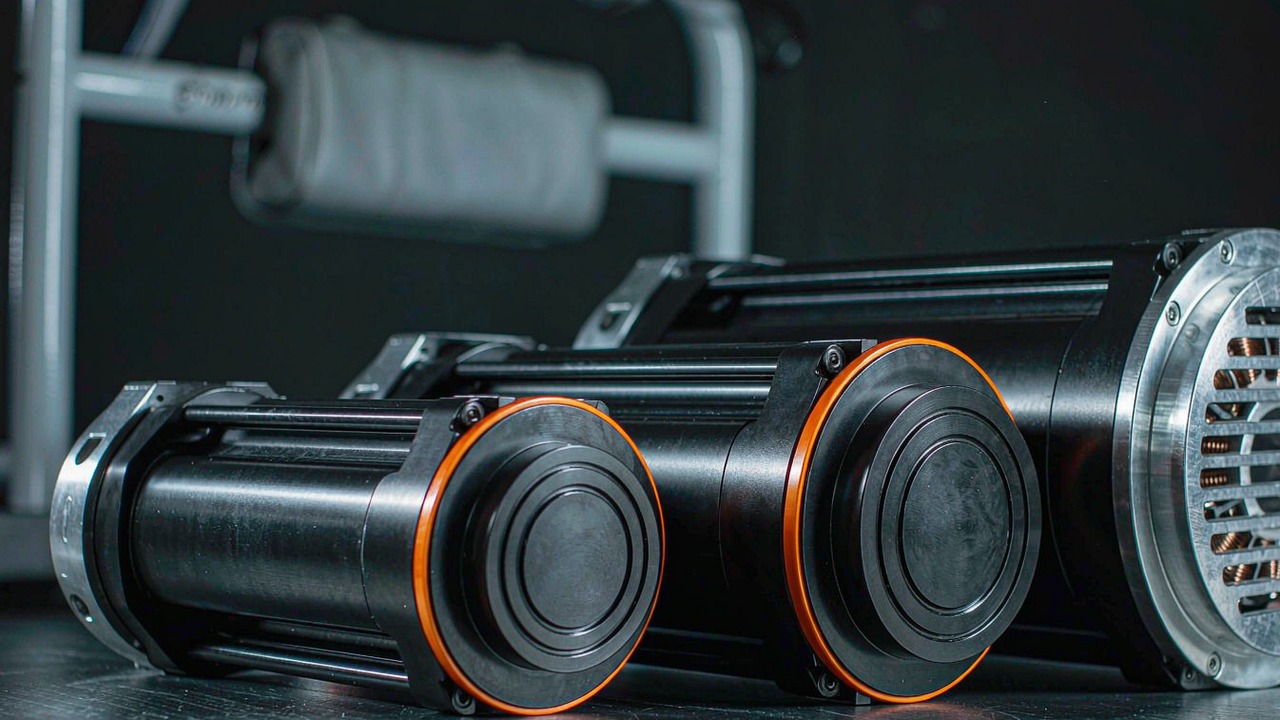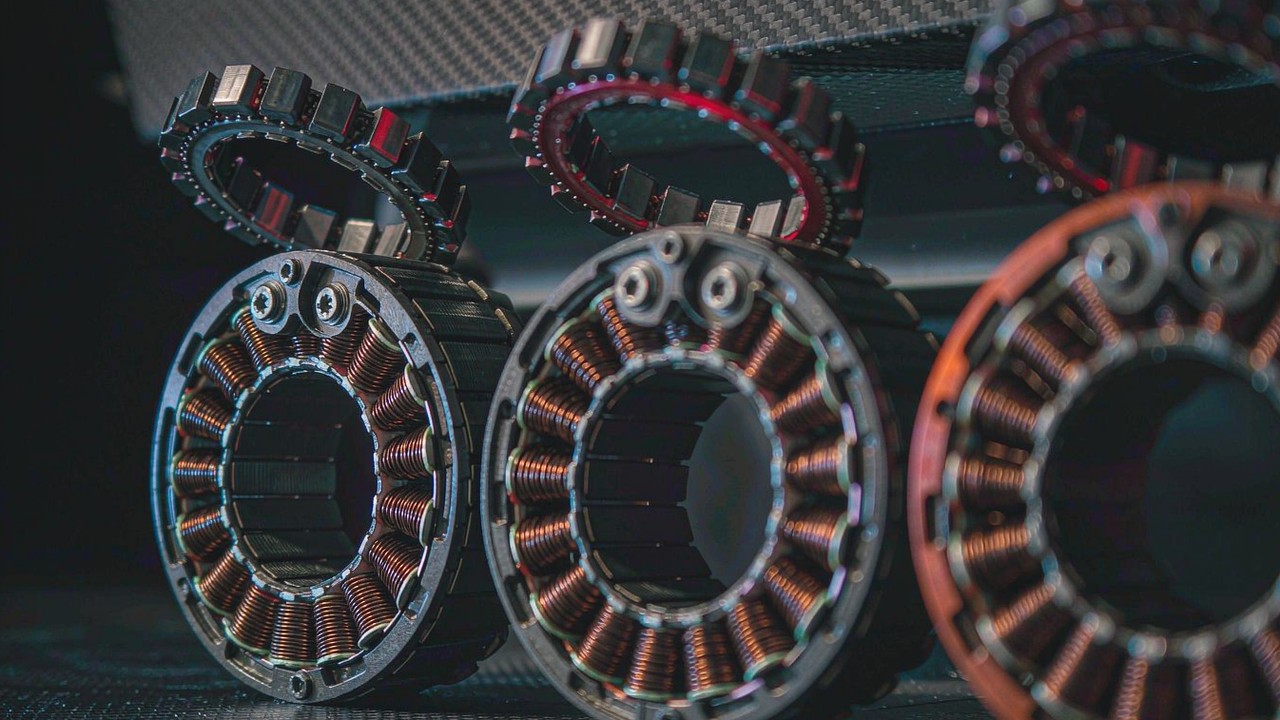
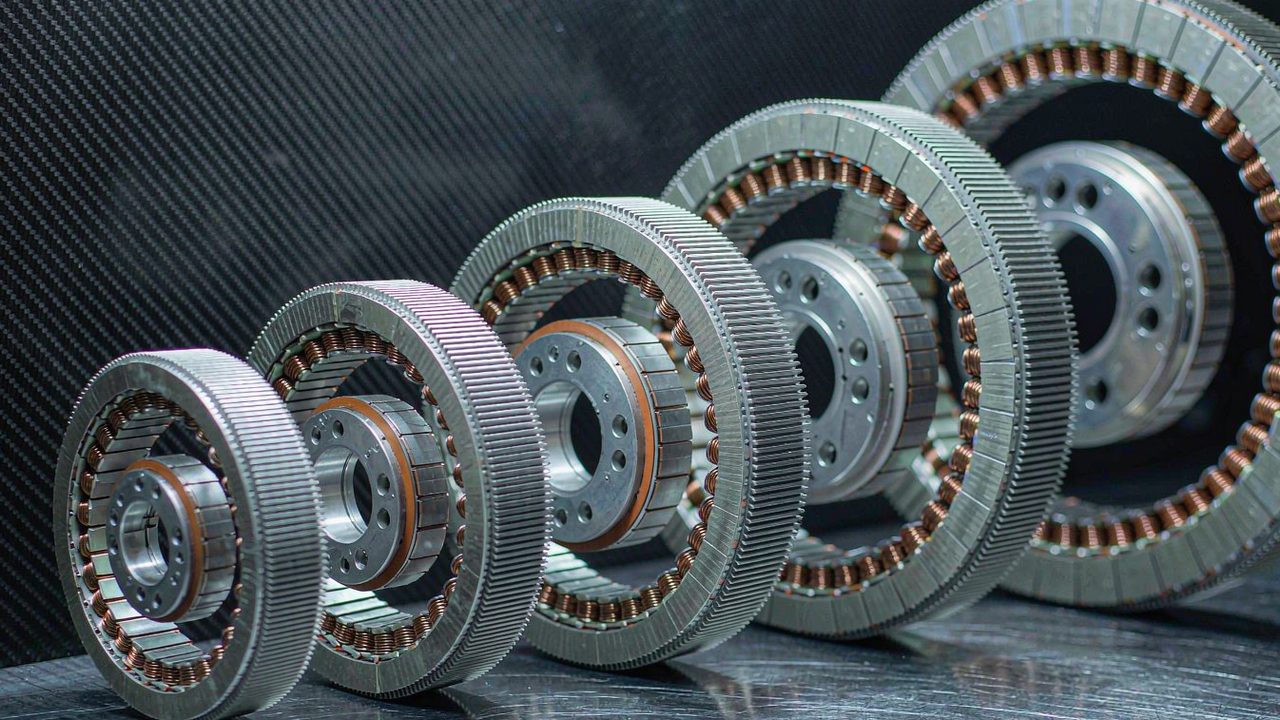
A frameless torque motor arrives as two parts with nothing between them: a stator wound and laminated to a frame size, and a rotor carrying the magnets, with no housing, no bearing stack of its own and no shaft. That is the whole proposition, and it is also why the twelve kits currently listed in the Frameless Torque Motors category cannot be lined up on one axis and read off in order. Two of the twelve weigh 40 g or less, and their published peak torque is measured in hundredths of a newton metre. One is rated for 838 W and publishes 12 Nm. Between the 20 g entry point and the 710 g top of the range the published peak torque spans from 0.072 Nm to 12 Nm, and a unit from either end of that spread is not a substitute for one from the other in any application. The useful question is therefore not which of the twelve is strongest, but where the boundary falls between the band that suits a distal, lightly loaded axis, the band that suits a working joint carrying a person or a payload, and the band that has to move a machine rather than a link.
Quick Answer
Sorted by published peak torque, the twelve units fall into three bands that do not overlap and are separated by clear gaps in the record: four units at or below 1 Nm peak between 20 g and 105 g, four units between 1.63 Nm and 2.68 Nm peak between 156 g and 270 g, and four units at 4 Nm peak and above between 352 g and 710 g. That ordering is not a marketing split. It is the ordering in which the published rated current climbs, the ordering in which the outer diameter climbs, and the ordering in which the winding moves from a single 16 V or 24 V design onto a 48 V bus or a multi-bus design that can actually carry the current a bigger winding asks for. Read across the Frameless Torque Motors category as a whole, that ladder is why the twelve cannot be collapsed into one ranking of strength.
Two structural facts cut across all three bands and matter more than the bands themselves. The first is the layout: seven of the twelve are inrunners, with the magnets on an inner rotor and the winding carried by the outer stator, and five are outrunners that reverse that arrangement. The second is feedback: three of the twelve records describe a kit supplied with Hall sensors and two describe a kit supplied without them, while the remaining seven records - all of them in the RI line - do not state the feedback arrangement at all, and that difference changes what the integrator has to add before the motor can be commutated at low speed. Where none of the twelve lands inside a required envelope, the frameless format is the one that can be re-specified, and the manufacturer behind these kits documents a route for that request.
Key Evaluation Metrics: How These 12 Motors Were Categorized
Five published quantities carry the categorisation below, and they are read in this order because each one narrows what the next has to explain. All twelve records publish every one of them, which is what makes a tiered comparison of this family possible at all.
Peak torque sets the tier boundary
Every unit here publishes two torque figures, and the tier boundaries in this guide are drawn on the larger of the two. Peak torque describes what the winding can produce for a short interval before either the drive reaches its current limit or the magnets lose their working point; it is a statement about a window rather than a capability, and it is the honest way to separate kits whose continuous ratings are close together. Read that way the twelve sort cleanly: 0.072 Nm, 0.23 Nm, 0.6 Nm and 0.9 Nm in the first band, then 1.63 Nm, 1.67 Nm, 2.4 Nm and 2.68 Nm, then 4 Nm, 4.1 Nm, 4.95 Nm and 12 Nm. The gaps between the bands - from 0.9 Nm to 1.63 Nm, and from 2.68 Nm to 4 Nm - are nearly a factor of two each, so a unit placed on the wrong side of a boundary is not a marginal call.
Rated torque is the continuous figure
The smaller of the two torque columns is the one a joint has to live with. Rated torque is the torque a kit can hold while the winding stays inside its insulation class, and unlike the integrated actuators in the Robotic Actuators category it is quoted at the motor rather than behind a gear stage, because a frameless kit has no gear stage. Across the twelve the ratio of peak to rated sits between about 2.8 and about 3.1 on every record, which is arithmetic on the two published columns, so the two figures move together and neither can be used to find a hidden bargain. What does not move together is torque per unit of mass: the two smallest kits publish about 3.6 and about 5.8 Nm of peak torque per kilogram, while the units from 60 g upward run between about 8.6 and about 16.9 Nm/kg on the same arithmetic. The smallest frames are the least efficient per gram, which is why the entry band exists as a band and not merely as a cheap version of the top one.
Current, power and the bus behind them
Rated current is the number that decides what a battery and a driver have to supply and how much heat has to leave the winding, and it is the column that most clearly separates the bands. The first band draws between 1.47 A and 3.4 A at rated, the second between 4.8 A and 7.1 A, and the third between 8.5 A and 20 A. Rated power follows the same ladder, from 18 W at the entry point to 838 W at the top, and the voltages behind those figures move with them: the smallest kit is rated at 16 V, the entry band and part of the middle band at 24 V, and the top band at 48 V, where five of the middle units publish operating points on 24 V, 36 V and 48 V rather than a single bus. One consistency is worth recording because it is not universal in this platform's records: multiplying rated torque by rated speed on each of the twelve and converting radians per second to revolutions per minute reproduces the published rated power within about four per cent on every single record, so the three columns were taken under one set of conditions and can be cross-read.
Envelope and mass in a kit with no housing
Diameter in this family runs from 25 mm to 113.5 mm and stack length from 13 mm to 36.2 mm, and because there is no housing the published dimension is the stator itself rather than a finished package - the integrator supplies the bearings, the shaft and the mounting, so the radial room a design has to find is the winding and the rotor, and the axial room is one stack. Mass is the honest proxy for how much of that room is filled: 20 g, 40 g, 60 g and 105 g in the entry band, 155.9 g to 270.4 g in the middle, and 352 g to 710 g at the top. In a frameless joint that mass sits where the motor sits, which for a distal axis is the whole argument for choosing this class at all.
Whether the kit carries hall sensors
Three of the twelve records name a kit supplied with Hall sensors and two name one supplied without, and the split falls along the RO line rather than the RI line: the RO40 KV140 Lite and RO50 KV108 Lite records are the two marked as supplied without Hall sensors, while the RO60, RO80 and RO100 Standard records are marked as supplied with them. That single word changes the surrounding design. A kit without Hall sensors has to be commutated from a position estimate derived from the winding itself, or from an encoder the integrator fits, and at low speed or at standstill - which is where a holding joint spends much of its time - the estimate is harder to obtain than it is in motion. A kit with Hall sensors gives a coarse absolute position out of the box and simplifies the start-up path, at the cost of a sensor harness inside the joint envelope. Neither is better in the abstract; what matters is that the difference is stated in the record rather than discovered after the mount is machined.
12 Frameless Torque Motors Specs Comparison Matrix
The table below reads every frameless torque motor currently listed in the Frameless Torque Motors category as one specification set, ordered by published peak torque because that is the axis the tiers are drawn on. Every figure is the manufacturer's published value held in this platform's product records. Speeds are motor-side, which for a frameless kit with no reduction stage is also the joint-side figure after any gearing the integrator adds.
| Model | Rated Torque | Peak Torque | Rated Power | Rated Speed | Envelope (Ø × L) | Mass |
|---|---|---|---|---|---|---|
| RI20 KV600 | 0.024 Nm | 0.072 Nm | 18 W | 7452 rpm | 25 × 14.5 mm | 20 g |
| RI30 KV260 | 0.076 Nm | 0.23 Nm | 33 W | 4110 rpm | 38 × 14 mm | 40 g |
| RO40 KV140 Lite | 0.2 Nm | 0.6 Nm | 51 W | 2450 rpm | 46.3 × 13 mm | 60 g |
| RO50 KV108 Lite | 0.3 Nm | 0.9 Nm | 66 W | 2100 rpm | 61.7 × 14.5 mm | 105 g |
| RI60 KV120 | 0.57 Nm | 1.63 Nm | 85 W | 1440 / 2320 / 3190 rpm | 60 × 23 mm | 155.9 g |
| RI50 KV100 | 0.58 Nm | 1.67 Nm | 66 W | 1090 / 1860 / 2600 rpm | 54 × 27 mm | 180.8 g |
| RO60 KV115 Standard | 0.8 Nm | 2.4 Nm | 352 W | 4200 rpm | 73.8 × 23 mm | 248 g |
| RI70 KV95 | 0.94 Nm | 2.68 Nm | 125 W | 1270 / 1990 / 2710 rpm | 76 × 24 mm | 270.4 g |
| RO80 KV105 Standard | 1.3 Nm | 4 Nm | 490 W | 3600 rpm | 92.6 × 26.4 mm | 352 g |
| RI80 V2.0 KV75 | 1.45 Nm | 4.1 Nm | 172 W | 1135 / 1785 / 2430 rpm | 85 × 27 mm | 411 g |
| RI100 KV105 | 1.76 Nm | 4.95 Nm | 252 W | 1370 / 2100 / 2825 rpm | 104 × 26 mm | 500 g |
| RO100 KV55 Standard | 4 Nm | 12 Nm | 838 W | 2000 rpm | 113.5 × 36.2 mm | 710 g |
Published rated and peak torque, rated power, rated speed at rated torque, stator envelope as outer diameter by stack length, and mass, for the frameless torque motors currently listed in the Frameless Torque Motors category, ordered by peak torque. Rated torque is the continuous figure within the winding's thermal limits; peak torque is a short-window figure. A single speed figure means a single-bus kit; three figures are the 24 V, 36 V and 48 V operating points in that order. These are bare stator and rotor kits, so no reduction ratio, no backlash and no output-side rating appears in any of the twelve records.
Two readings stand out once the twelve are on one page. The first is that the bands are separated by gaps in the record rather than by a chosen cut point. Between the 105 g RO50 KV108 Lite at 0.9 Nm peak and the 155.9 g RI60 KV120 at 1.63 Nm peak there is no unit at all, and the same is true between the 270.4 g RI70 KV95 at 2.68 Nm and the 352 g RO80 KV105 Standard at 4 Nm. A shortlist that needs, say, 1.2 Nm peak and 130 g cannot be satisfied by moving halfway between two neighbours, because there is no neighbour there.
The second is that mass and torque per unit mass point in opposite directions at the small end. The 20 g RI20 KV600 publishes 3.6 Nm of peak torque per kilogram and the 40 g RI30 KV260 about 5.8, while the 60 g RO40 KV140 Lite already reaches about 10 and the 710 g RO100 KV55 Standard about 16.9 - all four figures arithmetic on the published torque and mass columns. Reading that as a defect in the small kits misreads it. A 20 g frame has less iron, a shorter magnetic path and proportionally more of its mass in copper that cannot carry the flux the geometry allows, so the small end buys resolution and proximity, not density.
The smallest unit in this table, shown by CubeMars as a frameless kit for compact robotic joints. It is the clearest illustration of what the entry band actually looks like: a stator and a rotor with no housing, no bearing and no shaft, sized for a distal axis where the mass penalty of an integrated module is the binding constraint.
ToBMS video pageWatch on YouTubeTier 1: Entry and Compact
Four units sit in this band, all at or below 1 Nm of published peak torque and all between 20 g and 105 g. What unites them is not price or quality but the duty they can carry: a hand or wrist axis, a distal joint of a small manipulator, a lightly loaded rehabilitation linkage, or the pointing axis of a compact camera platform. What separates them is layout and feedback, and those two words decide the surrounding design more than the torque column does. All four are single-bus designs - 16 V for the smallest, 24 V for the other three - so a driver rated for a 24 V single supply already covers most of the band.
RI20 KV600 and RI30 KV260: the compact inrunner pair
The RI20 KV600 is the entry point of the whole category at 20 g in a 25 mm diameter, 14.5 mm stack, publishing 0.024 Nm rated and 0.072 Nm peak torque, 18 W rated power and 7452 rpm at rated speed on a 16 V bus. Its no-load speed of 9600 rpm is the highest in the table and its 600 KV the highest as well, which together describe a kit built to spin rather than to push: a 7-pole-pair winding on a 25 mm frame will not make useful torque, but it will make very fine angular resolution when it is geared or when it drives a small capstan directly. The RI30 KV260 is the same idea one frame size up - 40 g, 38 mm diameter, 14 mm stack - with 0.076 Nm rated and 0.23 Nm peak torque, 33 W rated power and 4110 rpm rated speed on 24 V. Both are marked as new arrivals in the record with launch dates inside the last few months, and both are inrunners, so the magnets sit on the shaft the integrator will supply and the winding sits in the stator the integrator will clamp. Neither publishes a rated current above 2 A, which is what makes them practical on a small driver inside a handheld or wearable envelope.
RO40 KV140 Lite and RO50 KV108 Lite: the hall-less outrunner pair
The RO40 KV140 Lite and the RO50 KV108 Lite are the two units whose records name a kit supplied without Hall sensors, and they are also the two outrunners in this band. The RO40 delivers 0.2 Nm rated and 0.6 Nm peak torque with 51 W rated power at 2450 rpm rated speed in a 46.3 mm diameter, 13 mm stack weighing 60 g; the RO50 doubles most of that at 0.3 Nm rated and 0.9 Nm peak torque, 66 W rated power, 2100 rpm rated speed, in a 61.7 mm diameter, 14.5 mm stack weighing 105 g. The flatness is the point of the outrunner layout here: 13 mm and 14.5 mm of axial room for two kits that reach 0.6 Nm and 0.9 Nm peak is what makes them fit a joint whose envelope is a disc rather than a cylinder. The trade is the missing sensor. With no Hall device in the record, commutation at low speed and at standstill has to come from an external encoder or from a sensorless estimate, and for a holding joint that spends its time stationary, that is a design decision made before the mount is machined rather than after.
Tier 2: Mid-Range and Collaborative
The middle band holds the four units that a working joint is most likely to be specified from: 1.63 Nm to 2.68 Nm of peak torque, 155.9 g to 270.4 g of mass, rated currents from 4.8 A to 8.5 A. This is the band where a shared component between several axes starts to make sense, because the spread between the lightest and heaviest unit is under a factor of two while the published torque spans 1.6 Nm to 2.7 Nm. It is also the band where the bus splits: the three inrunners here publish operating points on 24 V, 36 V and 48 V, while the outrunner publishes a single 48 V rating, so the choice of a 48 V supply is made once for the whole arm rather than per axis.
RI50 KV100 and RI60 KV120: two mid inrunners on a 24-48 V bus
The RI60 KV120 is the lighter of the pair at 155.9 g in a 60 mm diameter, 23 mm stack, publishing 0.57 Nm rated and 1.63 Nm peak torque, 85 W rated power and 1440 rpm rated speed on the 24 V operating point, rising to 3190 rpm at 48 V. The RI50 KV100 is the wider one at 180.8 g in a 54 mm diameter, 27 mm stack, publishing 0.58 Nm rated and 1.67 Nm peak torque, 66 W rated power and 1090 rpm rated speed at 24 V, 2600 rpm at 48 V. The two are close enough on torque to be interchangeable in a first estimate and different enough in shape to matter later: the RI60 carries a 14-pole-pair winding where the RI50 carries a 7-pole-pair one, so the RI60 makes more torque per amp at low speed while the RI50 turns faster for the same bus and its larger diameter with a shorter stack suits a flatter envelope. Both are recorded as FOC-driven, which is the commutation scheme that gets usable behaviour out of a kit with no position sensor at low speed.
RI70 KV95: the last unit under 3 Nm peak
The RI70 KV95 closes the middle band at 270.4 g in a 76 mm diameter, 24 mm stack, publishing 0.94 Nm rated and 2.68 Nm peak torque, 125 W rated power and 1270 rpm rated speed at 24 V rising to 2710 rpm at 48 V, on 7.1 A at rated. Read against the two units below it in the band, it is the first kit here whose rated torque approaches 1 Nm, which is the point at which a frameless kit can hold a link against gravity without gearing on a small machine. Its rated current of 7.1 A is the highest in the middle band, so the driver and the harness behind it step up a size at the same time as the frame does. Above it there is nothing until 4 Nm peak, which is why a design that lands between 2.7 Nm and 4 Nm of peak requirement has to either accept a bigger frame than it wanted or leave the frameless approach for an integrated unit.
RO60 KV115 Standard: the outrunner at the tier boundary
The RO60 KV115 Standard is the one outrunner in the middle band and the lightest unit in the table to publish a 48 V rating on its own, at 248 g in a 73.8 mm diameter, 23 mm stack. It publishes 0.8 Nm rated and 2.4 Nm peak torque with 352 W rated power at 4200 rpm rated speed and a 5520 rpm no-load, drawing 8.5 A at rated. That power figure is the outlier of the band - more than four times the RI60 KV120 rated power for barely half again the torque - and it is explained by the speed at which the rating is taken, since the same torque delivered at 4200 rpm is more work per second than at 1440 rpm. Its record is also one of the three that names a kit supplied with Hall sensors, so it is the natural middle-band choice where the joint has to start reliably from standstill under load, and the outrunner layout gives it the flat disc envelope the two Lite kits have at a quarter of the torque.
Tier 3: High-Performance and Heavy Payload
The top band opens at 4 Nm of published peak torque and closes at 12 Nm, between 352 g and 710 g, and every unit in it is either a 48 V single-bus design or a 24-48 V three-bus design. This is where a frameless kit stops being a component of a link and becomes the thing that moves a limb or a machine: hips and knees on a biped, leg joints on a quadruped, wheel drive units, and the load-bearing axes of a rehabilitation rig. Ratings here are large enough that the surrounding design matters as much as the motor: the band draws between 9.4 A and 20 A at rated, and where several of these axes share one battery and one thermal volume, the system budget rather than the single-unit record decides the ceiling.
RO80 KV105 Standard and RI80 V2.0 KV75: the first 4 Nm pair
The RO80 KV105 Standard is the entry to this band at 352 g in a 92.6 mm diameter, 26.4 mm stack, publishing 1.3 Nm rated and 4 Nm peak torque with 490 W rated power at 3600 rpm rated speed and 5040 rpm no-load on 48 V, drawing 15 A at rated. The RI80 V2.0 KV75 sits next to it on torque at 4.1 Nm peak and 1.45 Nm rated but in a very different shape - 411 g in an 85 mm diameter, 27 mm stack - and on a much lower rated power of 172 W at 1135 rpm rated speed on 24 V, rising to 2430 rpm at 48 V. The two make the same peak torque by different routes. The RO80 does it with current at speed on a single 48 V bus and a 15 A rated draw; the RI80 does it with a slower, higher-torque winding on 9.4 A across three selectable buses. The RO80 record names a kit supplied with Hall sensors, and the RI80 is recorded as FOC-driven. Where a joint has to hold a load against gravity for long periods, the RI80 low-speed rating is the more comfortable place to sit; where a wheel or a fast hip axis has to be moved quickly, the RO80 speed figure settles it.
Transgrid's Gorilla MK1 inspection platform, built around the unit that sits in the upper half of this band. The value of the footage here is that it is a deployment rather than a bench test: the kit is carrying a machine across ground rather than a load cell through a script, which is the strongest kind of evidence for how a frameless joint behaves under a sustained duty.
ToBMS video pageWatch on YouTubeRI100 KV105 and RO100 KV55 Standard: the top of the range
The two largest kits in the category take different positions on the same trade. The RI100 KV105 is the widest inrunner here at 104 mm diameter with only a 26 mm stack, weighing 500 g, and publishes 1.76 Nm rated and 4.95 Nm peak torque with 252 W rated power at 1370 rpm rated speed on 24 V rising to 2825 rpm at 48 V, on 13.6 A at rated. The RO100 KV55 Standard is the largest kit of the twelve in every dimension that matters: 113.5 mm diameter, 36.2 mm stack, 710 g, publishing 4 Nm rated and 12 Nm peak torque with 838 W rated power at 2000 rpm rated speed and 2550 rpm no-load on 48 V, drawing 20 A at rated. Its 55 KV is the lowest in the table, which is what a 21-pole-pair winding on a 113.5 mm frame is for: to make torque with current rather than with speed, at a bus voltage low enough that a battery pack can supply it. The RO100 record names a kit supplied with Hall sensors, and both are large enough that the integrator has to plan the heat path deliberately, since a bare stator has no housing to conduct into until one is designed around it.
Selection Matrix: Matching a Tier to an Application
The three bands map onto joint positions rather than onto industries, because the same motor appears in a wearable, a cobot and a mobile platform. The matrix below reads each band against the joints it can carry and the application categories on this platform where those joints appear.
| Tier | Peak Torque Band | Where It Fits | Bus | Mass Range | Representative Unit | Application Categories |
|---|---|---|---|---|---|---|
| Entry & Compact | up to 1 Nm | Hand, wrist and distal axes; small pointing platforms; lightly loaded assistive linkages | 16 V to 24 V | 20 g to 105 g | RI20 KV600 | Rehabilitation Robot, Collaborative Robot Arm |
| Mid-Range & Collaborative | 1.6 Nm to 2.7 Nm | Elbow and forearm axes; light knee axes; joint modules built around a shared part number | 24 V to 48 V | 156 g to 270 g | RI50 KV100 | Collaborative Robot Arm, Joint Module, Quadruped Robot |
| High-Performance & Heavy Payload | 4 Nm to 12 Nm | Hip, knee and shoulder axes; quadruped legs; wheel drive units; load-bearing assistive joints | 24 V to 48 V | 352 g to 710 g | RO100 KV55 Standard | Humanoid Robot, Exoskeleton, Wheel Robot, AGV |
Peak torque band, typical joint positions, bus range, mass range, a representative unit from each band and the application categories on this platform where those joints appear. The bands are drawn on published peak torque and do not overlap; the application lists indicate where the band is normally used rather than where it is restricted to, since one joint position appears across several machine types.
Two patterns in the matrix are worth stating plainly. The first is that the bus follows the band rather than the application. A hand axis on a cobot and a hand axis on a rehabilitation glove are both entry-band duties, and both are normally supplied from a single 24 V rail; the moment a joint has to hold a whole limb against gravity, the record moves onto 48 V, because holding torque at 4 Nm and above asks for a current that a small pack cannot deliver at 24 V without a step-up that adds its own losses. The second is that the band a requirement falls into is set by the worst torque the joint sees, not the average. A wrist that spends most of its life at 0.024 Nm and takes a 0.9 Nm peak during a fast reorientation belongs in the entry band, and the unit chosen has to be read against that peak, not against the duty it holds most of the day. Read on that basis the Frameless Torque Motors category separates into a distal group, a working-joint group and a machine-moving group, which is what the matrix above restates.
Not every requirement lands inside these twelve. Because a frameless kit is a stator and a rotor rather than a finished product, the same frame can be wound, stacked and bored to a different specification, and the manufacturer behind these models documents a route for exactly that: a different stack length, a different winding for another KV at the same bus, a different bore or a shaft interface the integrator needs. A requirement that falls in a gap between the bands - around 1.2 Nm peak, or beyond 12 Nm, or in an envelope none of the twelve diameters allows - is therefore a specification enquiry rather than a dead end. Each product page in the table above links to the manufacturer's own site, and that link is where such an enquiry starts; the figures in this guide remain the published ones held in the platform records.
A Selection Sequence for a Frameless Joint
Three steps carry most of the decision, in this order, because each one narrows what the next has to deliver.
Fix the duty and the worst-case peak torque first
Write down, before any model number: the mass the joint has to move, the moment arm at the worst posture, the duty cycle and how long each phase lasts, and the largest transient the joint will see. From those come three figures - the torque held continuously, the torque needed at the worst instant, and the angular travel the fastest phase demands. The band is chosen on the second of those, and the unit inside the band is chosen on the first.
Fix the bus and the envelope second
Choose the supply voltage before comparing units, because the multi-bus records publish different figures at 24 V, 36 V and 48 V and the comparison changes shape depending on which applies. Then settle the envelope: outer diameter against stack length, and whether the joint has radial room for a disc or axial room for a cylinder. A unit that wins on the torque column can lose on this step alone, because a 54 mm stator and a 60 mm stator fit different link geometries even when their published torque sits within a few hundredths of a newton metre.
Confirm what can be re-specified on an existing frame
A frameless motor is defined by its winding, its stack and its bore rather than by a sealed part number, so a requirement that misses the twelve by a small margin is usually a variation request rather than a new development: another KV at the same bus, a taller stack for more torque in the same diameter, or a bore sized for a particular shaft. The manufacturer's own product page is where that conversation starts, and every unit in the table above links to it.
Frequently asked questions
QWhy sort these twelve by peak torque rather than by mass or by rated torque?
Because peak torque is the one column where the twelve separate into three groups with real gaps between them, and because it is the figure a joint requirement is usually written against first. Mass would put two units of very different capability next to each other - the 352 g RO80 KV105 Standard and the 411 g RI80 V2.0 KV75 publish 4 Nm and 4.1 Nm of peak torque but only 490 W and 172 W of rated power, so they are not alternatives on a power-limited machine. Rated torque would compress the whole table, since every record holds a peak-to-rated ratio between about 2.8 and about 3.1. Peak torque is also the figure that has to cover the worst instant of a duty, which is what decides whether a joint survives a landing, a catch or a fast reorientation.
QWhat does a frameless kit leave the integrator to supply?
Everything between the stator and the load: the rotor mounting and the shaft, the bearing arrangement and its preload, the housing or the clamping that holds the stator in place and conducts heat out of it, and the position feedback in the cases where the record names a kit supplied without Hall sensors. That last item is the one most often underestimated, because a joint that holds position at standstill needs position information at standstill, and a sensorless estimate is hardest to obtain exactly there. The record does answer the question for each unit: the RO40 KV140 Lite and RO50 KV108 Lite are recorded as supplied without Hall sensors, and the RO60 KV115 Standard, RO80 KV105 Standard and RO100 KV55 Standard as supplied with them.
QWhy does torque per unit mass fall at the small end of the range?
Because a small frame has proportionally less iron and a shorter magnetic path, so a larger share of its mass sits in copper that cannot usefully carry flux, and because the winding has to be built from finer wire with less copper cross-section. On the published figures, peak torque per kilogram is about 3.6 on the 20 g unit, about 5.8 on the 40 g unit, about 10 on the 60 g unit and about 16.9 on the 710 g unit. The small kits are not worse products for that; they are chosen for where their mass sits and for the resolution a small frame gives at low torque, and density is simply not the axis on which that choice is made.
QIs the gap between 2.7 Nm and 4 Nm a real constraint?
It is real within this category as currently listed, and it is a consequence of how frame sizes are built rather than of a missing product line. A joint that genuinely needs 3.2 Nm of peak torque has three practical routes: accept the next frame up at 352 g and carry the extra mass, move to an integrated actuator in the Robotic Actuators class where a reduction stage multiplies a smaller motor into that range, or ask the manufacturer for a winding and stack variation on an existing frame. The third route is available because a frameless kit is specified rather than assembled, but it is a specification enquiry with a lead time, not an off-the-shelf choice, which is why the gap is worth knowing about before a shortlist is fixed.
QCan a requirement outside these twelve still be met?
Usually, and through the manufacturer rather than through this platform. A frameless motor is the one class where the motor is defined by its winding, its stack and its bore rather than by a sealed part number, so a requirement that needs a different KV at the same bus, a taller stack for more torque in the same diameter, or a bore sized for a particular shaft is a variation on an existing frame rather than a new development. The route is the manufacturer's product pages, which the records here link to for every unit. ToBMS keeps the specification layer - what is published, comparable and searchable - and the manufacturer remains the source of truth for what can be built and to what tolerance.
Official resources
CubeMars documents the frameless range on its own site, and each of the twelve units in this table has an official page carrying its full specification, winding data and mounting drawing. The manufacturer's product range is the entry point, and the two extremes of this comparison are documented individually - the RI20 KV600 at the light end and the RO100 KV55 Standard at the heavy end. Product documentation across the platform's categories is collected under Resources. The manufacturer remains the source of truth for winding options, thermal ratings, custom stack and bore enquiries and drive configuration; ToBMS keeps the discovery and comparison layer, and every figure used in this guide is a published value held in the platform's product records.
Where to go next
The closest companion to this guide is Frameless Torque Motors: Choosing a Stator and Rotor Kit for Robot Joints, which reads the same twelve units from the inside out - the stator, the rotor, the two layouts, and what each specification column promises - where this guide reads them from the outside in, by band and by joint position. Read together they answer the two different questions a frame size raises: what a frameless kit is, and where a given kit belongs.
Where the choice is between this class and an assembled one, BLDC Motors for Exoskeleton: Frameless Torque Motor vs Integrated Actuator sets the two routes side by side on mass, stiffness, backlash and where the winding heat has to go, which is the decision that precedes any band in the matrix above. Where a reduction stage is what makes a smaller motor reach a heavier joint, Quasi Direct Drive Actuators: What an 8:1 Ratio Buys You covers the low-ratio case, and Robotic Actuators: How to Choose the Right Integrated Actuator for Robot Joints covers the assembled alternative in full.
To shortlist rather than to research, filter candidates by torque, voltage, mass and envelope in Select and place them against each other in Compare Products. For the joint positions named in the matrix, the platform groups candidates under Humanoid Robot, Exoskeleton, Quadruped Robot, Rehabilitation Robot, Joint Module, Collaborative Robot Arm, Wheel Robot and AGV. All twelve units compared here sit in the Frameless Torque Motors category, and the CubeMars page collects the rest of the range.